15 Tax Deductions for Investment Property Owners You Can Claim
If you own a rental property in Melbourne or anywhere else in Australia, you’re probably leaving money on the table at tax time. Most landlords claim the obvious costs like interest and property management fees, then stop there, missing out on thousands of dollars in legitimate tax deductions for investment property that the ATO allows every year.
This article gives you a straight answer: a full list of what you can actually claim against your rental income, from the well-known expenses to the ones property investors consistently overlook. We’ve built this list from what actually shows up in client returns, not generic tax advice pulled from a textbook, so you’ll see deductions that apply to real Australian landlords, not theoretical scenarios.
Below you’ll find 15 categories of deductible expenses, covering everything from loan interest and depreciation through to repairs, insurance, and travel costs. Whether you’re managing one investment property or a growing portfolio, working through this list before you lodge your return, or better still, with your accountant, is how you keep more of your rental income in your pocket instead of handing it to the tax office unnecessarily.
1. Accounting and tax agent fees
Here’s a deduction almost every landlord claims but few claim fully. The fee you pay your accountant to prepare and lodge your tax return is itself tax deductible, along with a surprising range of related costs that most people forget to add up. This is often the first line item in a list of tax deductions for investment property owners, simply because everyone with a rental has to deal with it every single year.
What it covers
You can claim the cost of having a registered tax agent prepare your return, but the deduction goes further than the invoice for lodging your paperwork. It also covers:
- Time spent by your accountant calculating rental income and expenses
- Advice on depreciation schedules and capital works claims
- Amendments to previous tax returns relating to your rental property
- Travel costs to visit your accountant, where relevant
- Fees for tax advice specific to property investment decisions
If your accountant touched your rental property numbers, chances are you can claim it.
Eligibility criteria
The golden rule with this deduction is that the fee has to relate to managing your tax affairs, not general business or personal advice that has nothing to do with your investment property. If you pay a flat fee that covers your personal return, your business return, and your rental schedule all in one invoice, you generally need to apportion the cost. Most accounting firms, ours included, itemise this on request so you’re not guessing at tax time. You also need to have actually paid the fee in the financial year you’re claiming it, on a cash basis, which trips people up when invoices land in July but relate to the prior year’s work.
How to claim it
Claiming this one is straightforward if you keep your paperwork in order. Follow this sequence:
- Request an itemised invoice from your accountant that separates rental property advice from other work
- Keep the invoice and proof of payment, even if paid electronically
- Include the deductible portion under the correct label in your rental property schedule
- Carry forward any unused prior-year tax agent fees if your accountant has advised you to
Don’t rely on memory here. Digital record-keeping through your accounting software or a simple folder of scanned receipts saves you from scrambling in June. If you’re unsure how much of a combined invoice relates to your property versus your personal tax affairs, ask your accountant to break it down in writing before you lodge.
2. Loan interest and borrowing expenses
For most landlords, this is the single largest deduction on the whole return. The interest charged on the loan you took out to buy, build, or renovate your rental property is fully deductible, and it usually dwarfs every other expense on this list combined.
What it covers
Beyond the obvious interest charges, this category includes borrowing expenses incurred when you first set up the loan, such as loan establishment fees, lender’s mortgage insurance, title search fees, and mortgage broker commissions. If your total borrowing costs exceed $100, you spread the deduction over five years or the loan term, whichever is shorter. Redraw or line-of-credit facilities also qualify, provided the funds redrawn were genuinely used for the investment property and not diverted to personal spending.
Mixing personal and investment funds in one loan account is the fastest way to lose part of this deduction.
Eligibility criteria
Interest is only deductible to the extent the borrowed money was used to earn rental income. This matters enormously if you’ve ever redrawn on your investment loan to fund a holiday or pay off your family car, because the ATO expects you to apportion the interest between deductible and private use from that point forward. Fixed and variable rate loans are treated the same way, and it makes no difference whether the loan is with a bank or a private lender.
How to claim it
Get your annual loan statement from your lender each June, since it breaks down interest paid for the financial year. Keep records showing what any redrawn funds were spent on, and if your loan structure has ever changed, talk to your accountant before lodging so the apportionment is calculated correctly rather than guessed.
3. Council rates and land tax
Every landlord pays these two costs, yet plenty of investors forget land tax sits alongside council rates as a deductible expense rather than a cost you just absorb. Both are ongoing charges tied to owning the property, and both reduce your taxable rental income dollar for dollar.
What it covers
Council rates cover the local government charges for rubbish collection, roads, and other municipal services attached to your rental property. Land tax, charged by your state revenue office based on the unimproved value of land you own above the tax-free threshold, is a separate and often larger bill. Water rates and any emergency services levy charged alongside your council notice fall into the same deductible bucket, provided the property was available for rent during that period.
Land tax catches out plenty of investors who assume it’s a personal cost rather than a rental deduction.
Eligibility criteria
The property needs to be genuinely available for rent, whether tenanted or actively advertised, for the period you’re claiming these costs against. If you lived in the property for part of the year, you apportion council rates and land tax between private and income-producing use based on the number of days each applied. Land tax thresholds and rates vary by state, so a Victorian investor’s bill looks nothing like one in Queensland.
How to claim it
Keep your annual council rates notice and land tax assessment together with proof of payment, since both typically arrive once a year rather than quarterly. Enter the amounts against the correct labels in your rental schedule, and flag any period of private use to your accountant so the apportionment is accurate.
4. Landlord insurance premiums
Many property owners assume insurance is just a cost of doing business, but it sits firmly among the tax deductions for investment property owners can claim in full each year. The premium you pay to protect your rental from tenant damage, loss of rent, or building damage is fully deductible in the year you pay it, no apportionment formulas required.
What it covers
Landlord insurance premiums cover building cover, contents you own within the property such as carpets or blinds, loss of rental income if a tenant defaults or the property becomes uninhabitable, and legal liability if someone is injured on site. Standard home and contents policies don’t count here; this deduction applies specifically to policies written for a rental property, not your own residence.
A landlord policy protects your income stream, and the premium protects your tax return too.
Eligibility criteria
The property must be genuinely rented out or available for rent for the period the policy covers. If you occupied the property for part of the year, or used it as a holiday home between tenancies, you need to apportion the premium based on the days it was income-producing. Bundled policies covering multiple properties, including your own home, require a fair and reasonable split, which your accountant can help calculate.
How to claim it
Keep the insurance certificate or renewal notice along with proof of payment, since insurers rarely send a tax summary automatically. Claim the premium in the financial year it’s paid, even if the policy period straddles two tax years, and flag any private use periods to your accountant before lodging.
5. Property management fees
If you use a property manager to handle your rental, every dollar you pay them is deductible. This is one of the easier tax deductions for investment property owners to track, since it arrives as a single line on your monthly statement rather than something you need to reconstruct at tax time.
What it covers
Property managers typically charge a percentage of rent collected, plus separate fees for finding tenants, preparing lease agreements, and conducting routine inspections. All of these count, along with letting fees charged when a new tenant signs on, advertising costs the agent passes through, and any administration charges for managing repairs on your behalf.
If it’s on your property manager’s statement, it’s almost certainly deductible.
Eligibility criteria
The fees need to relate to a property that’s genuinely rented or actively available for rent. Self-managed landlords miss this deduction entirely, since there’s no agent fee to claim, though you can still claim your own advertising and administration costs separately. If your agent manages a mixed-use property, split between commercial and residential for instance, only the portion relating to income-producing use is deductible.
How to claim it
Most property managers issue an annual income and expense statement summarising every fee charged over the financial year, which makes this deduction almost effortless. Check that statement against your bank deposits to confirm nothing’s missing, then hand it straight to your accountant. If you’ve changed managing agents mid-year, request a statement from each one rather than assuming the new agent has historical figures on file.
6. Repairs and maintenance
Getting this deduction wrong is one of the most common mistakes landlords make, because the ATO draws a sharp line between a repair and an improvement, and only one of them is deductible in the year you pay for it. Fixing what’s broken restores the property to its original condition, while upgrading or replacing something entirely usually falls under capital works instead, which we cover next.

What it covers
Repairs include patching a damaged roof, fixing a leaking tap, replacing broken window glass, or repainting a wall damaged by tenants. Maintenance costs like servicing an air conditioner, cleaning gutters, or treating rising damp also qualify, since these prevent deterioration rather than adding value. The distinction matters because replacing an entire kitchen bench isn’t a repair, it’s an improvement, and improvements get depreciated over time rather than claimed upfront.
A repair fixes damage, an improvement adds value, and only one of them is deductible straight away.
Eligibility criteria
The damage or wear must have occurred while the property was rented or genuinely available for rent. Repairs needed at the time of purchase, even if completed shortly after settlement, generally aren’t deductible as repairs, since the ATO treats these as capital in nature. Ongoing maintenance during a tenancy is far more straightforward to claim than anything tied to the property’s condition when you bought it.
How to claim it
Document everything with dated invoices, before-and-after photos where possible, and a brief note explaining what caused the damage. Send these records to your accountant each year, since borderline cases between repairs and improvements are exactly where professional judgement earns its keep.
7. Capital works deductions
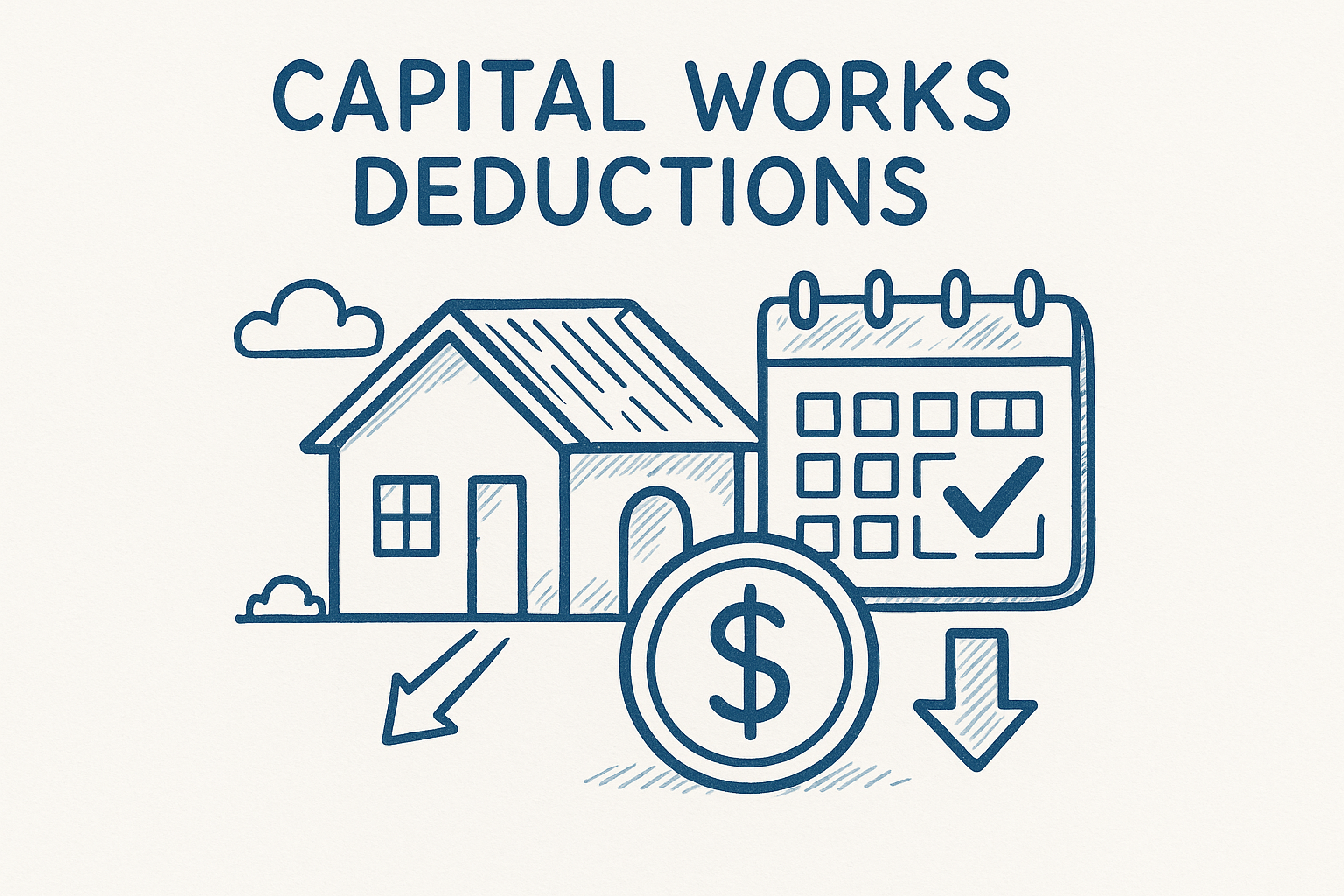
Buildings wear down over decades, not years, and the ATO recognises this through capital works deductions, sometimes called the building write-off. Rather than claiming the full construction cost upfront, you spread it over 40 years at 2.5% annually, and for most rental properties this quietly becomes one of the largest tax deductions for investment property owners never think to claim because it doesn’t show up on a bank statement.
What it covers
Structural elements qualify here: the original building construction, extensions, garages, carports, fences, and retaining walls. Capital works deductions also cover later structural renovations, like adding a second bathroom or replacing a roof entirely rather than patching it. This is the flip side of the repairs deduction covered above, where an improvement that adds value gets written off slowly instead of claimed immediately.
Structural improvements don’t disappear from your tax return, they just get spread over 40 years instead of one.
Eligibility criteria
Construction generally needs to have started after 15 September 1987 for residential properties to qualify for the full 2.5% rate. Older properties can still claim renovations completed after that date, even if the original structure predates it. You need to know the construction cost, not the purchase price, which is exactly where a quantity surveyor earns their fee.
How to claim it
Order a depreciation schedule from a qualified quantity surveyor before your first tax return on the property. That schedule becomes the backbone of your capital works claim for the full 40-year period, and your accountant applies it every year without needing to reassess construction costs from scratch.
8. Depreciation of plant and equipment
While capital works cover the building itself, plant and equipment depreciation deals with the removable, mechanical, and easily-worn items inside it. Think appliances, carpets, and blinds rather than bricks and mortar. This is a separate deduction category from the 40-year building write-off, and it works on much shorter timeframes because these items simply don’t last as long as the structure around them.
What it covers
Depreciable assets include hot water systems, air conditioning units, ovens, dishwashers, carpets, blinds, and even smoke alarms. Each item has an effective life set by the ATO, and you claim a portion of its value each year until it’s fully written off or you dispose of it. Some smaller items under $300 can be written off immediately rather than depreciated over years.
Carpets and appliances wear out fast, and your depreciation schedule should reflect that reality.
Eligibility criteria
Since 2017, second-hand plant and equipment in established residential properties generally can’t be claimed by investors who buy an already-tenanted home, unless the items are brand new when installed. This rule caught a lot of investors off guard, so check your settlement date and asset condition carefully with your accountant before assuming a deduction applies.
How to claim it
A quantity surveyor’s report lists every eligible asset alongside its written-down value and remaining effective life, updated automatically each year. Feed this schedule to your accountant annually rather than trying to estimate depreciation yourself, since incorrect claims here are one of the more common triggers for an ATO review.
9. Advertising for tenants
Finding a new tenant costs money, and every dollar spent chasing that outcome is deductible in full the year you pay it. Whether you’re between tenants for a week or a month, advertising costs for a rental property fall squarely within the list of tax deductions for investment property owners can claim without any apportionment headaches.

What it covers
Online listing fees on major rental platforms, professional photography for your listing, signage placed outside the property, and newspaper classifieds all qualify. Vacancy advertising also extends to the cost of preparing a listing description if you pay someone to write it, and any fees your property manager passes through for marketing the property to prospective renters.
Every cent spent finding your next tenant comes straight off your taxable rental income.
Eligibility criteria
The advertising has to relate to a genuine attempt to secure a tenant for the property while it’s held for income-producing purposes. Costs incurred advertising a property you’re simultaneously trying to sell get trickier, since the ATO expects you to separate rental advertising from sale advertising if both happen at once. Advertising during a period the property was used privately isn’t deductible, so the timing needs to line up with genuine availability for rent.
How to claim it
Keep the following on file for each advertising spend:
- Invoice or receipt from the listing platform or agency
- Screenshot of the published listing where possible
- Dates the advertisement ran
Most property managers itemise advertising fees on their annual statement, so cross-check that figure against your own records before handing everything to your accountant.
10. Cleaning, gardening and pest control
Keeping a rental presentable between tenancies and tidy while it’s occupied generates a steady stream of small, fully deductible expenses. On their own, a gutter clean or a lawn mow doesn’t look like much, but tallied over a year these routine costs are one of the more consistent tax deductions for investment property owners can bank without any capital works calculations getting in the way.
What it covers
Cleaning costs between tenancies, ongoing lawn mowing and garden maintenance, and regular or one-off pest control treatments all qualify here. This extends to carpet steam cleaning at the end of a lease, pressure washing driveways and paths, hedge trimming, and treating termites or other pests discovered during an inspection. If your property manager arranges any of this on your behalf, it usually appears as a pass-through charge on your annual statement.
Small recurring costs like mowing and pest treatments add up to a genuine deduction most landlords underclaim.
Eligibility criteria
The work needs to relate to the property while it’s tenanted or genuinely available for rent, not during a period you were living in it or using it privately. Where a tenant is contractually responsible for garden upkeep under the lease and you cover the cost anyway, keep a note explaining why, since the ATO may query costs that duplicate a tenant’s obligations.
How to claim it
Hold onto invoices from cleaners, gardeners, and pest technicians, along with your property manager’s statement showing any charges they’ve arranged. Match these against bank records each year and pass the full list to your accountant rather than estimating totals from memory.
11. Body corporate and strata fees
Owning a unit or townhouse inside a managed complex means you’re almost certainly paying body corporate fees, and the good news is these are deductible against your rental income. Strata levies fund everything from building insurance to common area upkeep, and since they’re a direct cost of holding an income-producing property, they sit comfortably among the standard tax deductions for investment property owners can claim each year.

What it covers
Admin and sinking fund levies both qualify, covering things like building insurance, common area cleaning, lift maintenance, and pool upkeep in larger complexes. Special levies raised for major works, like re-rendering the exterior or replacing shared plumbing, are usually deductible too, though very large capital works levies sometimes need to be treated as capital works deductions instead of an immediate expense.
Strata levies fund the building around your investment, and most of that cost comes straight off your taxable rental income.
Eligibility criteria
Regular levies are deductible in full provided the property is tenanted or genuinely available for rent. Special levies need closer attention, since the ATO looks at what the money was actually spent on rather than what the strata committee called it. If part of a levy funds a genuine capital improvement, your accountant may need to split that portion out.
How to claim it
Keep your strata statements or levy notices for the full financial year, noting any special levies separately from routine ones. Pass these straight to your accountant, flagging any large one-off charges so they can check whether the full amount is immediately deductible.
12. Utilities paid on behalf of tenants
Some landlords cover water, electricity, or gas as part of the rental arrangement, particularly with share houses or fully furnished properties, and these payments are fully deductible against your rental income. It’s a smaller item on most returns, but it’s still one of the tax deductions for investment property owners overlook simply because the bill arrives in their name rather than the tenant’s.
What it covers
Water usage charges, electricity, gas, and even internet or pay TV connections qualify if you, the owner, pay the account and the tenant doesn’t reimburse you. Shared utility arrangements in properties like boarding houses or student accommodation often see the landlord footing these costs as part of the weekly rent, which makes the whole amount deductible rather than just a portion.
If a bill lands in your name and the tenant never pays you back for it, it’s your deduction to claim.
Eligibility criteria
The key test is whether you actually paid the utility and weren’t reimbursed by the tenant through a separate arrangement. If your lease specifies that tenants pay their own electricity directly to the retailer, you can’t claim it just because your name is on the property title. Mixed arrangements, where tenants pay a fixed amount toward utilities and you cover the rest, need careful apportionment.
How to claim it
Keep every utility invoice and the matching payment record, and check your lease agreement to confirm who’s contractually responsible for each cost. Where a property manager collects and pays utilities on your behalf, their statement should already itemise these charges, making it easy to hand straight to your accountant.
13. Legal and professional fees
Owning a rental property occasionally means paying for advice beyond your accountant, and most of those costs count among the tax deductions for investment property owners can claim without much fuss. Legal fees tied to managing the property, rather than acquiring or selling it, are deductible in the year you pay them.
What it covers
This category includes legal costs for preparing or reviewing a lease agreement, pursuing a tenant for unpaid rent through a tribunal, and evicting a problem tenant. It also covers fees paid to a quantity surveyor for a depreciation schedule, and charges from a valuer if you need a valuation for loan or insurance purposes rather than for buying or selling the property.
Legal fees tied to running your rental are deductible, but fees tied to buying or selling it almost never are.
Eligibility criteria
The fee needs to relate to earning rental income, not to acquiring, disposing of, or improving the property’s ownership structure. Conveyancing costs when you purchased the property, and legal fees when you eventually sell, are capital in nature and get added to your cost base for capital gains purposes instead. Fees for drafting the original loan documents fall under borrowing expenses, covered earlier, rather than here.
How to claim it
Request an itemised invoice from any solicitor, valuer, or surveyor you engage, clearly describing the service provided. Keep these alongside proof of payment and hand the full list to your accountant, flagging anything connected to a purchase, sale, or dispute so it gets classified correctly rather than lumped in with routine expenses.
14. Travel and vehicle expenses
This is the one deduction most landlords assume still applies, and getting it wrong is an easy way to trigger an ATO review. Travel expenses to inspect, maintain, or collect rent from a residential rental property used to be a straightforward claim, but the rules changed dramatically from 1 July 2017, and plenty of investors haven’t caught up.
What it covers
For individual investors and most trusts, travel deductions for residential rental properties were removed entirely from the 2017-18 financial year onward. That means driving to inspect your property, collect rent in person, or meet a tradesperson on site is no longer claimable, regardless of how far you travelled or how genuine the purpose was. This change was specifically introduced to stop over-claiming on personal holidays disguised as property inspections.
If your rental is a standard residential property, travel to visit it almost certainly isn’t deductible anymore.
Eligibility criteria
The exception applies to entities carrying on a genuine property investment business, such as companies or complying superannuation funds running a large-scale operation, and to commercial property investors, since the ban only targets residential rentals held by individuals and most trusts. If you’re unsure whether your structure qualifies, this is worth confirming with your accountant before you claim anything travel-related.
How to claim it
Don’t assume the old rules still apply just because you remember claiming this before 2017. Check with your accountant whether your ownership structure falls into the narrow exception, and if it doesn’t, direct that travel time toward using a property manager instead, whose fees remain fully deductible.
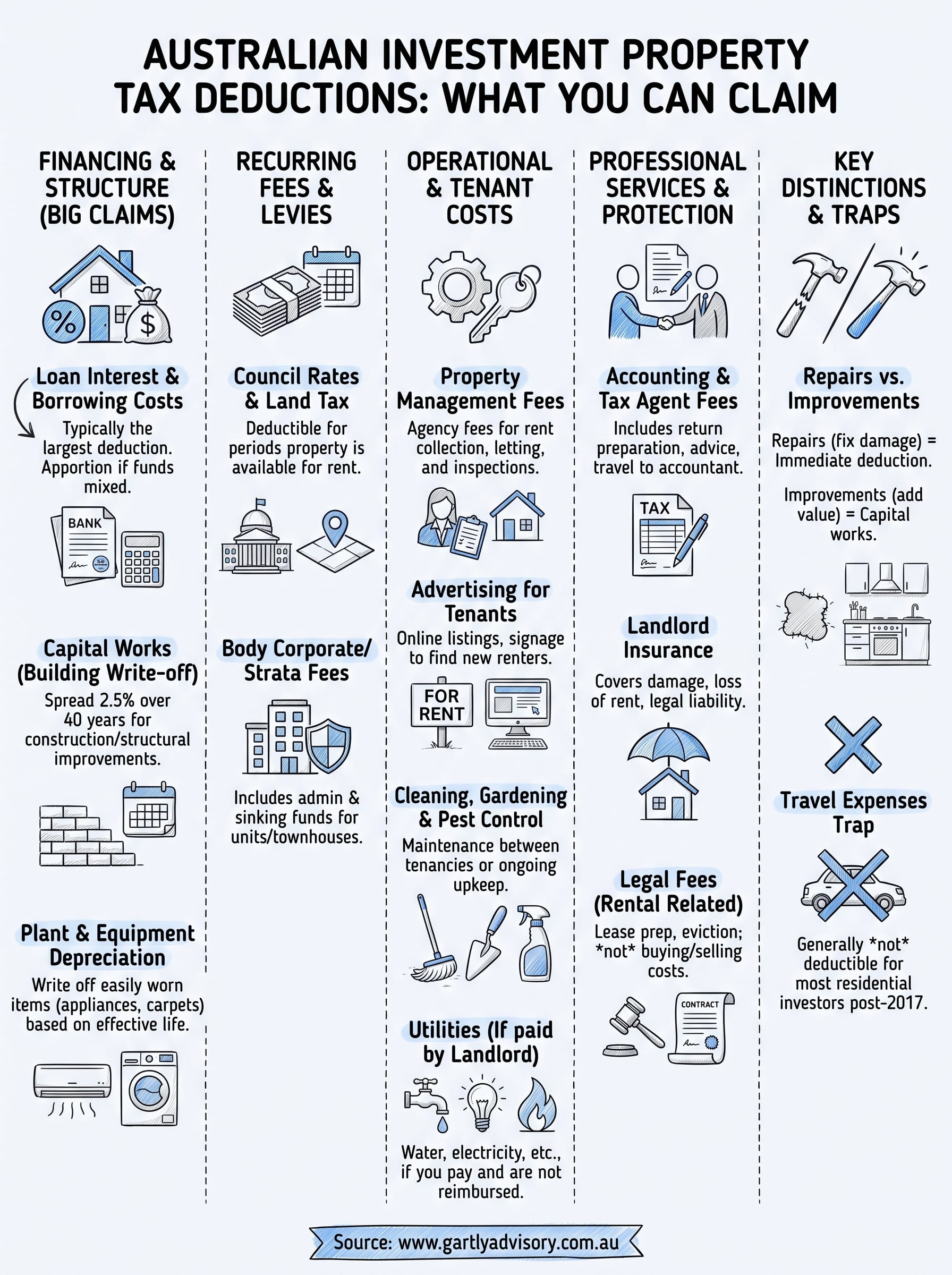
Making the most of your investment property at tax time
Fourteen categories, one clear message: rental property deductions add up fast when you claim everything you’re entitled to, not just the obvious few. Loan interest and depreciation will always carry the biggest numbers, but it’s the smaller items like pest control, strata levies, and utilities paid on a tenant’s behalf that separate a good return from a great one. Missing these isn’t dishonest, it’s just leaving your own money on the table year after year.
Getting this right consistently means treating tax time as a year-round habit rather than a scramble every June. Keep your invoices, statements, and depreciation schedule organised as expenses happen, and review this list before every lodgement. If you’d rather have someone who deals with investment property tax deductions every day check your return line by line, get in touch with Gartly Advisory and let’s make sure your next return reflects everything you’re actually owed.