
Understanding Common Business Tax Deductions in Australia
Is the thought of lodging your business tax return keeping you up at night? For many Australian business owners, navigating the world of tax deductions brings a familiar mix of stress and uncertainty. The fear of missing out on legitimate claims, coupled with the worry of making a mistake that could attract the attention of the ATO, can feel overwhelming and leave you paying more tax than necessary.
We understand these challenges, and we’re here to provide the clarity and support you need. This comprehensive guide is designed to be your trusted partner, offering straightforward advice on the common business tax deductions available in Australia. We will walk you through what you can claim, the essential records you must keep to remain compliant, and practical steps to legally minimise your tax bill. By the end, you’ll have the confidence to lodge your return with certainty, ensuring you improve your business’s cash flow and secure the maximum return you’re entitled to.
Key Takeaways
- Understand the ATO’s Three Golden Rules to ensure every business expense you claim is legitimate and compliant from the start.
- Identify a wide range of claimable day-to-day operating costs, from office rent and utilities to marketing and professional fees.
- Navigate the rules for more complex tax deductions, such as vehicle expenses and the correct way to claim large asset purchases over time.
- Discover commonly overlooked deductions that many business owners miss and learn how to avoid simple mistakes that could attract ATO attention.
The 3 Golden Rules for Claiming Any Business Tax Deduction
Navigating the world of business expenses can feel overwhelming, but the Australian Taxation Office (ATO) provides a clear framework to guide you. Before we explore specific categories, it’s essential to understand the foundational principles that govern all claims. The system of Taxation in Australia is built on a few core tests, and by mastering these, you can approach your tax obligations with confidence and clarity. Understanding these rules is the first step to ensuring you claim everything you are entitled to, without fear of making a mistake.
To provide further expert guidance on this topic, the video below offers valuable insights for business owners.
Think of these as your checklist for any expense. Every legitimate business tax deduction, from office supplies to vehicle costs, must satisfy these three golden rules.
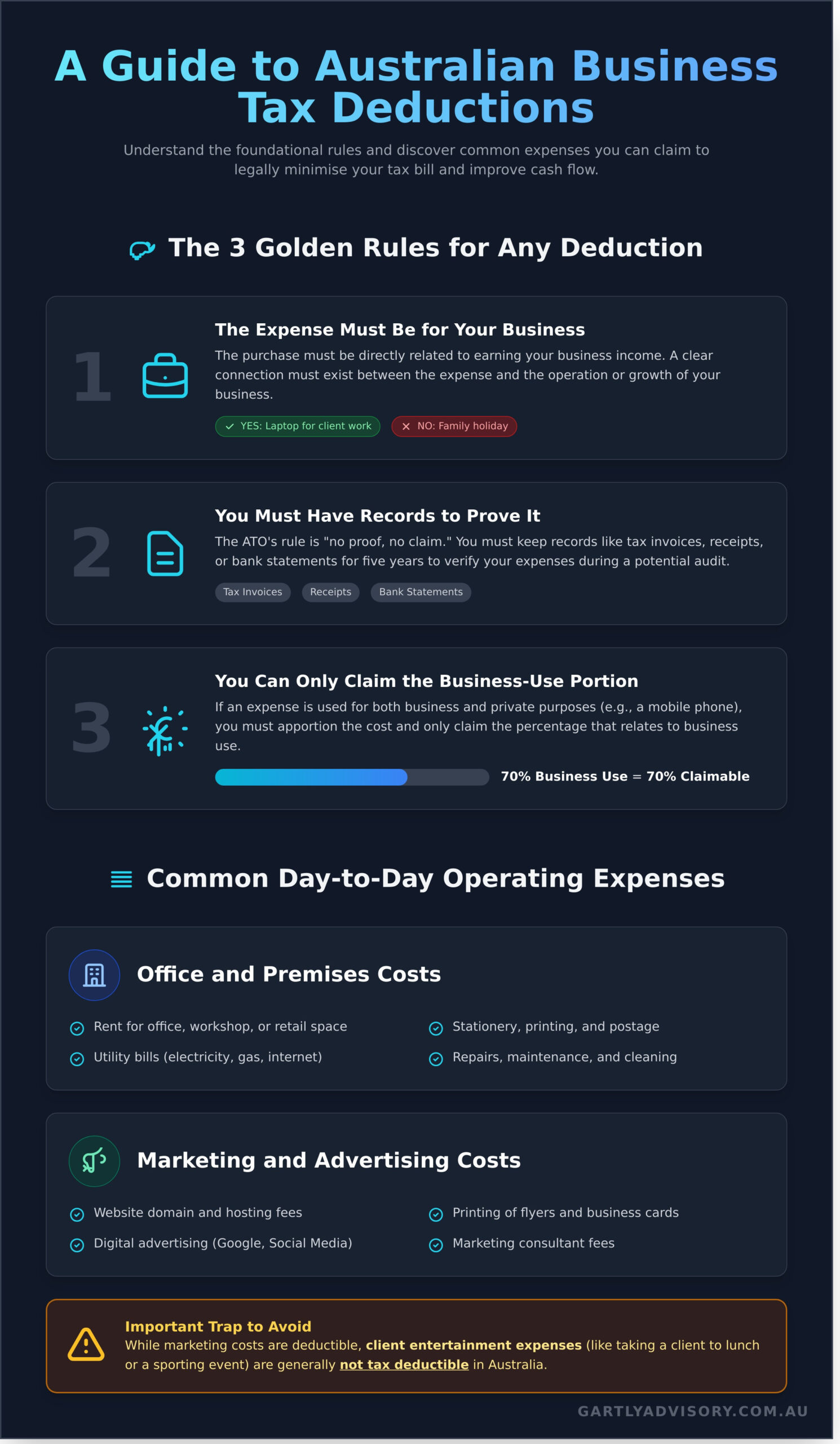
Rule 1: The Expense Must Be for Your Business
The first and most critical test is the connection between the expense and your business’s ability to earn income. You must be able to demonstrate that the purchase was made to help run or grow your business. For instance, buying a new laptop for drafting client reports is clearly a business expense. In contrast, the cost of a family holiday, even if you answer a few emails while away, is a private expense and cannot be claimed.
Rule 2: You Must Have Records to Prove It
The ATO operates on a straightforward principle: no proof, no claim. It is your responsibility to keep clear and accurate records for all your expenses. This includes tax invoices, receipts, and bank statements that show what you bought, when you bought it, who the supplier was, and how much it cost. Generally, you are required to keep these records for five years. Without proper documentation, a deduction can be denied during an audit.
Rule 3: You Can Only Claim the Business-Use Portion
Many assets are used for both business and private purposes. When this occurs, you can only claim a deduction for the portion related to your business. This is known as apportionment. A common example is a mobile phone plan. If you determine through a logbook or other records that you use your phone 70% of the time for business calls and data, you can only claim 70% of your monthly bill as a deduction.
Day-to-Day Operating Expenses: The Costs of Running Your Business
The most frequent and essential tax deductions for any Australian business are the day-to-day operating expenses. These are the direct costs you incur to earn your income, and keeping meticulous records of them is the foundation of a sound tax strategy. The Australian government provides guidance on many common business expenses, which form a reliable checklist for business owners. To provide clarity, we have grouped these core costs into logical categories.
Office and Premises Costs
If you operate from a commercial location, many of the associated costs are deductible. These are the expenses required to simply keep the doors open and the lights on. They typically include:
- Rent paid for your office, workshop, or retail shop.
- Utility bills such as electricity, gas, water, and business internet.
- Stationery, printing, postage, and general office supplies.
- Costs for repairs, maintenance, and cleaning services for your premises.
Marketing, Advertising, and Client Expenses
The costs of promoting your business and attracting customers are generally deductible. In today’s market, this covers both digital and traditional channels. Key examples include:
- Website expenses, including domain name registration and web hosting fees.
- Digital advertising spend on platforms like Google Ads and social media.
- Printing costs for flyers, brochures, and business cards.
Important Note: While the costs of marketing are deductible, client entertainment expenses, such as taking a client to lunch or a sporting event, are generally not tax deductible in Australia.
Professional Fees and Subscriptions
Running a business requires specialist support and tools. The fees you pay for professional advice and essential services are legitimate tax deductions that support your compliance and growth. Look for:
- Fees paid to your accountant, bookkeeper, or legal advisor.
- Annual ASIC company review fees or business name registration costs.
- Subscriptions to industry-specific software, trade journals, or publications.
- Bank fees and charges on your business bank accounts.
Vehicle and Travel Deductions: Claiming Costs on the Move
For many Australian businesses, vehicle and travel expenses represent a significant operational cost and, consequently, a crucial area for claiming tax deductions. Navigating the Australian Taxation Office (ATO) rules in this area can be complex, but with diligent record-keeping, you can ensure you are claiming everything you are entitled to. It is vital to understand the distinction between business and private use to substantiate your claims correctly.
Claiming Motor Vehicle Expenses
When claiming deductions for a car your business owns or leases, you generally have two methods to choose from:
- Cents per kilometre method: This is the simpler option, best suited for occasional business-related car trips. You can claim a set rate (e.g., 85 cents per km for the 2023-24 income year) for up to 5,000 business kilometres per car, per year. You need to be able to show how you calculated the business kilometres.
- Logbook method: For more extensive vehicle use, this method allows you to claim the business-use percentage of all your car expenses. You must keep a detailed logbook for 12 continuous weeks to determine this percentage. Once established, this logbook is valid for five years, provided your usage pattern remains consistent. Expenses you can claim include fuel, oil, insurance, registration, servicing, loan interest, and depreciation.
Business Travel Expenses
Legitimate business travel is deductible, but it’s important to know what qualifies. The cost of your daily travel between home and your regular place of work is typically considered a private expense and is not claimable. However, you can claim costs for travel directly related to earning your income.
This includes expenses for flights, public transport, taxis, or ride-sharing services when travelling to meet clients, visit suppliers, or attend conferences. If your business travel requires you to stay away from home overnight, you can also claim reasonable costs for accommodation and meals. For trips lasting six or more consecutive nights, the ATO requires you to keep a travel diary to record the specifics of your activities.
Accurate records are the foundation of all vehicle and travel tax deductions. Whether it’s a detailed logbook, a travel diary, or a folder of receipts for flights and accommodation, maintaining proof is non-negotiable. We can provide the guidance you need to set up a compliant record-keeping system, ensuring you are always prepared and can maximise your claims with confidence.
Assets and Capital Expenses: Deductions for Business Investments
Investing in significant assets-from a new vehicle to essential machinery-is a vital step towards growth. These are not just expenses; they are investments in your business’s future productivity and success. The Australian tax system recognises this and provides ways to claim the cost of these assets against your income. Understanding how to structure these claims is key to effectively managing your cash flow and tax obligations.
Essentially, there are two primary methods for claiming these large purchases: claiming the decline in value over time (depreciation) or claiming an immediate, upfront deduction.
Depreciating Assets
A depreciating asset is an item that has a limited effective life and can reasonably be expected to lose value over the time it is used. The Australian Taxation Office (ATO) allows you to claim a deduction for this loss in value (depreciation) over the asset’s lifespan. This spreads the tax benefit over several years.
Common examples of depreciating assets include:
- Computers and IT equipment
- Tools and machinery
- Motor vehicles used for business
- Office furniture and fit-outs
Instant Asset Write-Off and Temporary Full Expensing
To stimulate business investment, the government often introduces powerful incentives like the instant asset write-off or temporary full expensing. These schemes allow eligible businesses to claim an immediate, 100% deduction for the full cost of an asset in the year it is purchased and first used or installed, rather than depreciating it over several years. This provides a significant, immediate reduction in your taxable income and can be an invaluable tool for cash flow management.
It is crucial to remember that these government policies, including their eligibility thresholds and end dates, are subject to change. We always recommend checking the current rules on the ATO website or seeking professional guidance to ensure you are compliant and maximising your available tax deductions.
The rules can be complex, and navigating them correctly is vital for your financial strategy. Confused about asset write-offs? We can provide clarity. As your trusted partner, we can offer the support you need to make sound investment decisions for your business.
People and Professional Growth: Staff and Training Deductions
Your team and your own expertise are arguably your business’s most valuable assets. Investing in them is a direct investment in your future success. The Australian Taxation Office (ATO) recognises this, providing clear avenues to claim expenses related to your staff and professional development. These deductions directly support your business’s growth by helping you build a capable, motivated, and highly skilled team.
Employee-Related Expenses
For any business with a team, staff-related costs represent a significant and necessary operational expense. Ensuring you correctly claim these expenses is fundamental to managing your tax obligations. Key deductible costs include:
- Salaries and Wages: This includes all salaries, wages, bonuses, and allowances paid to your employees.
- Superannuation: Compulsory superannuation guarantee contributions made on behalf of your staff to their nominated funds are fully deductible.
- Workers’ Compensation: Premiums for your mandatory workers’ compensation insurance policies can be claimed.
- Fringe Benefits Tax (FBT): If you provide fringe benefits to your employees, the amount of FBT you pay is also a deductible expense.
Self-Education and Professional Development
Staying current in your industry is not just good practice-it’s essential for staying competitive. The costs associated with maintaining and upgrading your skills are generally deductible, provided they have a direct connection to your current business activities and income. This helps you and your business remain at the forefront of your field.
Common claims in this area include:
- Fees for courses, seminars, or training programs that enhance your professional expertise.
- The cost of professional memberships, accreditations, and annual subscriptions.
- Reference books, technical journals, and other publications relevant to your work.
Viewing these expenses as strategic investments rather than just costs is key to leveraging them for growth. Properly managing these employee and training-related tax deductions ensures you are not only compliant but also maximising your financial position. Navigating the specifics, particularly around FBT and self-education eligibility, can be complex. As your trusted partner, Gartly Advisory can provide the clear guidance needed to claim correctly and confidently.
Commonly Overlooked Deductions and Traps to Avoid
Navigating the world of business tax can be complex. While most business owners know the major deductions, true financial efficiency comes from understanding the nuances-the claims often missed and the errors that can attract unwanted attention from the ATO. As your trusted partner, we believe in proactive guidance that goes beyond a simple checklist.
Deductions You Might Be Forgetting
With decades of experience, we’ve seen many business owners leave money on the table. Before you finalise your next return, consider if you’ve claimed these commonly overlooked expenses:
- Home Office Expenses: Beyond simple running costs like power and internet, you may be able to claim occupancy expenses (e.g., a portion of rent or mortgage interest) if you have a clearly defined and dedicated business space.
- Cost of Managing Tax Affairs: The fees you pay your accountant or registered tax agent for preparing and lodging tax returns are generally deductible in the year they are paid.
- Software and Subscriptions: Your monthly fees for business-critical tools like Xero, Adobe Creative Cloud, or industry-specific software are all legitimate business expenses.
- Interest on Business Finance: Don’t forget to claim the interest paid on business loans, overdrafts, or asset finance agreements used to purchase equipment.
Common Mistakes to Avoid
Equally important is knowing what not to do. Simple errors can lead to complex problems, including audits and penalties. Here are some critical traps to steer clear of:
- Claiming 100% for Mixed-Use Assets: You must accurately apportion expenses for assets like vehicles or mobile phones between their business and private use. A logbook is often essential for this.
- Double-Dipping on GST: If you are registered for GST and claim a credit for a purchase, you can only claim a tax deduction for the GST-exclusive amount, not the full price.
- Poor Record-Keeping: Without receipts, logbooks, or invoices, you have no way to substantiate your claims if the ATO requests proof. Good records are your best defence.
- Assuming All Entertainment is Deductible: Client entertainment is a common area of confusion and is generally not deductible. There are very specific and limited exceptions.
Maximising your legitimate tax deductions while maintaining full compliance is a delicate balance. It requires careful planning and expert oversight. If you’re looking for guidance that goes beyond the numbers, our team at Gartly Advisory is here to provide the support you need. Talk to us and let us help you navigate your tax obligations with confidence.
Maximise Your Claims with Confidence and Clarity
Mastering your business expenses comes down to a few core principles. By adhering to the three golden rules of claiming, keeping meticulous records, and understanding the broad categories of legitimate costs-from daily operations to significant asset investments-you build a strong foundation for financial health. This proactive approach ensures you are well-prepared to manage your business tax deductions and retain more of your hard-earned revenue.
However, the complexities of Australian tax law mean that opportunities can be missed and costly mistakes can be made. As Chartered Accountants specialising in small business, we provide strategic guidance built on over 25 years of trusted advice. Our proactive support, which has earned us over 70 5-Star Google Reviews, is designed to help you not just comply, but thrive.
Frequently Asked Questions About Business Tax Deductions
What is the difference between a tax deduction and a tax offset?
Understanding this distinction is key to managing your tax obligations. A tax deduction reduces your taxable income, which in turn lowers the amount of tax you pay. For example, a A$100 deduction might save you A$30 in tax if your tax rate is 30%. In contrast, a tax offset (or tax credit) directly reduces the final tax payable, dollar for dollar. A A$100 offset will reduce your tax bill by the full A$100, making it more valuable.
How long do I need to keep my receipts and business records for tax purposes?
In Australia, the general rule is that you must keep business records, including receipts and invoices, for five years. This five-year period begins from the date you lodge your tax return. It is crucial to maintain well-organised records, whether physical or digital, as the Australian Taxation Office (ATO) can request them at any time during this period to substantiate the claims you have made. Proper record-keeping is the foundation of sound financial management and tax compliance.
Can my business still claim deductions if it made a loss for the year?
Yes, you can and should still claim all eligible deductions even if your business operates at a loss. These deductions will increase the size of your business’s tax loss for the financial year. This loss can then typically be carried forward to offset against profits in future years, reducing your tax liability when the business becomes profitable. There are specific rules around carrying forward losses, so seeking professional guidance is always a sensible step.
Can I claim the cost of starting my business, like legal fees and advice?
Certain costs incurred when starting your business are immediately deductible, while others are treated as capital expenses. Major start-up costs, such as professional advice on your business structure or legal fees for establishing your company, can often be claimed over a five-year period. This is known as a ‘blackhole expenditure’ deduction. It ensures you receive a tax benefit for these essential initial investments, even though they aren’t standard day-to-day running costs.
What are the specific rules for claiming home office expenses as a sole trader?
As a sole trader, you have two main options for claiming home office expenses. The ‘fixed rate’ method (currently 67 cents per hour worked from home) is a simpler way to claim running costs like internet, phone, and electricity. Alternatively, the ‘actual cost’ method allows you to claim the business-use percentage of all your actual running costs. This requires more detailed records but may result in larger tax deductions if you have significant expenses.
Is it better to use the cents per kilometre or logbook method for car expenses?
The best method depends on your circumstances. The cents per kilometre method is simpler, allowing you to claim a set rate for up to 5,000 business kilometres without extensive records. However, the logbook method often yields a larger deduction if your business use is high. It requires a 12-week logbook to establish a business-use percentage, which you can then apply to all your actual car running costs, including depreciation, for up to five years.
Related Posts