
Your Complete Small Business CGT Concessions Guide for 2026
Selling your business is a monumental achievement, a moment that should be celebrated. Yet, the prospect of navigating the Australian Taxation Office’s (ATO) rules on Capital Gains Tax can quickly turn excitement into anxiety. The fear of a significant and unnecessary tax bill, or of missing a concession you’re entitled to, is a heavy weight for any business owner to carry. This is precisely why we have prepared this comprehensive small business cgt concessions guide 2026.
Think of us as your trusted partner on this journey. In the sections below, we will demystify the four complex CGT concessions, translating them into clear, actionable advice. Our goal is to provide you with the support and guidance needed to understand your eligibility, confidently minimise your tax obligations, and know exactly what to discuss with your accountant. Let’s ensure the rewards of your hard work are properly protected.
Key Takeaways
- Before accessing any tax savings, you must first pass the strict basic eligibility conditions-a crucial first step that many business owners overlook.
- This small business cgt concessions guide 2026 breaks down how the four concessions work, including how to strategically combine them to significantly reduce your tax.
- Discover the ‘gold standard’ 15-year exemption that can potentially eliminate 100% of your capital gain if you meet specific long-term ownership and retirement rules.
- These valuable concessions are not automatic; learn how to correctly apply for them to avoid common mistakes that could result in a large, unexpected tax bill.
First, Do You Qualify? The Basic Eligibility Conditions for 2026
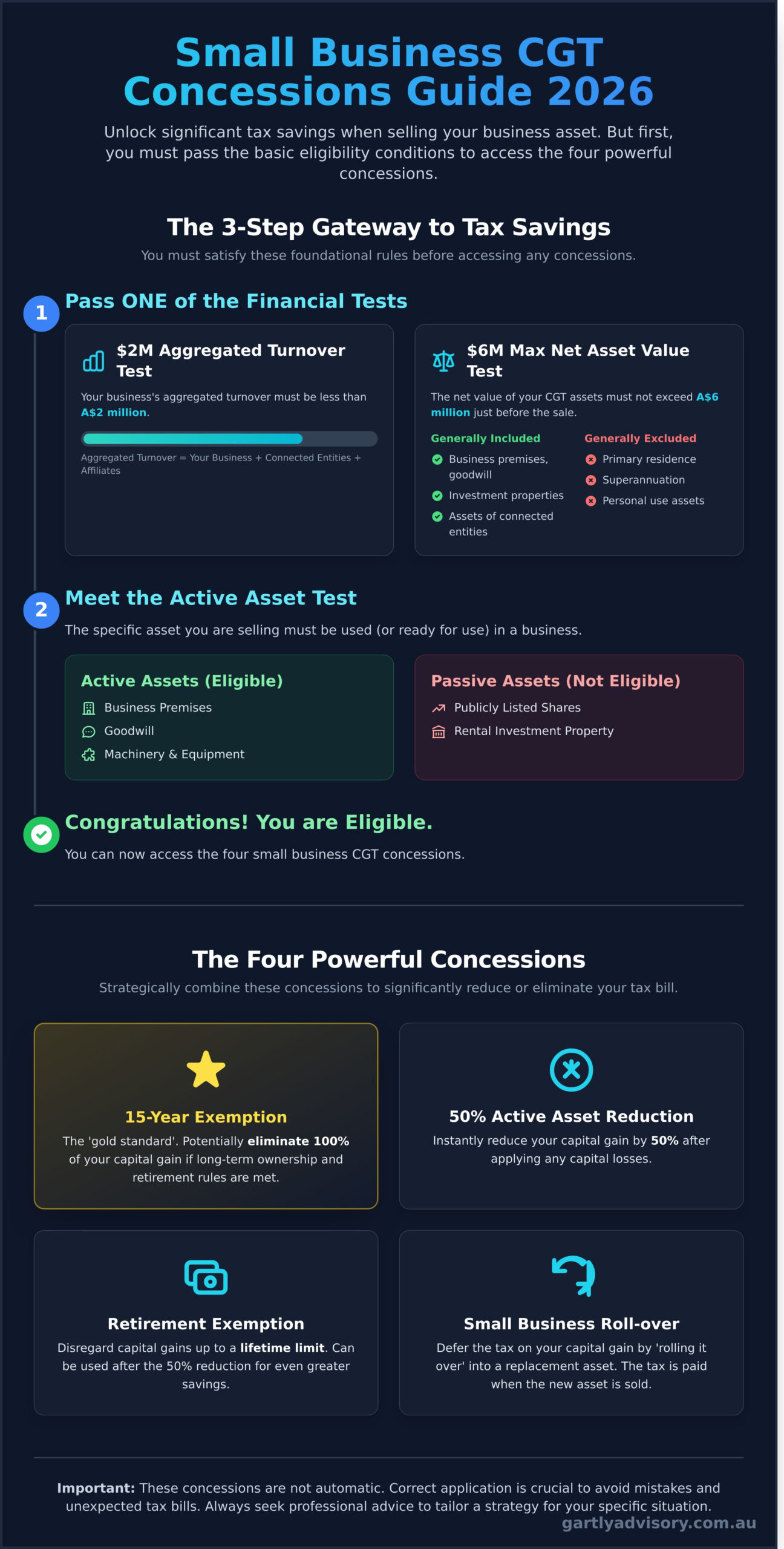
The Small Business Capital Gains Tax (CGT) concessions offer a significant opportunity to reduce or even eliminate the tax you pay when selling a business asset. However, before you can access any of the four powerful concessions, your business must first pass a set of strict basic eligibility conditions set by the Australian Taxation Office (ATO). Getting this step right is non-negotiable and requires careful calculation and honest assessment.
Understanding these foundational rules is the most important part of this small business cgt concessions guide 2026. Broadly, you must satisfy one of two major financial tests, and the asset itself must meet a specific condition. The complexities of Capital Gains Tax in Australia mean that seeking professional guidance is always a prudent step to ensure you are on solid ground.
To help you visualise these concepts, this video provides a helpful overview of how the concessions work in practice:
The $2 Million Aggregated Turnover Test
This is often the most straightforward path to eligibility. To pass, your business must have an ‘aggregated turnover’ of less than A$2 million for the income year. Aggregated turnover isn’t just your business’s annual turnover; it also includes the annual turnover of any entities that are ‘connected’ with you or are your ‘affiliates’. This could include another business you control or a business controlled by your spouse. For example, if your plumbing business turns over A$1.6 million and your spouse’s separate consulting entity turns over A$300,000, your aggregated turnover is A$1.9 million, and you would satisfy this condition.
The $6 Million Maximum Net Asset Value Test
If your business turnover exceeds A$2 million, you have another opportunity to qualify through the Maximum Net Asset Value (MNAV) test. To pass, the total net value of all CGT assets owned by you and certain related entities must not exceed A$6 million just before the CGT event (the sale). Critically, some significant assets are excluded from this calculation, which can make a crucial difference. Calculating this value is complex, but understanding what’s included is the first step.
| Assets Generally Included | Assets Generally Excluded |
|---|---|
| Business premises, goodwill, machinery | Your personal-use primary residence |
| Investment properties and shares | Superannuation and life insurance policies |
| Assets of connected entities | Personal-use assets (e.g., private car) |
The Active Asset Test
Finally, the specific asset you are selling must be an ‘active asset’. An active asset is one that is used, or held ready for use, in the course of carrying on a business. This test ensures the concessions are targeted at genuine business assets, not passive investments.
- Examples of active assets: Goodwill, business premises, machinery, and equipment.
- Examples of passive (non-active) assets: Shares in a publicly listed company or a rental investment property.
Passing these three basic conditions is your entry ticket to the concessions. If you meet them, you can then explore which of the four specific concessions best suits your situation.
The Four Small Business CGT Concessions Explained in Plain English
When selling a business asset, Capital Gains Tax (CGT) can significantly impact your final proceeds. Fortunately, the Australian Taxation Office (ATO) provides four powerful concessions designed to help small business owners reduce, defer, or even completely eliminate this tax liability. Understanding how these work is a critical part of any effective business exit strategy.
It’s often possible to apply multiple concessions to the same capital gain, but they must be considered in a specific legal order to maximise your benefit. This small business cgt concessions guide 2026 will walk you through each option, providing the clarity you need to partner with your advisor and make informed decisions.
Here is a high-level summary of the four concessions:
1. The 15-Year Exemption
This is the most valuable concession available, allowing you to disregard the entire capital gain on the sale of an asset. To be eligible, you must have owned the asset continuously for at least 15 years and the CGT event must happen in relation to your retirement (if you are 55 or over) or permanent incapacitation. It provides a complete tax exemption, making it the ultimate goal for long-serving business owners.
2. The 50% Active Asset Reduction
If you don’t qualify for the 15-year exemption, you can reduce your capital gain by 50% with this concession. A key benefit is that this reduction is applied in addition to the general 50% CGT discount available to individuals and trusts who have held an asset for more than 12 months. This compounding effect can lead to a substantial tax saving for any eligible business owner selling an active asset.
3. The Retirement Exemption
This powerful concession allows you to exempt capital gains up to a lifetime limit of A$500,000. Despite its name, you don’t actually have to be retiring. However, if you are under 55 years old when you make the choice, you must contribute the exempt amount directly into a complying superannuation fund. This makes it an excellent tool for using business sale proceeds to significantly boost your retirement savings.
4. The Small Business Roll-over
The roll-over concession doesn’t eliminate the tax but allows you to defer paying it. If you sell a business asset and use the proceeds to acquire a replacement active asset (or improve an existing one), you can ‘roll over’ the capital gain. This means the tax liability is deferred until you eventually sell the replacement asset, providing valuable cash flow to reinvest and grow your business.
Deep Dive: The 15-Year Exemption for Long-Term Owners
For many long-serving small business owners, the 15-year exemption is the gold standard of capital gains tax relief. It represents the ultimate reward for decades of hard work and dedication. If you meet the specific conditions, you can disregard the entire capital gain from the sale of your business asset, meaning you pay no tax on it. This is the most powerful concession available and a critical component of any effective retirement strategy, making it a key focus in our small business cgt concessions guide 2026.
Meeting the 15-Year Ownership Condition
To qualify for this complete tax exemption, you must satisfy the basic eligibility conditions for CGT concessions and meet two main requirements for the asset itself:
- Continuous Ownership: You must have owned the active asset continuously for at least 15 years.
- Retirement or Incapacity: The individual selling the asset must be either 55 years or older and selling in connection with their retirement, or they must be permanently incapacitated at the time of the sale.
Meeting these criteria allows you to secure your financial future without a significant tax burden diminishing your life’s work.
Practical Example: John the Baker Sells His Shop
Let’s consider John, a 60-year-old baker who has decided to retire. He has owned and operated his beloved bakery for 22 years. He sells the business premises for A$1.5 million, realising a capital gain of A$950,000.
Without any concessions, John would face a substantial tax bill on that A$950,000 gain, significantly impacting his retirement funds. However, because John is over 55, is retiring, and has owned the active asset for more than 15 years, he is eligible for the 15-year exemption.
By applying this concession, the entire A$950,000 capital gain is disregarded. The taxable amount becomes A$0. This powerful outcome allows John to move into his retirement with the full value of his hard-earned asset. John’s story is a perfect illustration of how proactive tax planning can lead to the best possible financial result.
Planning your exit? Let’s ensure you get the tax outcome you deserve.
Combining Concessions: The 50% Reduction and Retirement Exemption
One of the most powerful aspects of the Small Business CGT Concessions is the ability to apply them sequentially to significantly reduce or even eliminate a capital gain. Understanding the correct order of application is not just beneficial-it’s a requirement for compliance. By strategically layering the concessions, you can maximise your financial outcome when selling a business asset.
Let’s walk through a practical example to see how this works. Imagine you are a small business owner who has just sold an active asset and realised a capital gain of A$800,000.
Step 1: Apply the 50% Active Asset Reduction
The first step is always to apply any general CGT discounts (like the 50% discount for assets held over 12 months) and then the 50% active asset reduction. In our scenario, after applying the general discount, we apply the active asset reduction to the A$800,000 gain. This immediately reduces your assessable capital gain by A$400,000, leaving a new, more manageable figure of A$400,000 to address with the remaining concessions.
Step 2: Apply the Retirement Exemption
With the remaining A$400,000 capital gain, you can now elect to use the retirement exemption. This concession allows you to disregard capital gains up to a lifetime limit of A$500,000. Since the A$400,000 gain is within this cap, you can apply the exemption to the entire amount. The result is powerful: the remaining A$400,000 is also made tax-free. By combining these two concessions, the original A$800,000 capital gain has been entirely eliminated.
Important Rules for the Retirement Exemption
Applying the retirement exemption comes with specific conditions that depend on your age. Navigating these rules correctly is a critical part of any effective small business cgt concessions guide 2026. Key conditions include:
- If you are under 55: The exempt amount (A$400,000 in our example) must be paid into a complying superannuation fund or a retirement savings account.
- If you are 55 or over: You can choose to contribute the amount to super or receive it as a direct payment with no tax implications.
This is a complex area of tax law where professional guidance is essential to ensure you meet all obligations and secure the best possible outcome. As your trusted partner, we can provide the support you need to navigate these decisions with confidence.
Deferring Your Tax: How the Small Business Roll-Over Works
The small business roll-over concession provides a powerful strategic advantage: it allows you to defer a capital gain from the sale of a business asset. Its primary purpose is not to eliminate the tax, but to postpone it, freeing up capital to continue investing and growing your operations. This makes it ideal for business owners who are selling one asset with the clear intention of acquiring another to improve or expand their business.
However, this concession comes with a critical timeline. You must acquire a replacement asset within a two-year period, which begins one year before and ends two years after the CGT event happens. If a suitable replacement asset is not acquired within this window, the original capital gain becomes taxable. Understanding these deadlines is a crucial part of this small business cgt concessions guide 2026.
What Qualifies as a Replacement Asset?
The Australian Taxation Office (ATO) is specific about what constitutes a valid replacement asset. It cannot simply be a passive investment; the asset must be an ‘active asset’ used in a business. Simply putting the sale proceeds into a bank account or an investment property will not qualify. Examples of qualifying replacement assets include:
- New business premises, such as a factory or office.
- Essential plant and equipment for your operations.
- Goodwill or other intangible assets of another business you acquire.
How the ‘Roll-Over’ Defers the Gain
The term ‘roll-over’ describes exactly how the concession works. The capital gain you defer is ‘rolled over’ and applied to the new replacement asset by reducing its cost base. This means you will eventually pay CGT when the new asset is sold. The deferred gain effectively increases the future taxable gain on the replacement asset.
For example: You sell a business asset and make a capital gain of A$200,000, which you choose to defer. You then purchase a new qualifying asset for A$500,000. The cost base of your new asset is reduced by the deferred gain: A$500,000 – A$200,000 = A$300,000. When you eventually sell this new asset, your capital gain will be calculated from this lower A$300,000 cost base.
Navigating the roll-over rules requires careful planning to ensure compliance and maximise your benefit. To get expert advice tailored to your business journey, contact us at Gartly Advisory. We are here to provide the support and guidance you need.
How to Apply and Common Mistakes to Avoid
Understanding the theory behind the Small Business CGT Concessions is the first step. The next, more critical step is applying them correctly. These concessions are not automatic; you must actively elect to use them and be able to prove your eligibility to the ATO. This requires meticulous preparation and a deep understanding of the rules.
Success hinges on diligent record-keeping. You must maintain clear documentation that substantiates your eligibility for the basic conditions and any specific concessions you choose to apply. Without this proof, you risk having your claim denied during an ATO review, which could lead to a significant and unexpected tax liability.
The Application Process
Your choice to use one or more of the concessions is formally made when you lodge your income tax return for the year the capital gain occurs. You must keep detailed records of how you calculated your net asset value and met the active asset test. It is crucial to get this right from the start, as these decisions are binding and can be very difficult to amend later on.
Common Pitfalls to Watch For
Navigating the concessions is complex, and several common errors can disqualify an otherwise eligible business. Being aware of these potential traps is essential for anyone relying on this small business cgt concessions guide 2026 for their planning.
- Miscalculating Net Asset Value: A frequent mistake is incorrectly including exempt assets (like your family home or superannuation) when calculating the A$6 million maximum net asset value, or forgetting to include liabilities related to those assets.
- Forgetting Connected Entities: When assessing the A$2 million aggregated turnover test, you must include the turnover of any entities connected with you or your affiliates. Overlooking this can lead to an incorrect assessment of your eligibility.
- Failing the Active Asset Test: An asset must be actively used in your business operations. A common failure occurs when an asset, such as a commercial property, is primarily used to earn passive rental income rather than being used in the business itself.
- Missing the Roll-Over Deadline: If you use the small business roll-over concession, you have a strict two-year window to acquire a replacement asset or make a capital improvement. Missing this deadline will void the concession.
Why Expert Guidance is Crucial
The complexity of these rules and the high financial stakes involved make professional advice not just a benefit, but a necessity. An error in calculation or a missed deadline can negate the significant tax savings you were counting on. At Gartly Advisory, we provide the expert guidance needed to navigate this intricate process with confidence.
We act as your trusted partner, ensuring every condition is met and every opportunity is maximised. Let us help you secure your financial future by ensuring you apply the concessions correctly and remain fully compliant. To discuss your specific situation, contact us for a consultation today.
Secure Your Financial Future with Expert CGT Guidance
Understanding and applying the Capital Gains Tax concessions is one of the most significant financial opportunities for a small business owner. As we’ve explored, success hinges on meeting the basic eligibility conditions and strategically choosing from the four available concessions-from the complete 15-year exemption to the flexible small business roll-over. Navigating the rules outlined in this small business cgt concessions guide 2026 requires careful planning to ensure you don’t miss out on maximising your returns.
Applying these complex rules to your unique circumstances is where true value is unlocked. As Chartered Accountants with over 35 years of experience, we specialise in tax strategy for small to medium businesses. We go beyond the numbers to become your strategic advisors, a commitment reflected in over 70 5-Star Google Reviews from Melbourne business owners who trust our guidance.
Navigating CGT concessions is complex. Let our experienced team be your trusted partner. Take the next step towards securing the rewards of your hard work and ensure your financial future is in safe hands.
Frequently Asked Questions
Can I use the small business CGT concessions for an investment property?
Generally, an investment property will not qualify for these concessions. The asset must be an ‘active asset’, which means it is actively used in carrying on your business. A residential rental property, for example, is typically considered a passive investment and would not be eligible. However, a commercial property from which you operate your business could qualify. Understanding this distinction is a critical first step in determining your eligibility for these valuable concessions.
What happens if my business is run through a company or a trust?
The concessions are available for businesses structured as companies or trusts, but additional conditions must be met. The capital gain must flow to a ‘CGT concession stakeholder’, who is typically an individual with at least a 20% ownership interest in the entity. These rules ensure the tax benefit reaches the individuals behind the business. Navigating this requires careful planning, and we can provide the expert guidance needed to ensure full compliance.
Do I actually have to be ‘retiring’ to use the retirement exemption?
Despite its name, you do not need to be retiring. If you are under 55 years of age, the exempt capital gain must be contributed to a complying superannuation fund. If you are 55 or over, you can receive the funds directly, tax-free, with no obligation to stop working. This flexibility makes it a powerful planning tool for business owners at different stages of their journey, not just those ceasing work permanently.
What is the lifetime limit for the CGT retirement exemption in 2026?
As of 2026, the lifetime limit for the CGT retirement exemption is A$500,000 per individual. This is a cumulative cap, meaning all amounts you have claimed under this specific exemption throughout your life are tallied against this limit. It is essential to maintain accurate records of any previously claimed amounts when planning for future business sales to ensure you do not exceed this important threshold.
How do these concessions interact with the general 50% CGT discount?
The small business concessions are applied after the general 50% CGT discount. The correct order is to first reduce the capital gain by any capital losses, then apply the 50% general discount (for assets held over 12 months). The small business concessions are then applied to the remaining capital gain. This specific sequence of application provides a significant advantage and can substantially reduce your final tax liability, so getting the order right is crucial.
What if I sell my business to a family member?
Selling your business to a family member does not disqualify you from accessing the concessions. However, the transaction must be conducted at market value, just as it would be with an unrelated party. The ATO requires this to ensure the sale is a genuine commercial dealing. We strongly advise obtaining a formal business valuation to substantiate the sale price and provide the necessary evidence to support your claim for the concessions.
Are the rules for the CGT concessions likely to change in the future?
Tax legislation in Australia is always subject to change. While the core principles of these concessions have been stable for many years, government budgets or policy reviews can lead to amendments. Using a small business cgt concessions guide 2026 is an excellent starting point, but seeking up-to-date professional advice is essential for navigating the latest rules. This proactive approach protects your financial position and ensures you remain compliant with current law.