15 Tax Deductions for Small Business Owners in Australia
Every financial year, we watch business owners hand over more tax than they should, simply because nobody told them what they could claim. Understanding small business and tax deductions is not about clever loopholes. It is about knowing which everyday costs of running your business are legitimately deductible under Australian tax law, and keeping the records to prove it.
This article gives you a straight answer to that question. We have pulled together the fifteen most relevant tax deductions for small business owners across Australia, from vehicle and home office costs to super contributions and professional fees, so you can see exactly what reduces your taxable income and what the ATO expects in return.
We have worked with hundreds of Melbourne business owners over 25-plus years, and the pattern is always the same: those who understand their small business tax deductible expenses pay less tax and stress less at lodgement time. Read on for a practical, no-nonsense rundown of the deductions worth claiming this year.
1. Accounting, bookkeeping and professional advisory fees
Fees you pay for accounting, bookkeeping, and business advisory services are fully tax deductible expenses for small business owners, and they are often the most overlooked. Whether you pay for tax return preparation, BAS lodgement, payroll processing, or ongoing advisory support, the ATO treats these as a legitimate cost of running your business, not a luxury. Many owners we speak with assume advisory fees only count if they relate directly to tax, but that is not the case.
What it covers
This deduction covers a wide range of professional services: annual tax return preparation, monthly or quarterly bookkeeping, payroll and superannuation processing, business structuring advice, and strategic business advisory services such as cash flow forecasting or exit planning. It also extends to software subscriptions your accountant recommends, like Xero or MYOB, when they are used to manage your business finances.
If it costs you money to keep your books straight or get sound business advice, it almost certainly reduces your taxable income too.
Eligibility rules
The expense must relate to managing your business tax affairs or improving your commercial position, not personal financial planning unrelated to the business. Fees tied to setting up a new business structure before you start trading are generally not deductible in the same way as ongoing compliance costs, so timing matters. The Australian Taxation Office sets out specific rules around what counts as a deductible business cost versus a capital expense, and getting that distinction wrong is a common mistake.
How to claim it
Keep every invoice from your accountant or bookkeeper, and make sure the description clearly states the service provided. At tax time, these fees are simply included as a business expense in your return, reducing your assessable income dollar for dollar. If you are unsure whether a particular advisory fee qualifies, our tax planning and advisory services team can walk through your invoices and confirm what is claimable before you lodge.
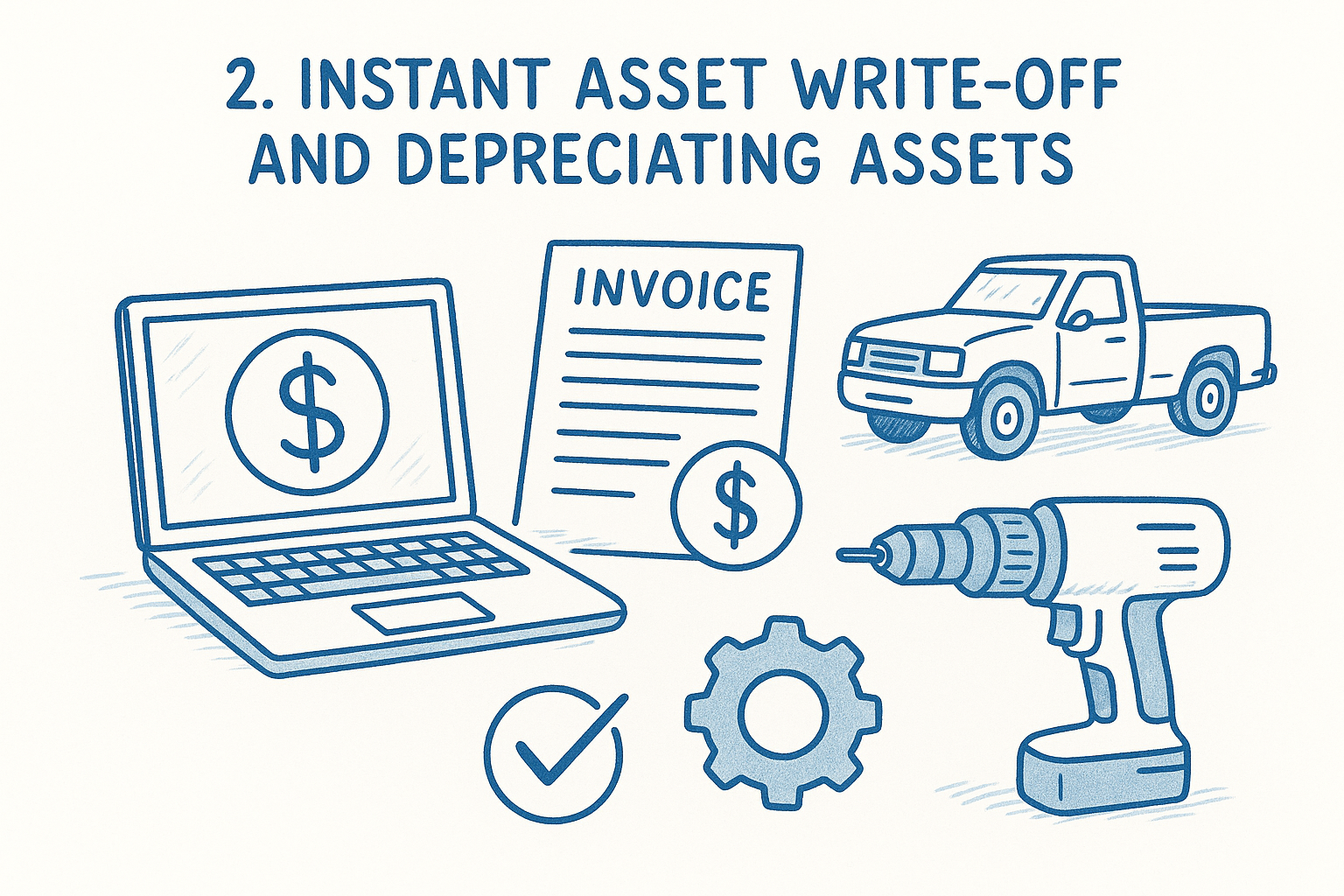
2. Instant asset write-off and depreciating assets
Buying equipment, tools, or machinery for your business often qualifies for an immediate deduction rather than years of slow depreciation. The instant asset write-off lets eligible small businesses claim the full cost of an asset in the year it is first used or installed, instead of spreading it out. This is one of the most valuable tax deductions for small business operators because it delivers an upfront cash flow benefit rather than a drawn-out tax break.
What it covers
Assets covered include laptops, work vehicles, tools, office furniture, and machinery used in the business. Anything above the threshold gets depreciated over its effective life instead.
A tool you buy today can cut your tax bill this year, not in five years’ time.
Eligibility rules
Thresholds change regularly, so check the current figure before you buy.
| Financial year | Turnover threshold | Asset cost limit |
|---|---|---|
| 2023-24 | Under $10m | $20,000 |
| 2024-25 | Under $10m | $20,000 |
Confirm the latest limit on the ATO’s depreciating assets page before purchasing, since government budgets frequently adjust it.
How to claim it
Keep the purchase invoice, note the date the asset was installed ready for use, and record it in your depreciation schedule at tax time. Gartly Advisory can help you time purchases to maximise this deduction each financial year.
3. Everyday operating and running expenses
Running a business racks up dozens of small costs that add up fast, and most of them are deductible. Rent, electricity, phone and internet bills, stationery, insurance premiums and bank fees all count as business expenses tax deductible against your income, provided they relate directly to earning that income. These aren’t glamorous claims, but they’re the bread and butter of reducing your tax bill each year.
What it covers
Think about what keeps your doors open day to day: rent or lease payments, utilities, insurance, marketing and advertising spend, subscriptions to industry software, and even the coffee you supply in the staff kitchen. Interest on business loans and bank fees on your business account also fall into this category.
Every dollar spent keeping the lights on is a dollar the ATO lets you claim back against.
Eligibility rules
The expense needs a genuine business purpose, and mixed-use costs must be apportioned between business and private use. Claiming 100% of your internet bill when you only use it for work half the time won’t survive an audit, so be honest about the split.
How to claim it
Set up a dedicated business account and run every operating cost through it, then reconcile monthly using accounting software. Gartly Advisory’s small business accounting and bookkeeping service keeps this reconciliation tight, so nothing slips through at tax time.
4. Employee wages, superannuation and contractor costs
Staffing costs sit among the biggest tax deductions for small business owners with employees, and getting them right matters more than most other claims because the ATO cross-checks your payroll tax obligations against your super and PAYG lodgements. Wages, salaries, bonuses and the superannuation guarantee contributions you make on top of them are all deductible, as are payments to contractors and freelancers you bring in for specific jobs.
What it covers
This deduction spans gross wages, overtime, allowances, superannuation guarantee payments, workers’ compensation premiums, and fees paid to contractors or subcontractors engaged through invoices rather than payroll.
Pay your team properly and on time, and the deduction takes care of itself.
Eligibility rules
Super contributions only count in the year you actually pay them, not the year they accrue, so a late June payment that lands in July gets claimed the following financial year. Contractor payments need a genuine independent contracting arrangement, not a disguised employment relationship, or the ATO may reclassify the cost and apply penalties. Check your obligations against the ATO’s guidance on employer super obligations before assuming a payment qualifies.
How to claim it
Run payroll through compliant software, lodge super via a clearing house, and keep contractor invoices with ABNs listed. Gartly Advisory’s payroll and advisory support keeps these payments compliant and fully deductible each quarter.
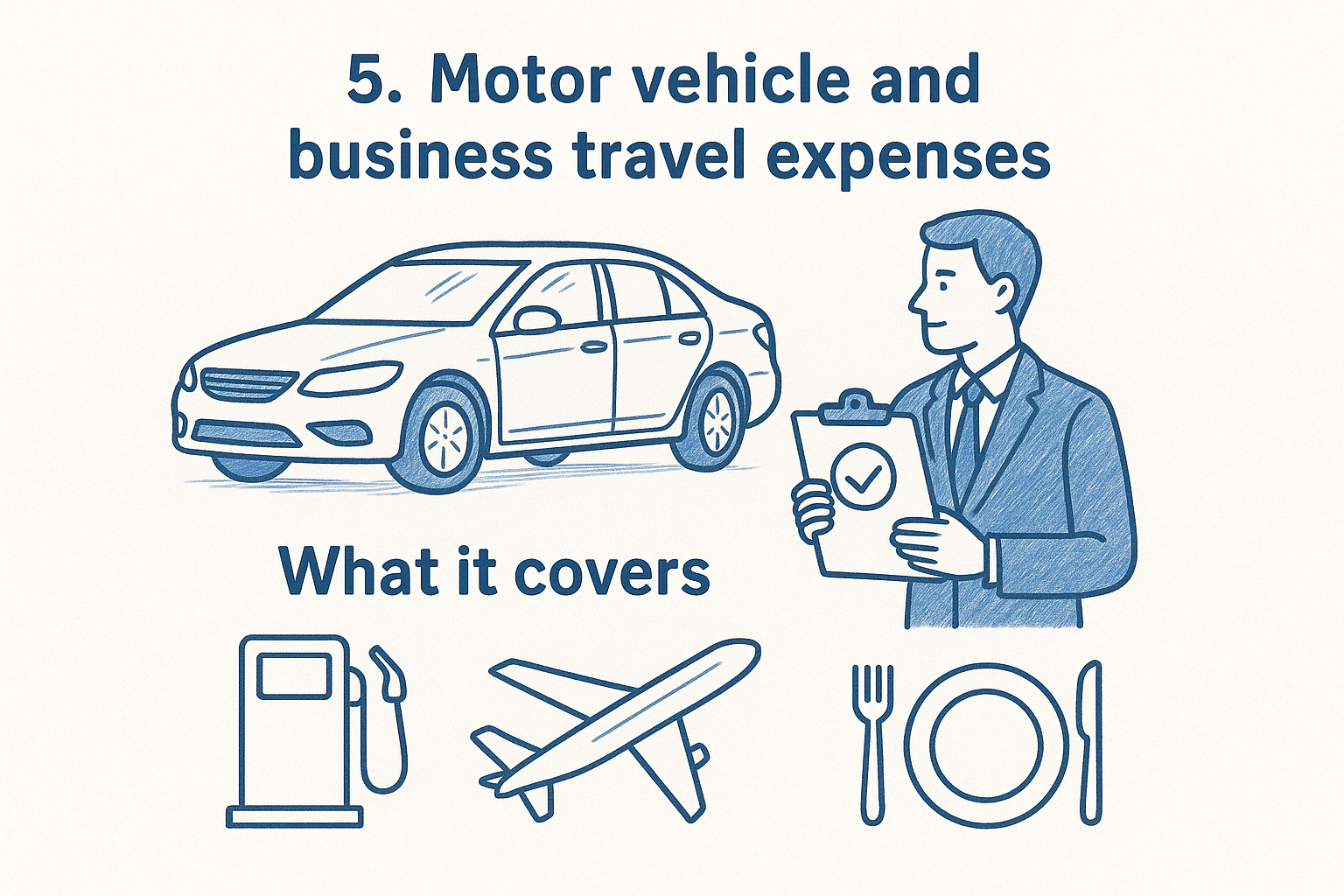
5. Motor vehicle and business travel expenses
Driving for work costs money, and the ATO lets you claw a good chunk of that back through motor vehicle and business travel expenses. Whether you’re visiting clients, collecting stock, or travelling between job sites, the kilometres you rack up for genuine business purposes are deductible, along with flights, accommodation and meals when you travel away from home overnight for work.
What it covers
This deduction spans fuel, servicing, registration, insurance and depreciation on a business vehicle, plus interstate flights, hotel stays and reasonable meal costs on work trips. Tolls and parking fees for client visits count too.
Commuting to your regular workplace never counts, but every kilometre driven for a client, job site or supplier run does.
Eligibility rules
You can use the cents-per-kilometre method for cars, currently 88 cents per kilometre up to 5,000 kilometres, or the logbook method for higher-mileage claims requiring a 12-week logbook. Trips must have a genuine business purpose, and private detours during a work trip need separating out. Confirm current rates on the ATO’s car expenses page before lodging.
How to claim it
Keep a logbook, save fuel and travel receipts, and log business trips as they happen rather than reconstructing them later. Gartly Advisory’s bookkeeping team can set up mileage tracking so this deduction stays accurate all year.
6. Home-based business expenses
Running your business from a spare room or garage still generates real costs, and the ATO recognises that. If you work from home, even part-time, you can claim a share of your household running costs against your income, making this one of the easiest small business tax deductions to miss simply because owners don’t realise it applies to them.
What it covers
This deduction covers a portion of electricity, gas, internet, phone, and depreciation on office furniture and equipment used for work. If you have a dedicated home office, you may also claim a share of occupancy costs like rent, mortgage interest, and council rates, though this can affect your main residence capital gains tax exemption later.
A spare room used purely for invoicing and admin can still shave real dollars off your tax bill.
Eligibility rules
You need to apportion costs based on actual business use, either using the ATO’s fixed rate method of 67 cents per hour or a detailed record of actual expenses. Claims must reflect genuine work use, not personal browsing or family phone calls, so keep that split honest. Check the ATO’s guidance on running your business from home for the current rates and record-keeping requirements.
How to claim it
Track hours worked from home in a diary for a representative month, keep utility bills, and record any equipment purchases separately. Gartly Advisory can help you choose the method that delivers the biggest legitimate claim for your setup.
Staying on top of your deductions
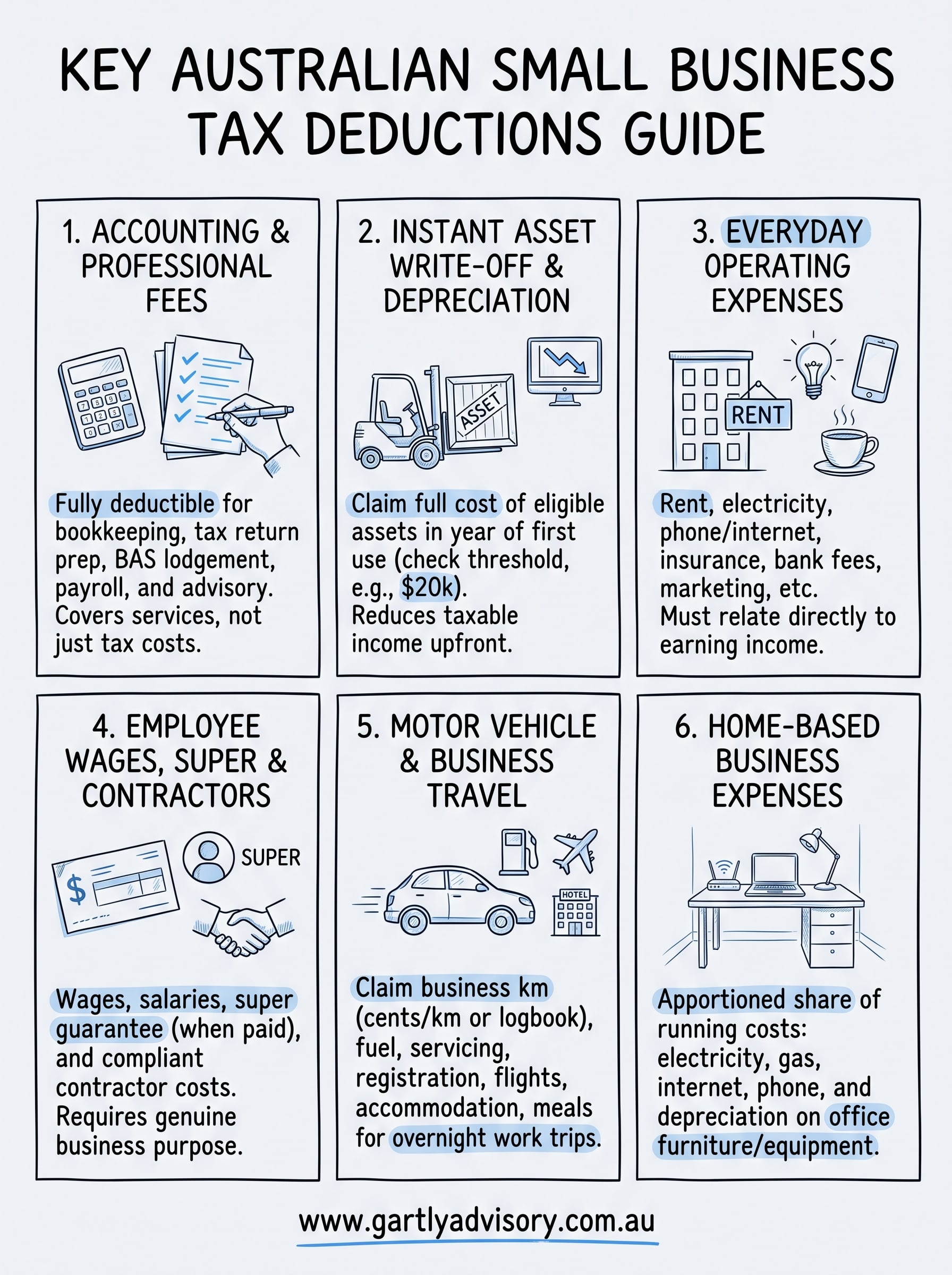
Getting your small business tax deductions right isn’t about chasing every possible claim. It’s about knowing which costs genuinely relate to earning your income, keeping clean records throughout the year, and understanding where the ATO draws the line between a legitimate business expense and a private one. The fifteen areas covered here, from advisory fees and asset write-offs to vehicle costs and home office claims, cover most of what a typical Melbourne business owner deals with each financial year.
Where it gets tricky is the detail: apportioning mixed-use costs correctly, timing purchases to maximise the instant asset write-off, or knowing whether a contractor arrangement actually holds up under scrutiny. Getting that wrong costs you money either way, through missed deductions or ATO penalties. If you’d rather have someone check your position before you lodge, reach out through our advisory services for business owners and we’ll make sure you’re claiming everything you’re entitled to, nothing more, nothing less.