
How to Set Up a Testamentary Trust in Australia
If you’re working out how to set up a testamentary trust, you’re probably thinking about what happens to your estate once you’re gone, not just who gets what, but how it gets protected. A testamentary trust isn’t a document you buy off the shelf. It’s a structure written into your will that only springs into life after your death, and getting it wrong can undo years of careful planning. That’s why so many business owners and families across Melbourne come to us before they finalise their will, not after.
The short answer is that a testamentary trust is set up through your will, drafted with specific trust provisions, and it only takes effect once you pass away and your estate is administered. It requires careful drafting, clear trustee appointments, and a solid understanding of who the beneficiaries are and how assets should flow to them. Get the wording wrong and the trust may not do what you intended, or worse, it may not hold up at all.
In this guide, we’ll walk you through the practical steps, from choosing a trustee to defining the trust’s terms, so you understand exactly what’s involved before you sit down with your solicitor or accountant to put it in place.
Why a testamentary trust matters for your estate plan
Most people assume a will is enough to look after their family once they’re gone. It isn’t, not if you want real protection for the money and assets you’ve spent decades building. A testamentary trust gives you control over how your estate is used long after you can’t speak for yourself, and that control matters most when beneficiaries are young, vulnerable, going through a divorce, or simply not ready to manage a lump sum. Without one, an inheritance passes straight into a beneficiary’s name and becomes fair game for creditors, ex-partners, and poor financial decisions.
Protecting inheritances from creditors and relationship breakdowns
Assets held inside a testamentary trust generally sit outside a beneficiary’s personal estate, which means they’re harder to reach if that beneficiary is sued, declared bankrupt, or goes through a family law dispute. We’ve seen inheritances disappear within a couple of years because they landed directly in a beneficiary’s bank account during a messy divorce. Structuring the inheritance through a trust, with a trustee who controls distributions, keeps the asset a step removed from those risks.
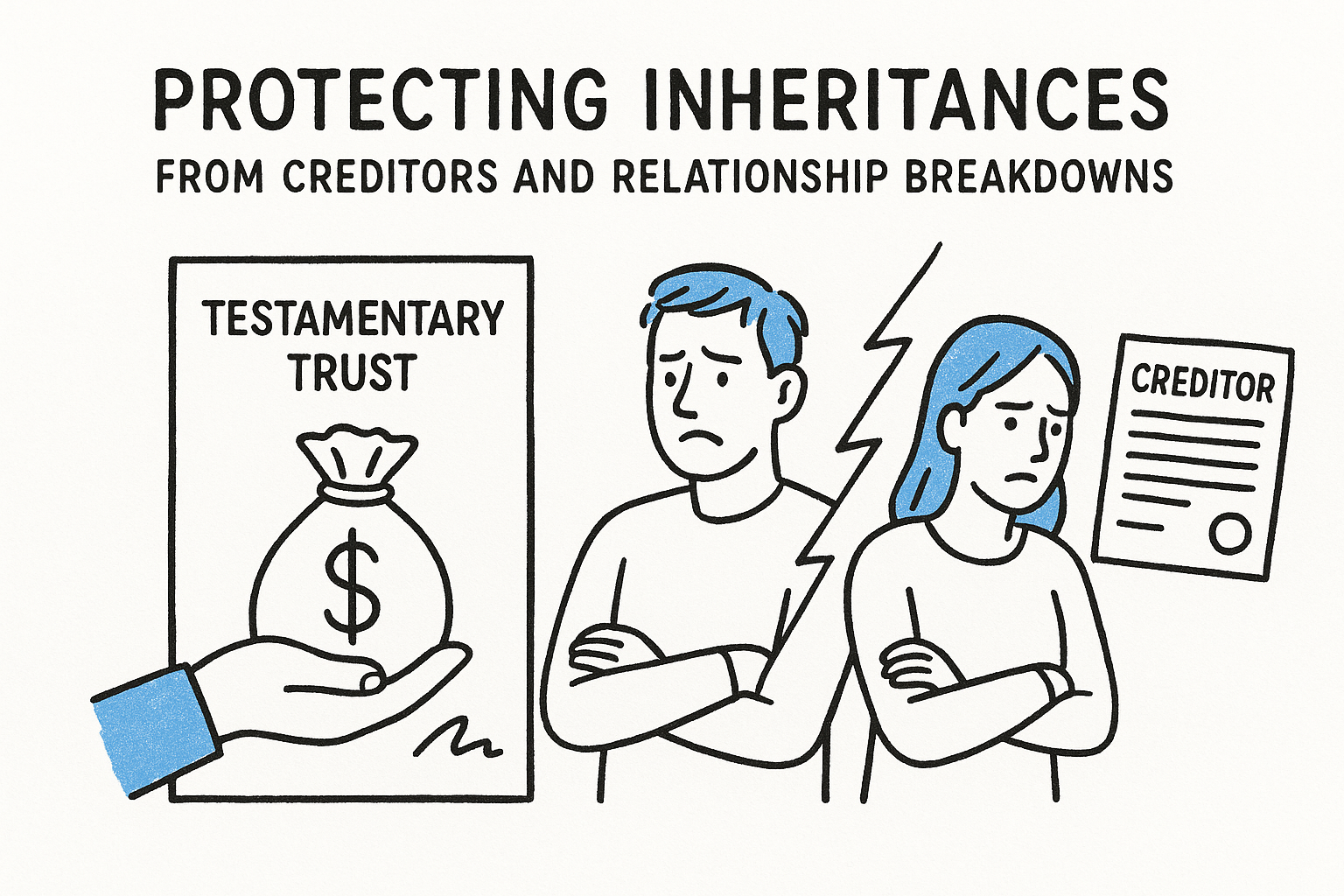
A testamentary trust puts a legal buffer between your estate and the risks life throws at the people you leave it to.
Tax savings that direct inheritances can’t match
Beyond protection, the tax treatment is where a testamentary trust genuinely outperforms a straight bequest. Income distributed to minor beneficiaries from a testamentary trust is taxed at normal adult marginal rates, including the tax-free threshold, rather than the punitive rates that usually apply to unearned income for under-18s. According to the Australian Taxation Office, income from a testamentary trust counts as "excepted trust income" and escapes those higher rates entirely.
| Scenario | Tax treatment for a minor beneficiary |
|---|---|
| Direct inheritance, income invested in child’s name | Taxed at penalty rates, up to 66% on income over $416 |
| Income via testamentary trust | Taxed at normal adult marginal rates, tax-free threshold applies |
| Practical effect | A family can legally distribute income across several children, reducing the household’s overall tax bill |
That difference alone can be worth thousands of dollars a year across a family with several grandchildren, and it’s one of the main reasons business owners with growing family wealth ask us about this structure well before retirement.
Keeping control over how and when assets are distributed
Speed of access is another factor worth weighing. Rather than handing over the full inheritance the day probate finishes, a testamentary trust lets you set conditions, an age of entitlement, staged distributions, or discretion left entirely with a trusted trustee. This is especially useful if a beneficiary has a disability, a gambling problem, or simply isn’t financially mature yet. You can build in flexibility so the trustee responds to circumstances as they arise, rather than locking in a rigid formula that might not suit anyone by the time it’s needed.
Why this matters more for business owners
Finally, if you own a business, hold investment property, or run a self-managed super fund, the stakes are higher again. These assets often carry complex tax consequences on transfer, and a poorly structured inheritance can trigger capital gains tax events or disrupt succession plans you’ve spent years building. A testamentary trust, drafted properly, can hold these assets, manage the tax timing, and keep the business or portfolio intact for the next generation instead of forcing a fire sale to settle the estate.
How to set up a testamentary trust in your will
Setting up a testamentary trust isn’t something you draft on a Sunday afternoon with a template downloaded from the internet. It needs to sit inside a properly drafted will, with clauses that spell out exactly how the trust operates, who runs it, and when it activates. Getting the sequence right matters as much as the wording itself.
Start with your estate planning goals
Before anyone touches a drafting document, you need to work out what you’re actually trying to achieve. Are you protecting assets for young children, shielding an inheritance from a beneficiary’s marriage breakdown risk, or managing tax across a large family group? Your goals shape every clause that follows, from the age of entitlement to how much discretion your trustee holds.
Choose your trustee carefully
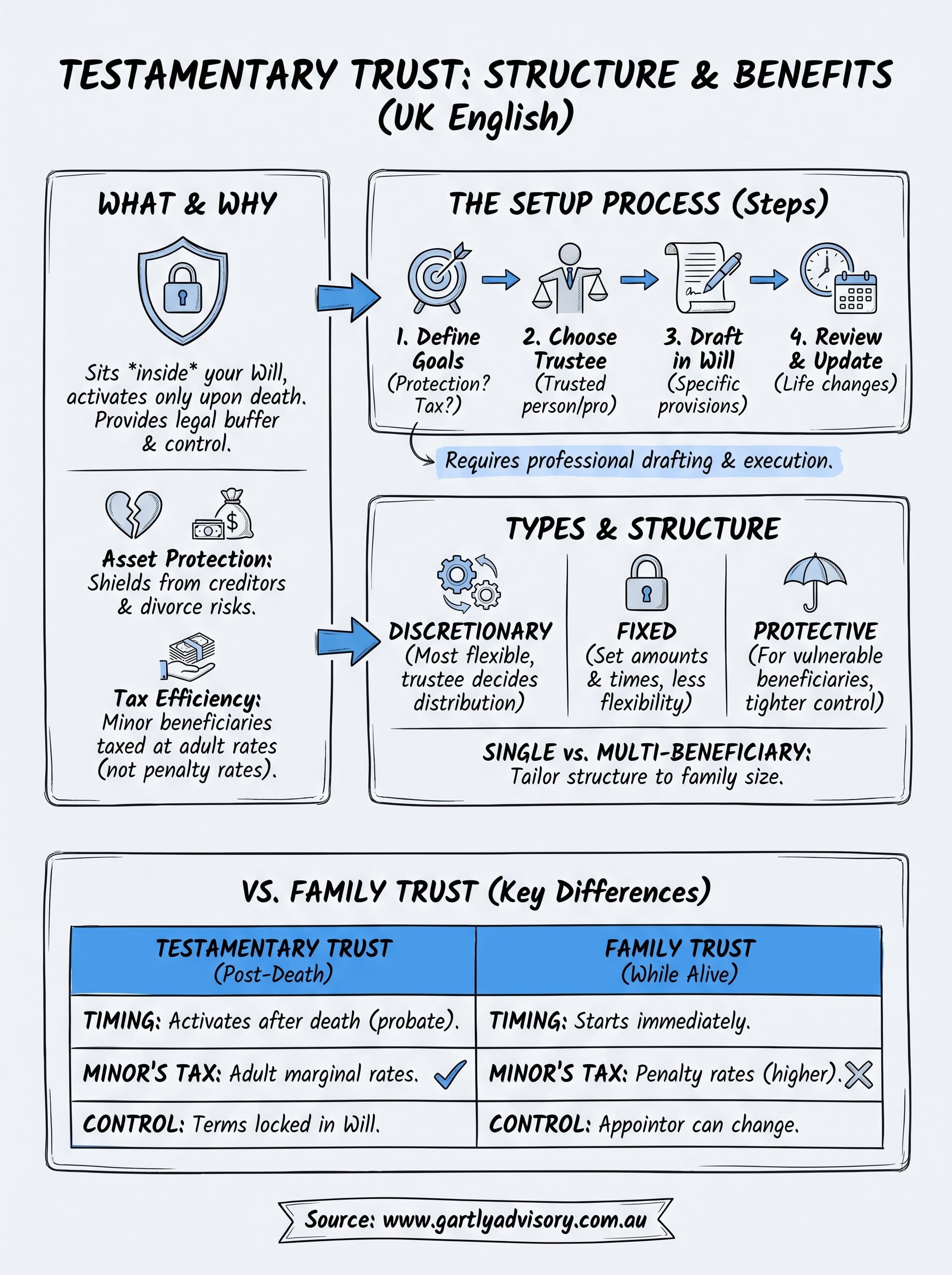
Your trustee controls the trust once you’re gone, so this decision carries real weight. Common choices include:

- A trusted family member with financial sense
- A professional trustee, such as an accountant or solicitor
- A combination of both, often with a family member and a professional acting jointly
Understand the trustee’s role fully. They decide when and how much beneficiaries receive, manage trust investments, and lodge tax returns for the trust each year. Choose someone who won’t buckle under family pressure to distribute early.
Draft the trust deed provisions within your will
This is where a solicitor experienced in estate planning earns their fee. The provisions need to cover the trust’s beneficiaries, the trustee’s powers, how income and capital get distributed, and what happens if a nominated trustee can’t act. Vague or copy-paste wording is the single biggest reason testamentary trusts fail to deliver the protection families expect.
A testamentary trust is only as strong as the wording sitting inside your will.
Have your will reviewed and executed properly
Once the trust provisions are drafted, your solicitor finalises the will and it goes through the standard signing and witnessing process required under Australian law. It’s worth having both a solicitor and an accountant review the document together, since tax outcomes and legal enforceability need to line up. This step is where many DIY wills fall down, because the testamentary trust clauses look fine on paper but conflict with other parts of the will.
Review the structure periodically
Your circumstances change, and your will should keep pace. Revisit the trust provisions whenever you have a new child, a business changes hands, or a beneficiary’s situation shifts significantly, so the structure still matches your estate plan‘s goals when it eventually activates.
Who should consider a testamentary trust
Not every estate needs this level of structure, but plenty of families assume it’s only for the wealthy when it’s really about circumstances, not net worth. If your estate has any complexity at all, minor children, a business, a beneficiary who’s not financially reliable, it’s worth at least discussing a testamentary trust with your adviser before you finalise your will.
Parents with young or vulnerable children
Parents of minors are the clearest case. Without a trust, a child’s inheritance typically sits with a guardian or gets released outright at 18, an age when most people aren’t ready to manage a large sum responsibly. A testamentary trust lets you set an age of entitlement further out, or leave distributions at a trustee’s discretion, so the money supports school fees, housing, or a first business rather than disappearing within a year.
The right time to set up a testamentary trust is before you think you need one, not after a crisis forces the issue.
Business owners and self-managed super fund members
If you run a business or hold assets inside an SMSF, a straight bequest can trigger tax events or force a sale just to pay out beneficiaries. A trust structure gives your executor room to manage the transition, keep the business trading, and time asset disposals sensibly rather than under estate deadlines.
Families with a beneficiary going through separation or facing creditor risk
Separation, bankruptcy, and lawsuits are the scenarios that make a testamentary trust earn its keep. Holding an inheritance through a trust structure rather than paying it directly to a beneficiary makes it far harder for an ex-partner or creditor to claim it as a personal asset. Anyone with a beneficiary in a shaky marriage, a risky profession, or a history of poor money management should treat this as a priority, not an afterthought.
Blended families and multi-generational wealth
Blended families face a different problem: balancing fairness between children from different relationships while protecting each branch’s inheritance from the other’s circumstances. A testamentary trust lets you ring-fence assets for specific beneficiaries while still giving a trustee discretion to respond to genuine need. For multi-generational wealth, the tax splitting benefits across grandchildren often make the structure worthwhile on financial grounds alone, well before you factor in the asset protection.
Types of testamentary trusts you can choose from
Once you’ve decided a testamentary trust suits your estate, the next question is which structure to use. Not every trust needs to hold your entire estate, and not every beneficiary needs the same level of control handed to a trustee. Matching the type to your family’s actual circumstances is where a lot of the value gets created, or lost if you pick the wrong fit.
Discretionary testamentary trusts
Discretionary trusts give your trustee the power to decide who receives income and capital, and when, from a defined class of beneficiaries. This is the most common structure because it offers maximum flexibility, letting the trustee respond to a beneficiary’s changing circumstances rather than sticking to a fixed formula written years earlier. It’s also the structure that delivers the tax-splitting benefits across children and grandchildren we covered earlier, since income can be directed to whichever beneficiary makes the most sense in a given year.
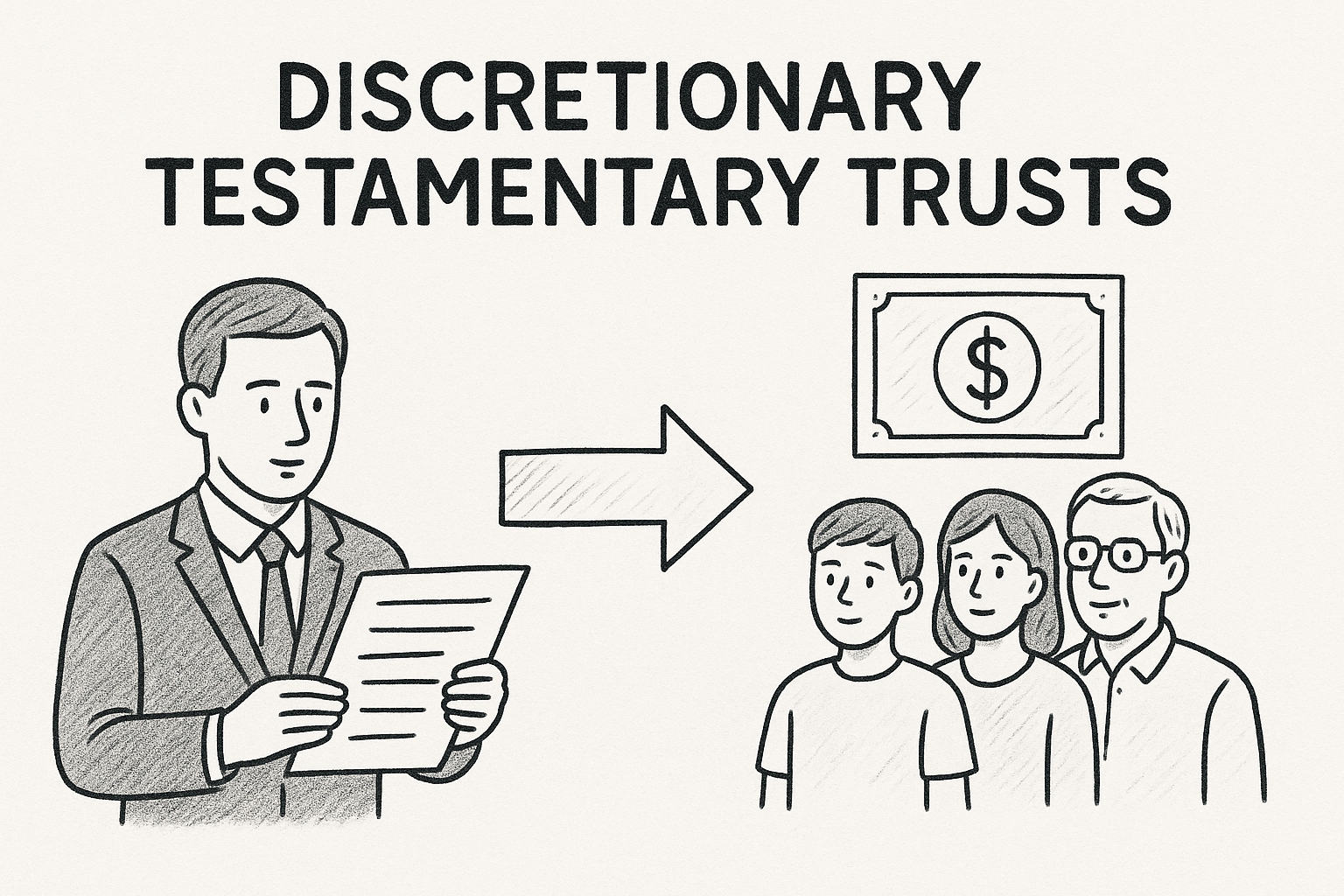
Flexibility is the whole point of a discretionary testamentary trust, it lets your trustee make decisions you can’t make from the grave.
Fixed testamentary trusts
A fixed trust sets out exactly what each beneficiary receives and when, with no discretion left to the trustee. Some families prefer this for certainty, particularly where relationships between beneficiaries are strained and any perceived favouritism could cause conflict. The trade-off is losing the flexibility to adapt if a beneficiary’s needs change, so this option suits situations where the outcome you want is already clear and unlikely to shift.
Protective testamentary trusts
Protective trusts exist specifically to shield a vulnerable beneficiary, someone with a disability, an addiction, or a history of poor financial decisions. The trustee holds tighter control over distributions, often limiting access to income rather than capital, and the trust terms can include specific safeguards around how funds get used. These structures work well alongside a special disability trust, which carries its own tax and Centrelink concessions worth discussing with your accountant.
Single beneficiary versus multi-beneficiary trusts
You can also structure a testamentary trust around one beneficiary or several, and this choice affects everything from tax splitting to how disputes get managed:
| Structure | Best suited to |
|---|---|
| Single beneficiary trust | One child, simplifying administration and avoiding disputes over discretion |
| Multi-beneficiary trust | Families with several children or grandchildren, maximising tax-splitting opportunities |
Most solicitors draft separate testamentary trusts for each child within the one will, so each family branch runs its own trust independently rather than sharing a single pool of assets.
Testamentary trust vs family trust: what’s the difference
People often confuse these two structures because both split income and protect assets, but they operate in completely different worlds. A family trust (also called a discretionary trust) is set up while you’re alive and runs your affairs from day one, whereas a testamentary trust only exists inside your will and activates after you die. Confusing the two, or assuming one can substitute for the other, is a common mistake we see in first drafts of DIY estate plans.
When each structure gets created and starts operating
Genuinely, timing is the biggest difference. You establish a family trust now, appoint yourself or a company as trustee, and use it immediately to hold investments, run a business, or distribute income to family members each financial year. A testamentary trust sits dormant inside your will until probate is granted, then springs into life to receive and manage the assets left to a particular beneficiary. If you want asset protection and tax splitting today, a family trust does the job. If you want that same protection to apply to what you leave behind, you need a testamentary trust as well.
Tax and control differences worth knowing
Just as importantly, the tax rules diverge sharply once minors are involved. Income streamed to a minor from a family trust attracts the punitive rates set for unearned income, while income from a testamentary trust qualifies as excepted income and gets taxed at ordinary adult rates. Control also differs: a family trust’s appointor can usually change trustees or wind up the trust at will, while a testamentary trust’s terms are locked in by your will and generally can’t be altered once you’ve passed.
A family trust manages wealth while you’re alive; a testamentary trust protects what happens to it once you’re not.
| Feature | Family trust | Testamentary trust |
|---|---|---|
| When it starts | Immediately, while you’re alive | After death, once probate is granted |
| Set up via | Trust deed, standalone document | Clauses within your will |
| Minor’s income tax | Penalty rates apply | Adult marginal rates apply |
| Can be changed later | Yes, by the appointor | No, locked in by the will |
Often the strongest estate plans use both, running a family trust during your lifetime and layering testamentary trusts into your will so the protection and tax benefits continue seamlessly for the next generation.
Costs of setting up and running a testamentary trust
Money matters here too, and plenty of people assume a testamentary trust costs a fortune to set up. It doesn’t, but it isn’t free either, and the real expense often shows up years later in ongoing administration rather than the initial drafting. Understanding both sides of that cost picture helps you decide whether the protection and tax savings justify the outlay for your family’s situation.
Upfront legal and drafting costs
Setting up the trust provisions inside your will typically costs more than a standard will, simply because the clauses need proper drafting rather than a template fill-in. A basic will might run a few hundred dollars through a solicitor, while a will with testamentary trust provisions usually sits higher, often between $800 and $2,500 depending on complexity, the number of beneficiaries, and whether you’re layering in special disability trust clauses or business succession terms. Complex estates with multiple trusts for different children, or provisions covering an SMSF and business assets, push toward the top of that range and sometimes beyond it.
Ongoing running costs once the trust activates
Once probate is granted and the trust actually starts operating, the ongoing costs kick in. These include:
- Annual tax return preparation for the trust, generally handled by an accountant
- Trustee fees, if you’ve appointed a professional trustee rather than a family member
- Investment management or administration fees, depending on what assets the trust holds
- Occasional legal costs if a dispute arises between beneficiaries or over trustee decisions
A family member acting as trustee often waives their own fee, which keeps running costs down to little more than the annual accounting bill. A professional trustee, by contrast, usually charges a percentage of the trust’s assets or income each year, so weigh that against the peace of mind it buys.
Weighing cost against the benefit
Measured against the tax savings alone, most families come out well ahead. Splitting income across several children at adult marginal rates instead of penalty rates can save thousands annually, which dwarfs the few hundred dollars in extra drafting fees or the modest annual accounting cost.
The cost of setting up a testamentary trust is small next to what it saves your family in tax and protects them from in risk.
Getting a clear quote from your solicitor and accountant before you commit avoids surprises later, and it lets you compare the ongoing running costs against the specific benefits your family stands to gain.
Where to go from here
Setting up a testamentary trust isn’t a job for a generic template. It’s a structure that lives inside your will, and its value depends entirely on how carefully it’s drafted, who you appoint as trustee, and whether the tax and asset protection provisions actually match your family’s circumstances. Get those details right and you’ve built a genuine safeguard for the people you leave behind. Get them wrong and you’ve created a false sense of security that unravels the moment it’s tested.
The right next step is a conversation with people who understand both the legal drafting and the tax consequences behind it, not one or the other. Geoff Gartly and the team at Gartly Advisory have spent decades helping Melbourne business owners and families structure estates that hold up when it matters most. If you’re ready to work out what a testamentary trust should look like for your family, book a consultation with Gartly Advisory and start the conversation properly.