Business Exit Strategy: What It Is and How to Plan One
Most business owners spend years building their company and almost no time planning how they’ll leave it. A business exit strategy is simply your plan for stepping away. That might mean selling to a competitor, handing the business to a family member, or listing it on the market entirely. Without one, you’re leaving the sale price, the timing, and the outcome to chance.
So what is an exit strategy in business, really? It’s the roadmap that determines how you convert years of hard work into a payout, retirement fund, or clean break. It also covers everything from succession planning to trade sales, management buyouts, and winding things up. Get it right and you walk away with maximum value and minimal stress. Get it wrong, and you’re negotiating from a position of weakness, often when you can least afford to.
This article breaks down what a solid exit plan actually looks like. It also covers the main exit strategy options available to Australian business owners, and the practical steps for building one that protects your financial position. We’ve worked with hundreds of Melbourne business owners on exactly this, so expect straight answers, not textbook theory.
Why a business exit strategy matters
Most owners think exit planning is something you do in the final year before selling. That’s backwards. A business exit strategy works best when it’s built years in advance. That’s because the decisions you make today (how you structure the business, who holds equity, what systems you rely on) directly shape what buyers will pay tomorrow. Waiting until you’re tired, unwell, or facing a forced sale means negotiating from weakness rather than strength.
The financial gap between planned and unplanned exits
Research consistently shows that businesses sold through a deliberate, well-timed process fetch significantly higher multiples than those sold under pressure. Buyers can smell desperation, and they price accordingly. A planning business exit strategy approach gives you time to clean up financials, diversify your customer base, and remove yourself as the single point of failure. All of these directly lift valuation, which is exactly where an exit strategy advisor who maximises your Melbourne business value focuses attention.
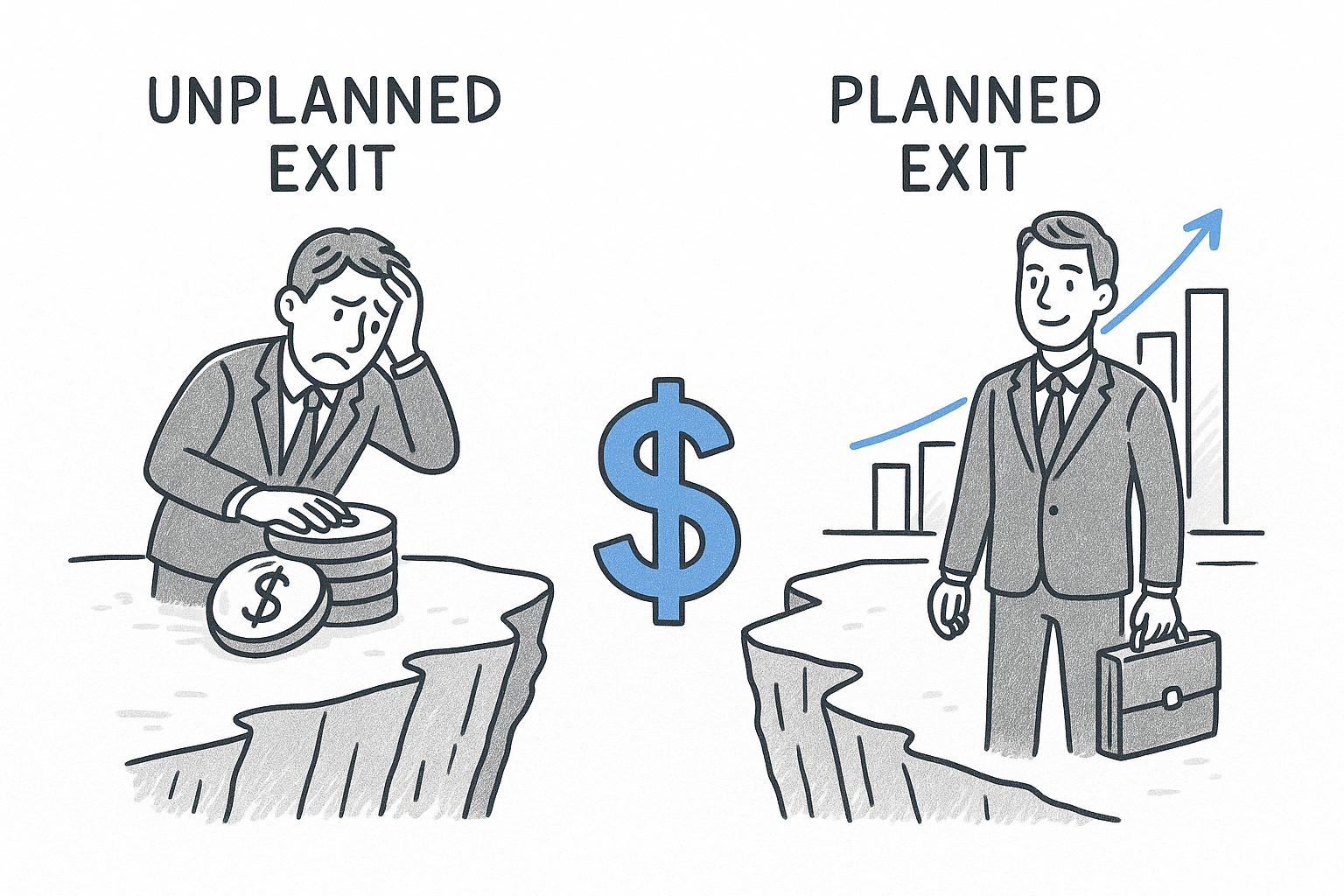
A business without an exit strategy is worth whatever a buyer decides on the day, not what you’ve actually built.
Consider the practical difference between the two paths:
| Factor | Unplanned exit | Planned exit |
|---|---|---|
| Typical timeframe | Weeks to months | 2-5 years |
| Buyer leverage | High | Low |
| Valuation outcome | Discounted, forced-sale pricing | Market or premium pricing |
| Tax outcome | Often unoptimised | Structured for concessions |
| Owner stress | High | Manageable |
It’s not just about selling
Exit planning matters even if you never intend to sell in the traditional sense. Death, illness, divorce, business partner disputes, and burnout all force exits, often without warning. If you haven’t documented succession planning arrangements or set up buy-sell agreements between partners, your family or co-owners can be left fighting over a business nobody knows how to run or value. That’s why we wrote a complete succession planning guide for Melbourne owners. We’ve seen this play out with Melbourne trades businesses. In one case, the founder held every client relationship, every supplier contact, and every piece of technical knowledge in his own head. When he became unwell, the business lost half its value in six months simply because there was no plan for someone else to step in.
Tax and super consequences of your business exit strategy
Getting the structure right before you exit can mean the difference between paying full capital gains tax and accessing small business CGT concessions to maximise your return. These concessions could reduce your tax bill substantially, sometimes to zero on eligible assets. This is where an accountant who understands both exit strategy business structuring and superannuation strategy earns their fee many times over. Rolling proceeds into a self-managed super fund, timing the sale across financial years, or restructuring ownership ahead of a sale are all legitimate strategies. However, they only work if you plan them well ahead of settlement, not the week before. The Australian Taxation Office sets strict eligibility rules around these concessions, and missing a technical requirement can cost you the entire benefit.
Confidence for the next chapter
Beyond dollars and structures, exit planning gives you clarity about what comes next. Owners who plan properly report far less anxiety around retirement, career changes, or handing over to family. That’s because they know the numbers, the timeline, and the process. Nobody wants to reach 65 realising the business they poured decades into won’t fund the retirement they pictured. Building the plan early gives you options: sell now, sell later, bring in a partner, or keep growing towards a bigger number. Without a plan, none of those choices are really yours to make.
How to plan a business exit strategy step by step
Building an exit plan isn’t complicated once you break it into stages, but it does need discipline. Most owners never get past step one because they treat it as a someday task rather than a scheduled project. Here’s how exit planning works for small business owners and how we walk clients through how to plan an exit strategy for a business without it becoming an overwhelming exercise.
Start your business exit strategy with the end in mind
First, decide roughly when and how you want to leave. Are you targeting a trade sale in five years, handing over to your kids, or winding down slowly over a decade? This single decision shapes every structural choice that follows, from how you pay yourself to who you hire. Owners who skip this step end up building a business that suits nobody, not a buyer, not a successor, and not themselves.
Get your numbers and structure right
Next, get an honest valuation done, even if you’re years from selling, and understand what drives the value of a small business for sale. You need a baseline to measure progress against, and it often reveals uncomfortable truths about customer concentration or thin margins. Alongside this, review your business structure with your accountant. A trust, company, or partnership arrangement that made sense at start-up may cost you dearly at exit if it blocks access to CGT concessions.
Plan the exit before you plan the sale, because structure decisions made too late can’t be undone.
Build the team and documentation you need
Then assemble the right advisers early: an accountant experienced in exit strategy example business plan work, a solicitor for contracts and buy-sell agreements, and possibly a business broker once you’re within two years of selling. Documentation matters more than owners expect. Buyers pay premiums for businesses with clean financials, documented processes, and contracts that don’t rely on the owner’s personal relationships.
Reduce owner dependency and test the market
After that, spend real time removing yourself as the single point of failure. Delegate client relationships, document supplier arrangements, and build a management layer that can run operations without you in the room. This is usually the step that adds the most measurable value, and it sits at the heart of the five steps that increase your business value before sale. Finally, before you commit to a sale process, get informal feedback from your accountant or advisor on how the business would actually be received in the current market. A structured checklist helps:
- Confirm ownership structure supports your chosen exit type
- Get a formal or informal valuation
- Document key processes and client relationships
- Line up your accountant, solicitor, and broker
- Set a realistic timeline, ideally two to five years out
Given time, each of these steps compounds into a materially better outcome.
Types of business exit strategies to consider
Deciding which exit strategy business owners should pursue depends on your goals, your industry, and how much control you want during the handover. There’s no single "correct" choice here, only the option that best matches your timeline and your appetite for risk. Below are the main paths we see Melbourne business owners take.
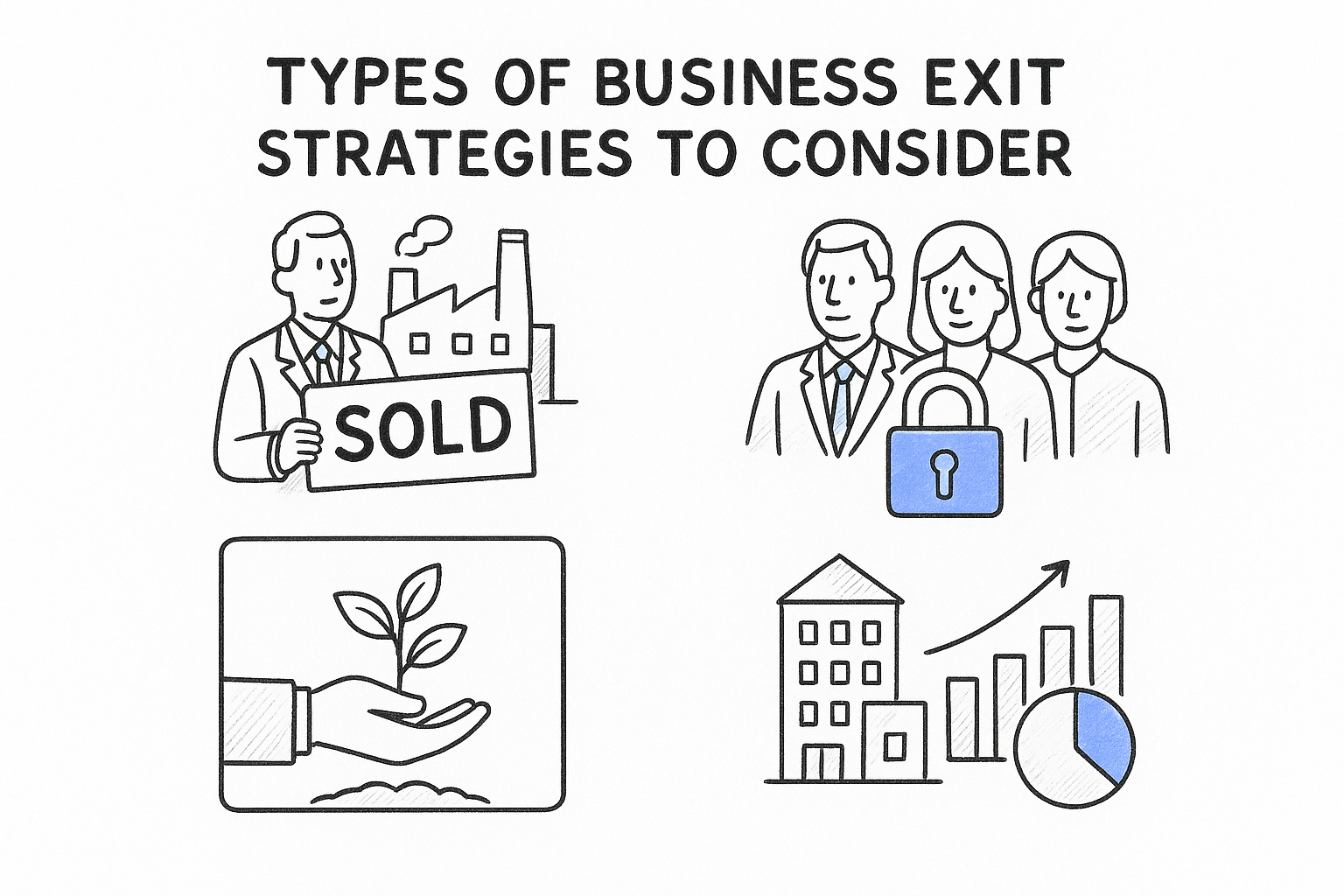
Trade sale to a third party
A trade sale means selling your business outright to another company, competitor, or private buyer. This is usually the exit strategy selling business owners picture first when they think "sell my business", and it tends to deliver the highest lump sum if the business is well-prepared. Buyers pay a premium for strong recurring revenue, documented systems, and a management team that doesn’t disappear with the founder.
Management or employee buyout
Here, existing managers or staff purchase the business, often financed over time rather than paid upfront. It suits owners who want continuity for staff and clients, and it usually involves a longer settlement period than a trade sale. Vendor finance arrangements are common, so you carry some risk until the final payment clears.
Family succession
Passing the business to children or relatives protects the legacy but introduces its own complications: sibling disputes, unclear valuations, and family members who may not actually want the role. Formal succession planning, including buy-sell agreements and independent valuations, prevents resentment later, so it pays to work through family business succession step by step.
The best exit strategy is the one that matches how much control you’re willing to give up and how quickly you need the cash.
Liquidation or wind-down
Sometimes the most sensible option is closing the doors, selling assets, and distributing proceeds. This suits businesses tied heavily to the owner’s personal skills or reputation, where no buyer would pay for goodwill anyway.
IPO or investor buyout
Rarely relevant for small and medium businesses, but worth knowing: larger operations sometimes exit through public listing or by selling a controlling stake to a private equity investor.
| Exit type | Typical timeframe | Best suited to |
|---|---|---|
| Trade sale | 6-18 months | Businesses with strong systems and recurring revenue |
| Management buyout | 1-3 years | Owners wanting continuity for staff |
| Family succession | 2-5 years | Family-run businesses with willing successors |
| Liquidation | Weeks to months | Owner-dependent businesses with limited resale value |
| Investor buyout/IPO | 2+ years | Larger, high-growth operations |
Geoff Gartly’s team regularly helps clients weigh these exit strategy options against their personal and financial goals before committing to one path.
Exit strategies for a struggling or failing business
Not every exit starts from a position of strength. If revenue is falling, debts are mounting, or you’re simply out of energy, you still need a plan, and acting early changes the outcome dramatically. An exit strategy for a failing business looks different from a planned sale because the priority shifts from maximising value to protecting yourself, your family, and often your staff from further loss.
Recognise the warning signs early
Owners typically wait too long before addressing decline, hoping next quarter will turn things around. Cash flow gaps, missed supplier payments, and mounting director loans are all signals that it’s time to get advice on surviving a cash flow crisis, not wait another six months. The earlier you involve your accountant, the more options remain on the table.
The difference between a bad exit and a disaster is usually just how early you asked for help.
Options when the business is genuinely struggling
Several paths exist depending on how much value remains and how much debt sits against the business:
- Sell the assets or client base to a competitor while some goodwill still exists, rather than waiting until there’s nothing left to sell
- Restructure the business, cutting costs and renegotiating supplier or lease terms to buy time for recovery
- Bring in a partner or investor to inject capital in exchange for equity, provided you’re willing to give up some control
- Voluntary administration, which pauses creditor action while a plan is worked out with an independent administrator
- Liquidation, closing the business and distributing whatever assets remain to creditors in order of priority
Each option carries different consequences for directors, particularly around personal liability if you’ve provided guarantees on loans or leases. So read our strategic advice on managing business debt first.
Get advice before, not after, you’re forced
Directors who keep trading while insolvent risk personal liability under Australian law. So this isn’t a decision to make alone or delay. The Australian Securities and Investments Commission sets out director obligations around insolvent trading, and ignoring them can turn a business failure into a personal financial disaster. This is exactly the kind of situation where our business dispute resolution and outsourced CFO services in Melbourne earn their keep, giving you an objective read on the numbers before you make a decision you can’t undo. A struggling business isn’t automatically a lost cause, but it does need honest numbers and fast decisions rather than hope.
Plan your business exit strategy early for a confident exit
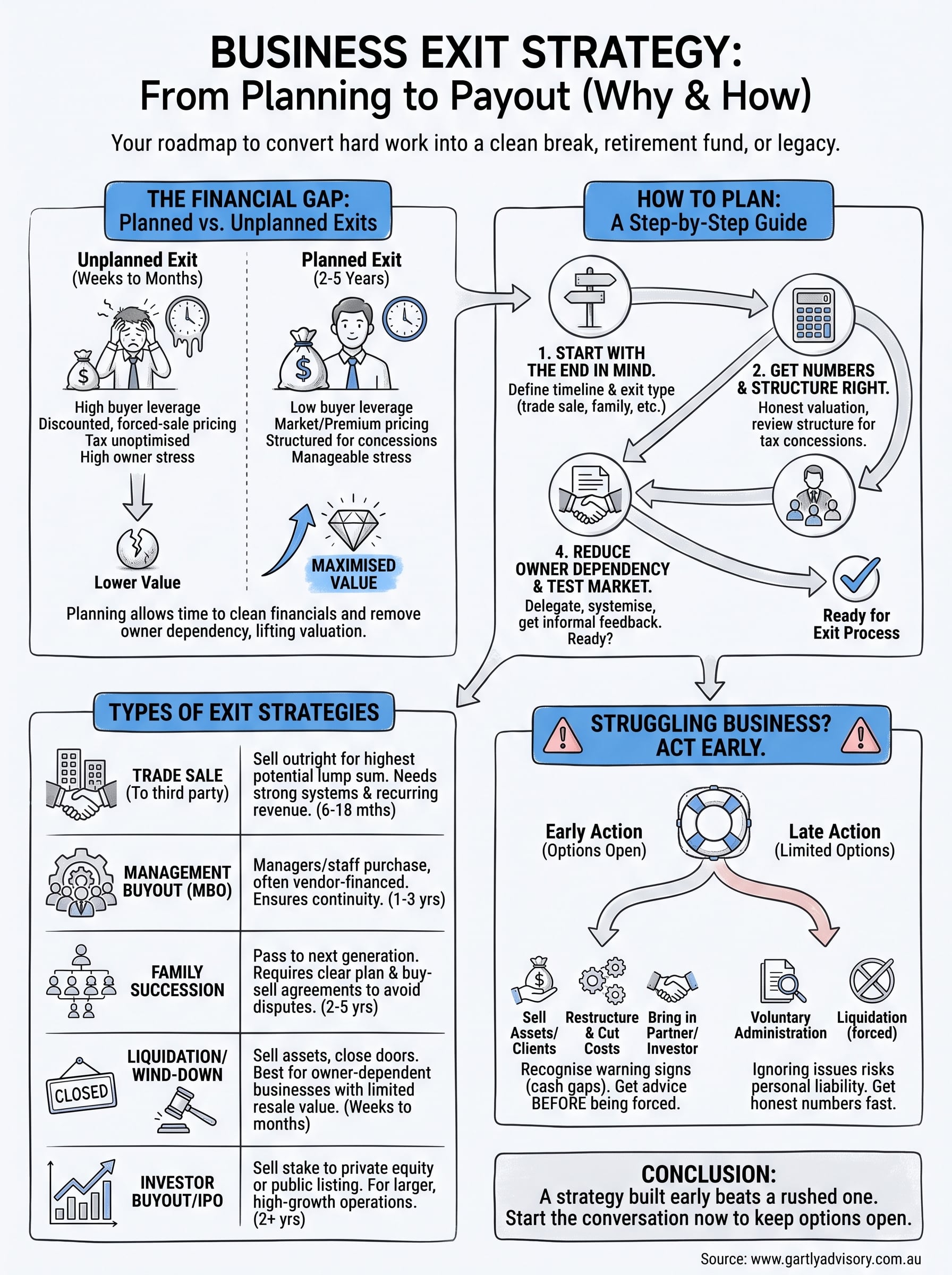
Every path outlined here, whether it’s a trade sale, family succession, or working through a genuine downturn, points to the same conclusion: a business exit strategy built early beats one rushed together under pressure. The owners who walk away with the best outcomes aren’t necessarily running the biggest businesses. They’re the ones who treated exit planning as an ongoing project rather than a last-minute scramble. They also got proper advice on structure, valuation, and tax well before settlement day.
You don’t need every answer today, but you do need to start the conversation. Whether you’re five years out or facing pressure right now, the sooner you get honest numbers in front of you, the more options stay open. Gartly Advisory has guided hundreds of Melbourne business owners through exactly this process, and we’d rather have the conversation with you now than after the decisions have already been made for you. Get in touch with our team to start your exit planning journey and build your exit plan properly.
Frequently asked questions about a business exit strategy
It is your plan for stepping away from your business. That might be a trade sale, family succession, a management buyout or a wind-down.
Ideally years in advance. A planned exit typically takes two to five years and gives you time to lift the business’s value.
The main options are a trade sale, a management or employee buyout, family succession, liquidation or wind-down, and an IPO or investor buyout.
You can sell assets or the client base, restructure, bring in an investor, or use voluntary administration or liquidation. Get advice early.
Small business CGT concessions may substantially reduce tax on eligible assets. The ATO sets strict eligibility rules, so plan your structure early.