
How to Reduce Tax in Australia: 9 Legal Strategies
Every June, business owners across Melbourne ask the same question: is there anything else I can legally do before EOFY to bring my tax bill down? If you’re wondering how to reduce tax in Australia, the good news is there are genuine, ATO-approved ways to do it, and most business owners are only using a fraction of them.
The short answer is that legal tax reduction comes down to timing, structure, and knowing which deductions and concessions actually apply to your situation. Strategies like salary sacrificing into superannuation, claiming the right business deductions, and using the right entity structure can shave thousands off your tax bill each year, without any grey areas or audit risk.
We’ve worked with hundreds of Melbourne business owners over 35 years, and this article walks through nine practical strategies we use with clients every day. From superannuation contribution caps to trust distributions and asset write-offs, you’ll get a clear picture of what’s available and how to apply it before the next tax deadline arrives.
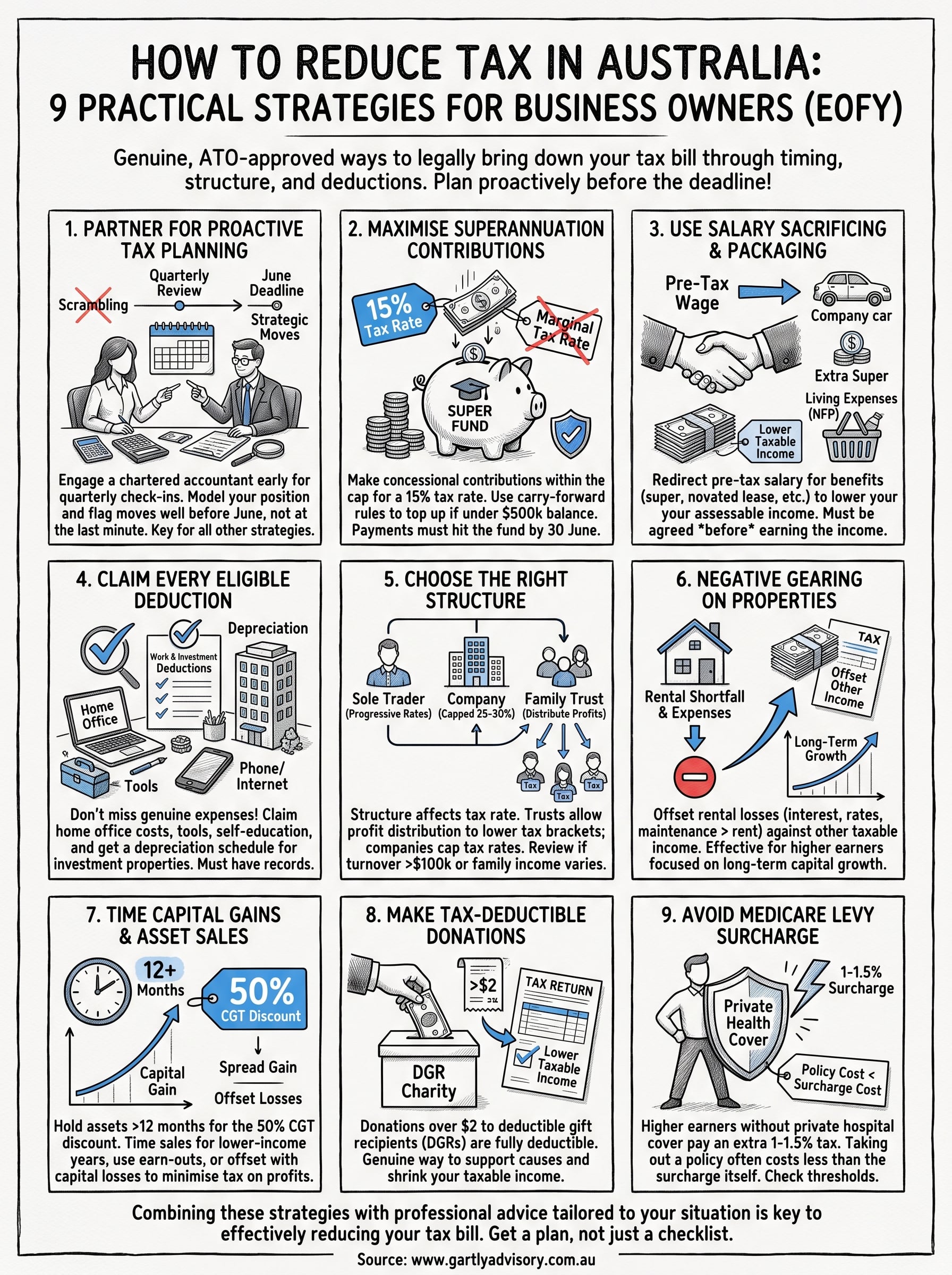
1. Partner with a chartered accountant for proactive tax planning
Most business owners treat tax as a once-a-year event, something to sort out in June or hand over to whoever does the books. That’s exactly why so many of them overpay. Proactive tax planning means reviewing your position throughout the year, not scrambling at the deadline, and it’s the single strategy that makes every other item on this list actually work. Without someone actively looking for opportunities as your financial year unfolds, deductions get missed, super caps go unused, and structuring decisions get made too late to matter.
How it works
A chartered accountant who uses real tax planning strategies for SMEs sits down with you well before June, models your likely tax position, and flags moves you can still make. This might mean bringing forward an equipment purchase, adjusting how profits are distributed through a trust, or timing an asset sale. At Gartly Advisory, this is built into our outsourced CFO and advisory services, where we track your numbers quarterly rather than waiting for a once-a-year catch-up.
The biggest tax savings come from decisions made months before EOFY, not from receipts sorted in the last week of June.
Who it suits
This approach suits business owners who feel like their accountant only appears at tax time, franchise operators juggling multiple reporting requirements, and trades or property management businesses with irregular income that makes forecasting tricky. It also suits anyone who’s grown quickly and suspects their current structure or advice hasn’t kept pace with the business.
Key rules to keep in mind
The ATO draws a firm line between legitimate tax planning and tax avoidance schemes, and Part IVA of the Income Tax Assessment Act 1936 gives them the power to unwind arrangements entered into purely to reduce tax. Genuine planning always has a commercial rationale behind it, not just a tax outcome. Keep these points front of mind:
- Engage an accountant well before 30 June, ideally with quarterly check-ins.
- Document the commercial reasons behind any structuring or timing decisions.
- Confirm your adviser is a registered tax agent with the Tax Practitioners Board.
- Review your plan annually, since thresholds and caps change each financial year.
2. Maximise your superannuation contributions
Superannuation remains one of the most reliable ways to reduce tax in Australia, because contributions inside the concessional cap are taxed at just 15%, well below most marginal rates. Putting extra money into super instead of taking it as wages or profit is one of the few strategies that lowers your tax bill and builds long-term wealth at the same time.

How it works
Each financial year, you can make concessional contributions (employer contributions plus any salary sacrifice or personal deductible contributions) up to the ATO’s cap. If you haven’t used your full cap in previous years and your super balance is under $500,000, you may be able to use carry-forward concessional contributions to top up beyond this year’s cap.
Every dollar diverted into super at 15% tax instead of your marginal rate is money the ATO doesn’t touch until retirement.
Who it suits
Business owners with a strong income year, employees close to retirement, and anyone who took a pay cut in a previous year and now has unused cap space all benefit here. It also suits clients running a self-managed super fund, who want direct control over how contributions are invested.
Key rules to keep in mind
- The concessional cap is $30,000 for the 2024-25 year, indexed periodically.
- Contributions above the cap attract extra tax.
- Carry-forward rules apply only if your total super balance sits under $500,000.
- Payments must land in your fund before 30 June to count for that year.
3. Use salary sacrificing and salary packaging
Salary sacrificing lets you swap part of your pre-tax wage for benefits your employer pays for directly, so you’re taxed on a smaller income while still getting real value out of the arrangement. Beyond the super contributions covered above, salary packaging can extend to items like a work car, additional super, or (for eligible not-for-profit employees) everyday living expenses, making it one of the more flexible ways to legally reduce your tax bill.
How it works
You and your employer agree in writing to redirect part of your salary before tax is calculated, usually into super, a novated lease, or another approved benefit. Because the money never hits your bank account as wages, it’s not counted in your taxable income for the year.
A dollar sacrificed before tax is worth more than a dollar earned and taxed, then spent on the same benefit.
Who it suits
This strategy suits PAYG employees on solid salaries, particularly those in higher tax brackets who want a car or extra super without the hit to take-home pay. Business owners who also draw a wage from their own company can use it too, alongside employees of charities and public hospitals who access broader packaging concessions.
Key rules to keep in mind
- The arrangement must be agreed before you earn the income, not after.
- Salary-sacrificed super still counts toward your concessional cap.
- Novated leases carry fringe benefits tax implications your employer needs to manage.
- Not-for-profit packaging caps differ from standard employer arrangements.
4. Claim every eligible work-related and investment deduction
Most people claim the obvious deductions and stop there, leaving genuine expenses sitting unclaimed on their tax return. Work-related deductions cover far more than the standard uniform and phone bill line items most taxpayers default to, as any proper tax deductions checklist shows, and investment property owners often miss depreciation entirely. Getting this right is one of the simplest ways to lower your taxable income without changing anything about how you earn it.
How it works
Any expense directly connected to earning your income is potentially deductible, provided you’ve spent the money yourself, weren’t reimbursed, and can produce a record. That includes home office running costs, self-education tied to your current role, tools and equipment, and for property investors, a depreciation schedule prepared by a quantity surveyor.
Deductions you forget to claim are a tax cut you handed straight back to the ATO.
Who it suits
Employees working from home, tradespeople buying their own tools, and landlords with older properties they’ve never had depreciated all leave money on the table here. It also suits business owners unsure which portion of mixed-use expenses, like a car or phone, they can legitimately split between personal and business use.
Key rules to keep in mind
- You need a record for every claim, whether that’s a receipt, logbook, or diary entry.
- The expense must relate directly to earning assessable income, not private enjoyment.
- Depreciation schedules typically pay for themselves within the first year’s claim.
- The ATO’s occupation-specific guides list common deductions for your line of work.
5. Choose the right business or trust structure
The structure you trade through, whether that’s a sole trader setup, a company, or a discretionary trust, has a direct effect on how much tax you pay on the same dollar of profit. Getting this wrong is one of the most expensive mistakes we see, because early decisions on sole trader vs company structure are hard to unwind later without triggering capital gains tax or stamp duty.
How it works
Setting up a family trust lets you distribute profits to family members or a corporate beneficiary each year based on who’s in the lowest tax bracket, while a company caps tax at the 25% or 30% company rate regardless of how much you draw out personally. Combining a trading trust with a corporate trustee often gives business owners the flexibility to split income and cap tax at the same time.
The right structure doesn’t just protect your assets, it decides how much of your profit the ATO gets to keep.
Who it suits
Family businesses with variable income between partners, growing companies retaining profit for expansion, and anyone currently trading as a sole trader once turnover climbs past $100,000 should all review their setup with an adviser.
Key rules to keep in mind
- Trust distributions must be resolved and documented before 30 June.
- Company profits face top-up tax when paid out as unfranked dividends.
- Restructuring can trigger CGT, so get advice before switching entities.
- The ATO scrutinises trust distributions under section 100A closely.
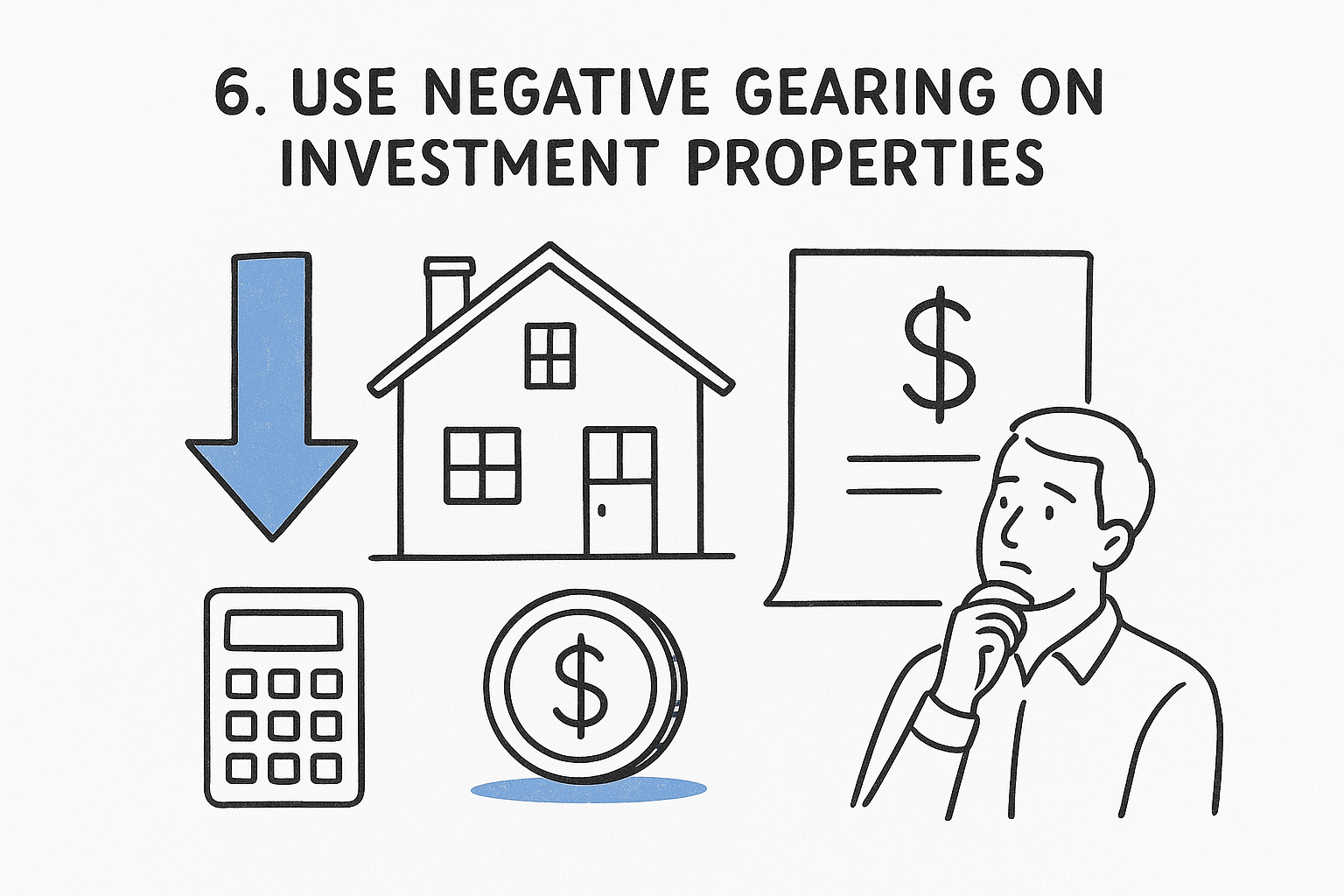
6. Use negative gearing on investment properties
Buying an investment property that costs you more to hold than it earns in rent sounds like a bad deal, until you factor in the tax outcome. Negative gearing lets you offset that shortfall against your other taxable income, which is why so many Melbourne investors use it alongside strategies like the depreciation schedules covered above. It’s not a loophole, it’s a deliberate feature of the tax system that rewards long-term property investment.
How it works
When your rental income doesn’t cover the loan interest, rates, insurance, and maintenance on a property, the shortfall becomes a deductible loss against your salary or business income. Combine that loss with depreciation and other investment property deductions on the building and fittings, and many investors reduce their taxable income substantially while still holding an appreciating asset.
A negatively geared property turns today’s shortfall into tomorrow’s tax deduction, provided the asset itself is doing the heavy lifting.
Who it suits
This strategy suits higher-income earners with the cash flow to absorb a shortfall, and investors focused on long-term capital growth rather than immediate rental yield. It doesn’t suit anyone relying on rental income to meet daily living costs, since the strategy assumes you can fund the gap from other earnings.
Key rules to keep in mind
- The loss only offsets other assessable income, it doesn’t generate a cash refund on its own.
- Interest is deductible only on the portion of the loan used to buy or improve the property.
- Selling later triggers capital gains tax, which the next strategy addresses directly.
- Keep every loan statement and expense receipt, as the ATO reviews rental deductions closely.
7. Time your capital gains and asset sales strategically
When you sell an asset for more than you paid, the profit gets added to your taxable income that year, so the timing of that sale matters just as much as the price you get for it. Minimising capital gains tax on a business sale is about controlling when a gain lands, not avoiding it altogether, and it’s one of the most overlooked ways to reduce your taxable income for business owners sitting on shares, property, or a business sale.
How it works
Holding an asset for more than 12 months before selling triggers the 50% CGT discount for individuals and trusts, halving the taxable portion of your gain straight away. Beyond that, you can push a sale into a lower-income year, spread a large gain across multiple financial years through an earn-out arrangement, or offset it against capital losses you’ve banked from other investments.
A capital gain taxed in the right financial year can cost you half as much as the same gain taxed in the wrong one.
Who it suits
Investors nearing retirement with a lighter income year ahead, business owners planning an exit, and anyone holding shares or property with an unrealised loss they could crystallise to offset a gain all benefit from this approach.
Key rules to keep in mind
- The 50% discount only applies to assets held over 12 months.
- Capital losses must offset gains before any discount is applied.
- Small business CGT concessions can reduce or eliminate tax on an active business sale.
- Settlement date, not contract date, generally determines the financial year for the gain.
8. Make tax-deductible charitable donations
Giving money away sounds like an odd way to reduce tax in Australia, but a well-timed donation genuinely lowers your taxable income while supporting a cause you care about. Charitable donations to a registered charity are one of the few deductions that cost you real money out of pocket, yet they still shrink the tax bill you’d otherwise pay on that same dollar.
How it works
Donations of $2 or more made to an organisation with deductible gift recipient (DGR) status are fully deductible in the year you make them, provided you don’t receive anything of material value in return, like raffle tickets or auction items. Business owners with a strong profit year sometimes bring forward planned giving into that financial year specifically to bring their taxable income down, then scale back in leaner years.
A donation to a DGR charity is one of the only deductions where the ATO and your conscience end up pointing the same direction.
Who it suits
This strategy suits business owners having an unusually profitable year, retirees drawing down super who want to support family causes tax-effectively, and anyone already planning to give who hasn’t checked whether their chosen charity qualifies.
Key rules to keep in mind
- Confirm DGR status on the ATO’s charity register before donating.
- Keep a receipt for every donation over $2.
- You can’t claim raffle tickets, membership fees, or items received in exchange.
- Large one-off gifts can sometimes be spread across up to five tax years.
9. Avoid the Medicare Levy Surcharge with private health cover
Higher-income earners without private hospital cover get hit with an extra tax most people don’t even realise exists. The Medicare Levy Surcharge adds between 1% and 1.5% on top of the standard 2% Medicare levy, and it applies purely because you’ve chosen not to hold appropriate cover, not because you’ve used the public system. Taking out a policy often costs less than the surcharge itself, making this one of the easiest strategies on this list to act on.
How it works
Once your income crosses the relevant threshold, the ATO calculates the surcharge automatically at tax time unless you’ve held private hospital cover for the full financial year. Compare your annual premium against the surcharge you’d otherwise pay before deciding, since for many earners the maths favours taking out cover.
Paying for private hospital cover often costs less than the tax the ATO charges you for going without it.
Who it suits
Singles earning above roughly $97,000 and families above roughly $194,000 (thresholds move slightly each year) should check their position, particularly anyone who’s had a recent pay rise or bonus push them over the line unexpectedly, the same earners who should check whether Division 293 tax now applies to their super contributions.
Key rules to keep in mind
- Cover must include hospital treatment, not just extras like dental or physio.
- Thresholds are indexed and published annually by the ATO.
- Excesses on your policy must sit under the government-set limit to count.
- Partial-year cover only reduces the surcharge proportionally, it doesn’t remove it entirely.
Putting these strategies into action
None of these nine strategies work in isolation, and none of them work if you leave the conversation until May. Superannuation caps, trust distributions, asset timing, and deduction claims all need decisions made while the financial year is still open, not after it closes. The real skill isn’t knowing that these options exist, it’s knowing which combination suits your income, your structure, and your goals this particular year.
That’s the gap between reading a list like this and actually reducing tax in Australia by a meaningful amount. Every business we work with has a different mix of trusts, super balances, property, and income timing, so the right plan looks different for everyone. If you want someone checking these levers against your actual numbers well before 30 June, talk to an accountant who does real tax planning at Gartly Advisory and get a plan built around your business, not a generic checklist.