

Downsizer Contribution Rules 2026: A Plain-English Guide for Australians
What if the family home you’ve lived in for a decade wasn’t just a place of memories, but a tax-effective A$300,000 boost to your retirement lifestyle? It’s no secret that the ATO’s rulebook can feel like a labyrinth of complex jargon, especially when you’re trying to figure out the downsizer contribution rules 2026 while managing a house sale. You want to make sure your hard-earned equity works for you, but the fear of missing that strict 90-day settlement deadline or accidentally triggering a reduction in your Age Pension is enough to keep anyone awake. We believe you deserve a partner who looks beyond the numbers to secure your journey towards success.
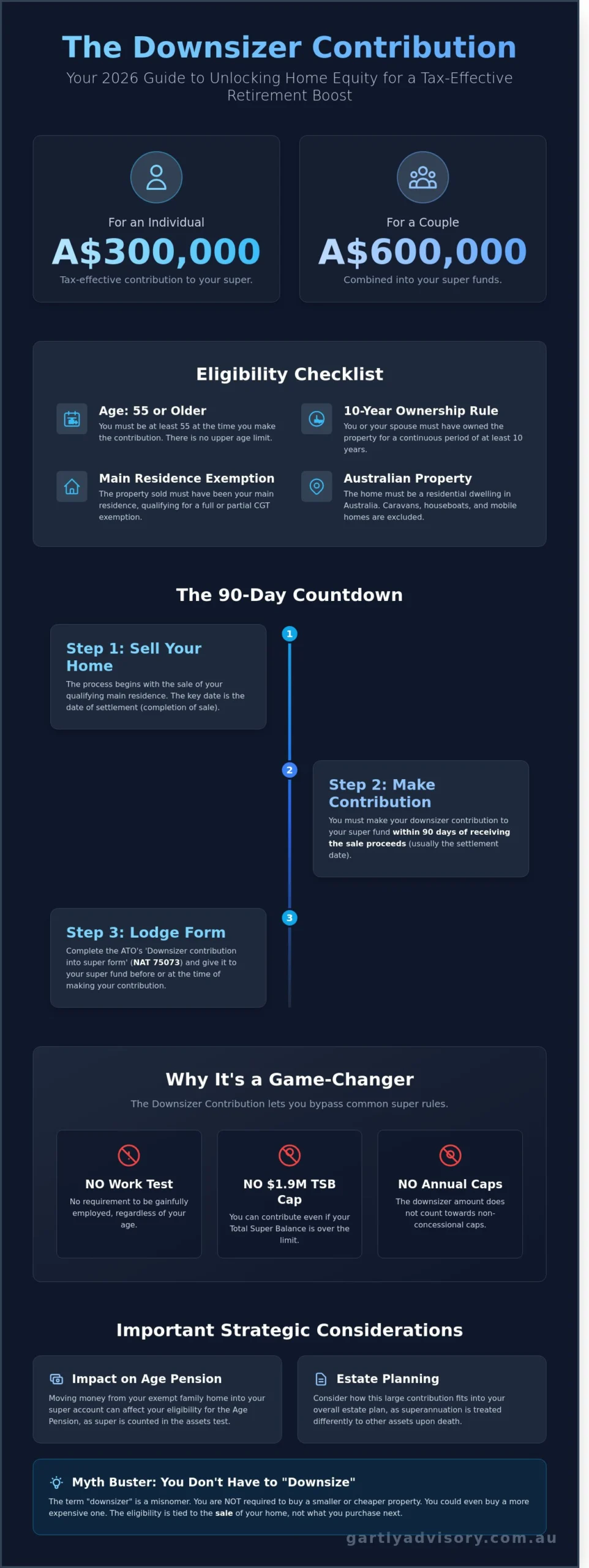
We’re here to clear the fog and show you how to unlock up to A$300,000 per person, or a massive A$600,000 for couples, using your home equity under the latest 2026 guidelines. You’ll gain the confidence to handle your settlement timeline without the stress of hidden traps. This guide breaks down exactly who is eligible, how the rules affect your pension, and why this strategy is a cornerstone for a comfortable Australian retirement.
Key Takeaways
- Learn how the drop in eligibility age to 55 allows you to contribute up to A$300,000 into your superannuation without being restricted by standard contribution caps.
- Master the latest downsizer contribution rules 2026 to ensure your property meets the 10-year ownership requirement and you lodge your paperwork within the strict 90-day settlement window.
- Discover the strategic “spouse advantage” that allows a couple to contribute a combined A$600,000, even if the family home is only registered in one person’s name.
- Get clear, step-by-step guidance on completing the ATO’s NAT 75073 form and managing the settlement countdown to ensure your contribution is processed smoothly.
- Understand the critical impact on your Age Pension and estate planning to ensure that moving equity from your home into super aligns with your long-term financial security.
What is the Downsizer Contribution and Why Does it Matter in 2026?
The downsizer contribution is a practical way for Australians to move up to A$300,000 into their superannuation after selling their family home. If you’re part of a couple, you can combine this to put A$600,000 into your fund. These funds don’t count toward your standard non-concessional caps, which is a massive win for those who’ve already maxed out their limits. Since the government lowered the eligibility age to 55 on 1 January 2023, the downsizer contribution rules 2026 have become a standard part of the early retirement toolkit for thousands of households.
You don’t actually have to move into a smaller house to use this rule. The Australian Taxation Office (ATO) cares about the sale of your primary residence, not the size of your next one. You could sell your home, buy a similar-sized property in a more affordable suburb, and use the leftover equity to fund your retirement. The primary requirement is that you’ve owned the home for at least 10 years. In 2026, this flexibility allows you to restructure your life without the pressure of downsizing in the literal sense.
The “Beyond the Numbers” Benefit for Your Retirement
We often talk about advice that goes beyond the numbers, and this contribution is a perfect example. It acts as a final catch-up for your retirement savings. Many people find themselves with plenty of equity but not enough liquid cash as they stop working. Selling the family home unlocks that value. By 2026, property owners in Victoria should look closely at their equity levels. With Melbourne’s median house price at roughly A$915,000 in early 2024, the potential to shift wealth into a tax-effective super environment is huge. It moves you away from a high-maintenance property toward a lifestyle-focused future.
The Difference Between Standard Contributions and Downsizer Rules
Standard super rules are often quite restrictive. Usually, you have to pass a work test if you’re older, or you’re blocked by the Total Super Balance (TSB) limit, which sits at A$1.9 million for the 2024-25 financial year. The downsizer contribution rules 2026 ignore these hurdles. Key advantages include:
- No requirement to meet the work test regardless of your age.
- Ability to contribute even if your Total Super Balance exceeds A$1.9 million.
- Exemption from the standard A$120,000 annual non-concessional contribution cap.
This creates a unique window to move a large sum into super that simply isn’t available through standard pathways. It allows you to take initiative and secure your financial future regardless of your previous contribution history.
Eligibility Checklist: Are You Ready to Downsize?
Before you start planning where the new furniture will go, you need to be certain you meet the Australian Taxation Office (ATO) criteria. The downsizer contribution rules 2026 are designed to be accessible, but they aren’t a free-for-all. To contribute up to A$300,000 per person into your superannuation, you must tick every box on the eligibility list. This isn’t just about moving to a smaller house; it’s about following a specific legislative pathway that rewards long-term homeowners.
- The Age Requirement: You’ve got to be 55 or older at the time you make the contribution. There’s no upper age limit, which is a significant advantage for those in their 70s or 80s who are only now deciding to move.
- Type of Property: The home must be a residential building located within Australia. Caravans, houseboats, and mobile homes are strictly excluded from these rules.
- The CGT Factor: The sale must be eligible for the Main Residence Exemption. This applies even if you only qualify for a partial exemption.
- The 10-Year Rule: You or your spouse must have owned the property for at least 10 years leading up to the sale.
Understanding the 10-Year Ownership Requirement
The ATO is very specific about how they count time. The 10-year clock starts from the date of the original settlement and stops on the date of the new settlement. If you lived in the home for five years and then rented it out for the next five, you still meet the decade-long ownership test. For those who have inherited a property, you can often count the time the deceased person owned the home toward your 10-year total. Transfers between spouses during a divorce also generally maintain the original ownership start date, so you don’t lose your progress toward that 10-year milestone just because the title changed names.
The Main Residence Exemption Explained
Living in the property as your primary home is the standard, but it isn’t always a black-and-white requirement. If you’ve used part of your house for a home business or rented out a spare room on a short-term basis, you can still qualify. As long as at least a partial Main Residence Exemption applies, you’re usually in the clear. Even for older family homes purchased before Capital Gains Tax (CGT) began on 20 September 1985, the rules remain supportive. If the property would have qualified for the exemption had it been bought later, it’s eligible for the scheme.
We find that many clients feel overwhelmed by these technicalities, but our team can provide the guidance needed to confirm your status before you sign a contract. Getting this right ensures you don’t miss out on the chance to boost your super balance using the downsizer contribution rules 2026. It’s about more than just a sale; it’s about securing your financial future through a trusted partnership with experts who understand the system.
The $600,000 Opportunity: Spouses and Strategic SMSF Use
Maximising your retirement savings often requires looking beyond individual limits. Under the downsizer contribution rules 2026, a couple can potentially move A$600,000 into the tax-effective superannuation environment in one go. This isn’t just for people who both appear on the house deed. Even if only one partner technically owns the home, both individuals can often contribute up to A$300,000 each from the sale proceeds. It’s a powerful way to shift equity from a non-performing asset into a fund that supports your lifestyle.
How Spouses Qualify Without Being Legal Owners
The Australian Taxation Office (ATO) provides a specific pathway for partners who aren’t legal owners. As long as your spouse owned the home for at least 10 years and it was your primary residence, you can likely participate. You’ll both need to meet the age requirement, which is currently 55 years or older. Consider a couple selling their family home in Melbourne for A$1.2 million. Even if the husband is the sole person on the title, the wife can still contribute A$300,000 into her own account while he contributes A$300,000 into his. This effectively doubles the amount of capital you’re moving into a low-tax environment, regardless of whose name was on the contract of sale.
Optimising Your SMSF with Downsizer Funds
If you manage your own retirement savings, you might be asking what is the Downsizer Contribution and how it interacts with your Self-Managed Super Fund (SMSF). These contributions don’t count towards your non-concessional caps, which is a huge win for those already at their limit. While some SMSF members prefer in-specie asset transfers, remember that downsizer contributions must be made in cash. You can’t simply transfer a portion of a property title; the home must be sold to an external party first.
You must also be mindful of the Transfer Balance Cap, currently set at A$1.9 million. While you can put the money into an accumulation account regardless of your total balance, the cap limits how much you can move into the tax-free pension phase. This is a “use it or lose it” chance for each individual. You only have 90 days from the date of settlement to get these funds into your SMSF. Missing this deadline means the opportunity is gone forever. Following the downsizer contribution rules 2026 strictly ensures you don’t fall foul of ATO compliance during this transition.
The 90-Day Countdown: How to Make the Contribution
Once you’ve sold your family home, the clock starts ticking immediately. Under the downsizer contribution rules 2026, you have a strict 90-day window to complete the entire process. This countdown begins on the day of settlement, which is the date the keys change hands and the money is paid, rather than the date you sign the contract. If your settlement occurs on 1 March, your funds must be cleared in your super account by 30 May. We’ve seen many clients feel rushed during this period, so preparation is key to staying calm and compliant.
Following a clear sequence helps ensure your contribution is accepted without a hitch. You should follow these three essential steps:
- Step 1: Complete the NAT 75073 form. This is the official ATO document titled ‘Downsizer contribution into super’. You must fill this out accurately to notify your fund of the nature of the deposit.
- Step 2: Submit the form to your fund. You need to provide this form to your superannuation provider either before or at the same time you make the payment.
- Step 3: Transfer the funds. Ensure the amount you transfer doesn’t exceed the total proceeds from your sale. If your home sells for A$280,000, your maximum contribution is capped at that sale price, even if the individual limit is A$300,000.
Common Pitfalls and the NAT 75073 Form
Your super fund needs to know exactly how to categorize your money. Without the NAT 75073 form, the fund might treat your deposit as a standard personal contribution. This error can lead to the contribution being rejected or triggering unnecessary tax because it counts toward your regular non-concessional caps. While roughly 98% of major Australian super funds are equipped to handle these payments, it’s a smart move to call your fund’s member services line to confirm their specific electronic transfer requirements first. Missing the 90-day deadline is the most common point of failure for Australians trying to boost their retirement savings.
What if You Need More Time? Extensions Explained
The ATO recognizes that life doesn’t always go according to plan. You might be granted an extension if you face circumstances beyond your control, such as a significant ill-health event or a complex legal dispute that delays the distribution of estate funds. You must apply for this extension through the ATO’s formal channels before the initial 90-day period expires. Be aware that the ATO is quite strict with their criteria. They have consistently ruled that simply forgetting the deadline or being unaware of the downsizer contribution rules 2026 is never a valid reason for an extension.
Beyond the Rules: Impact on Age Pension and Estate Planning
Selling the family home is a massive life event, but the financial ripple effects go far beyond the sale price. When you use the downsizer contribution rules 2026, you’re effectively moving wealth from an exempt asset into a countable one. This shift can change your financial profile in the eyes of Centrelink almost overnight. It’s a move that requires a steady hand and a clear strategy to ensure you don’t accidentally disadvantage your daily cash flow.
The Interaction with Centrelink Asset Tests
Your family home is a sanctuary, both personally and financially. For Age Pension purposes, the value of your principal place of residence is ignored. However, superannuation is a different story once you reach Age Pension age. When you deposit up to A$300,000 into your fund, that money suddenly becomes visible to the asset and income tests. For every A$1,000 you’re over the asset threshold, your pension could drop by A$3.00 per fortnight. You’ve got to weigh up whether the tax-free earnings inside super beat the loss of pension income. Since 1 January 2023, the government extended the asset test exemption for home sale proceeds from 12 to 24 months. This gives you a two-year breathing space to find your next home without your pension taking an immediate hit.
Estate Planning and Intergenerational Wealth
One of the biggest wins of a downsizer contribution is the tax benefit for your heirs. Most Australians don’t realize that adult children often pay 17% tax on the taxable portion of inherited super. Because downsizer contributions are non-concessional, they’re added to the tax-free component of your balance. This simple move can save your children tens of thousands of dollars in future taxes. If you’re managing your own fund, our SMSF Guide explains how to keep these components organized. It’s about building a legacy that isn’t eaten away by avoidable taxes. At Gartly Advisory, we’ve spent 25 years helping families protect their wealth through these exact transitions.
The journey towards success isn’t just about following the downsizer contribution rules 2026; it’s about making the rules work for your specific family goals. Geoff Gartly and our team of Chartered Accountants bring 35 years of experience to the table. We provide advice that goes beyond the numbers to ensure your transition is compliant and comfortable. We love the opportunity to support our clients through these complex shifts. Let us be your trusted partner as you move into this next chapter. Contact us now to schedule a consultation and ensure your downsizing move is a financial success.
Secure Your Retirement Strategy for 2026
Navigating the downsizer contribution rules 2026 requires more than just knowing the eligibility age is 55. You must act within 90 days of your property settlement to successfully inject up to $300,000 per person into your superannuation. For couples, this $600,000 opportunity can fundamentally shift your financial trajectory and retirement lifestyle. It’s about looking beyond the numbers to see how these rules impact your Age Pension and long term estate plans. Our team brings 35 years of strategic accounting experience to help you navigate these complexities with confidence. We aren’t just ticking boxes; we’re licensed SMSF advisors based in Melbourne who focus on proactive growth and genuine partnership. Don’t leave your retirement to chance when specific deadlines and strict ATO criteria apply. Your family’s financial security depends on making the right moves at the right time. We love the opportunity to support our clients through these major life transitions. Talk to our SMSF specialists in Ormond to plan your downsizer strategy today. Let us be your safe pair of hands on this journey toward a stable and rewarding future.
Frequently Asked Questions
Can I make a downsizer contribution if I buy a more expensive house?
You can certainly make a downsizer contribution even if your new home costs more than the one you sold. The Australian Taxation Office (ATO) doesn’t require you to actually move into a smaller or cheaper property to qualify for this scheme. The name is a bit of a misnomer; it’s really about the act of selling a long-held family home rather than the physical size or price of your next residence. As long as you meet the 10-year ownership requirement and the other eligibility criteria, you can put up to A$300,000 into your superannuation. This applies even if you decide to upgrade to a luxury penthouse or a more expensive coastal retreat. We’ve helped many clients navigate these downsizer contribution rules 2026 to ensure they maximize their retirement savings regardless of their next property’s price tag. You just need to ensure the contribution is made within 90 days of settlement to stay compliant with the current regulations. Professional guidance is always recommended to ensure your settlement dates align perfectly with these strict windows.
What happens if I sell my home and move into a retirement village?
Moving into a retirement village is a common path for our clients, and it generally qualifies you for the downsizer contribution. Whether you’re buying a strata title unit or entering a leasehold arrangement, the key factor is the sale of your previous principal place of residence. If that home was your
Related Posts