How to Lodge a Company Tax Return in Australia
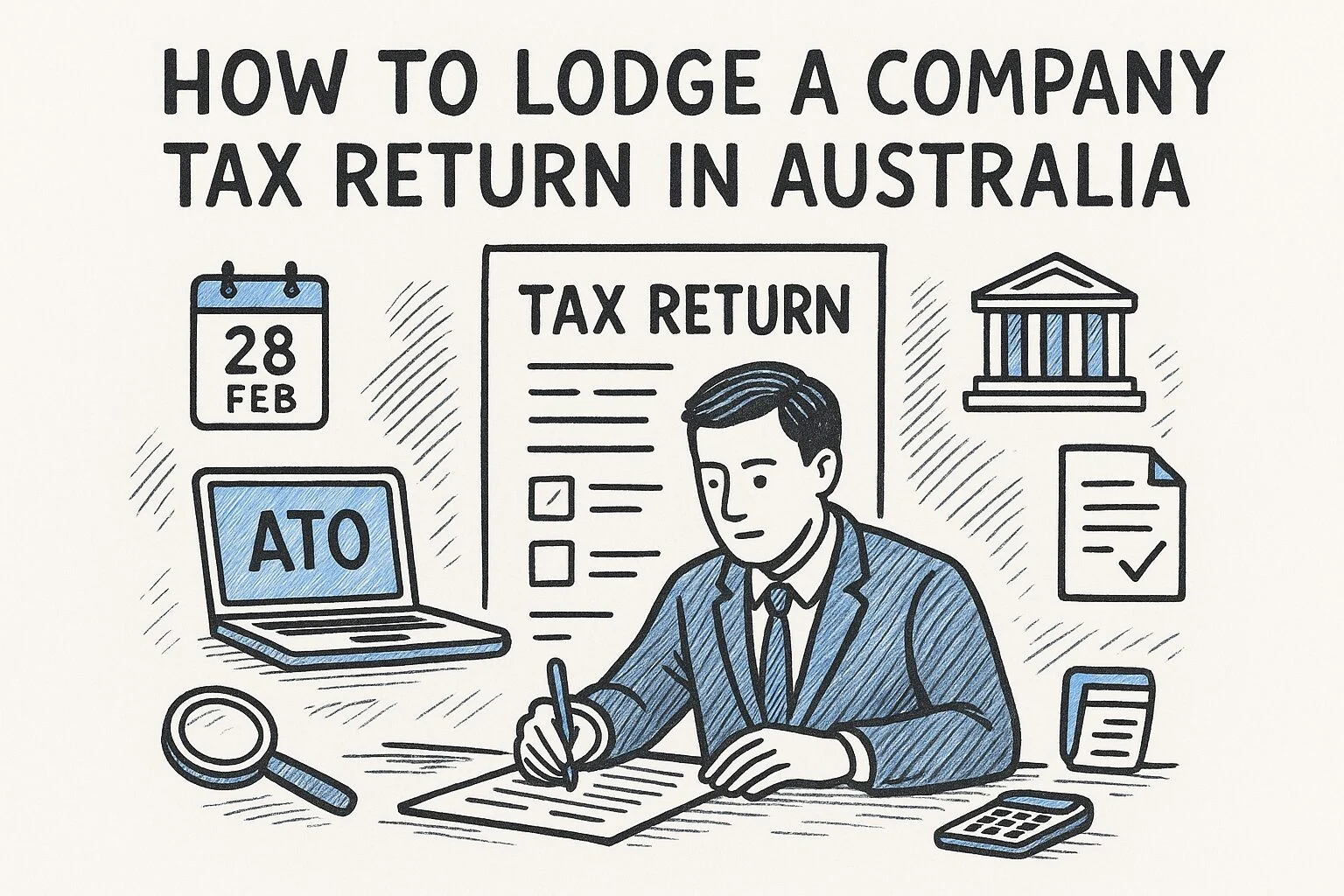
Every company registered with ASIC has to lodge a tax return each year, even if it made a loss or sat dormant. Working out how to lodge a company tax return for the first time trips up plenty of directors, especially when the ATO’s rules on deadlines, income tax rates, and reporting requirements seem to shift depending on your business structure and turnover.
The short answer is that you can lodge yourself through the ATO’s Online services for business, or hand it to a registered tax agent who can also extend your deadline well past the standard 28 February cutoff. Which path suits you depends on how complex your accounts are, how confident you feel with company tax obligations, and how much time you actually have to spare during tax season.
This guide walks through both options step by step, including what documents you need, how PAYG instalments factor in, and the key dates you cannot afford to miss. We will also flag where directors typically run into trouble, so you can decide whether self-lodging makes sense or whether it is time to bring in an accountant who deals with company returns every day.
What you need before you lodge your company tax return
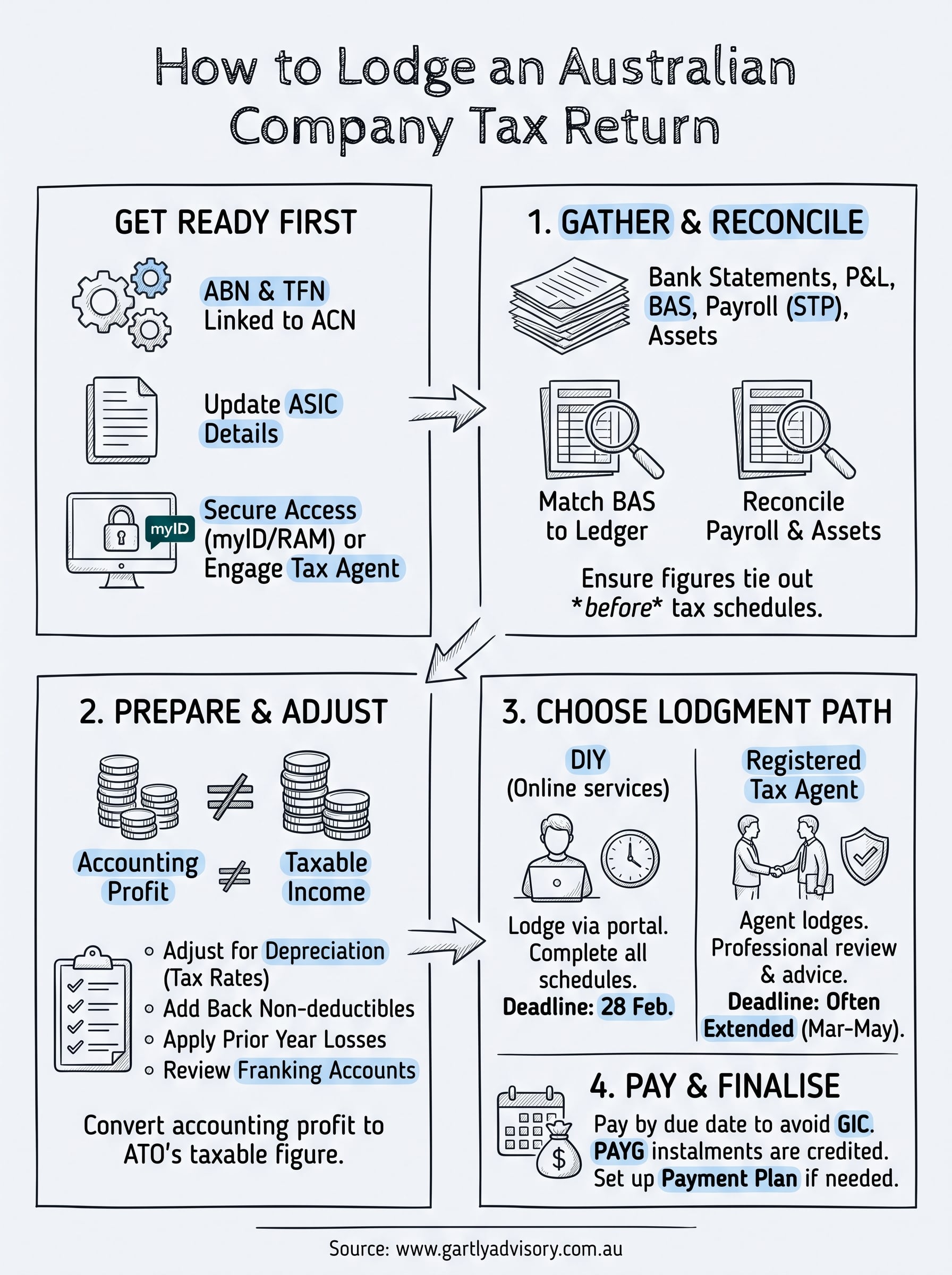
Before you touch the tax return itself, make sure your company’s registration details are current with both the ATO and ASIC. Your Australian Business Number (ABN) and Tax File Number (TFN) need to be active and correctly linked to your company’s Australian Company Number (ACN). If your registered address, associates, or share structure changed during the year, update the ASIC business register first, because mismatched details are one of the most common reasons a lodgment gets kicked back or delayed.
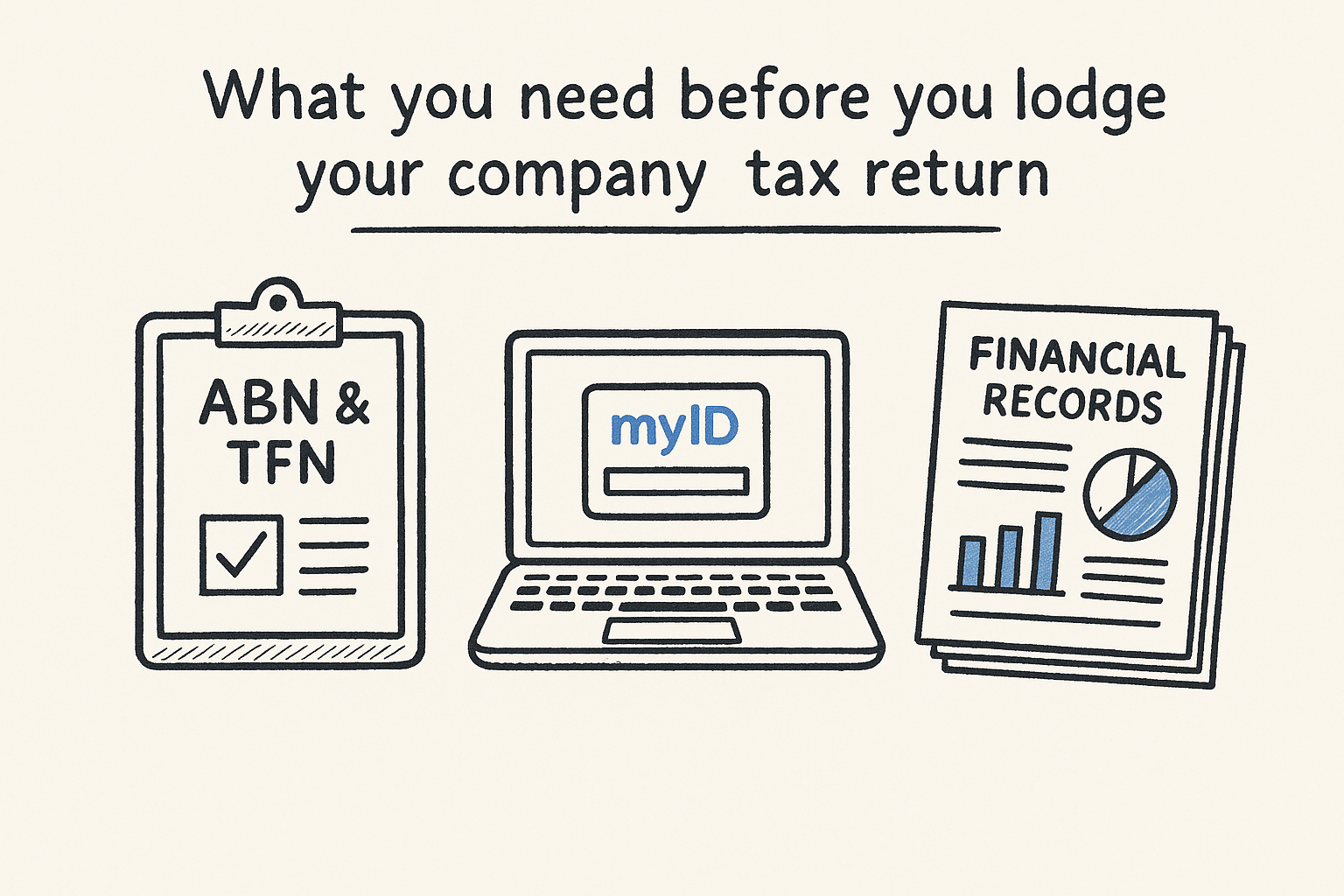
You can’t lodge a company tax return until your ABN and TFN are active and correctly matched to your company’s ACN.
Set up the right access before deadline week
Getting locked out of Online services for business the week before your return is due happens more often than you’d think, so sort this early. You’ll need a myID (formerly myGovID) linked through Relationship Authorisation Manager (RAM) as the authorised director, or you’ll need to have already engaged a registered tax agent who can lodge on your behalf through their own portal. If you’re setting this up for the first time, budget at least a few business days, since RAM verification can take time if your details don’t match ASIC’s records exactly.
Pull together your core financial documents
Once access is sorted, turn your attention to the paperwork itself. Reviewing what you’ll need before you start avoids the frustrating stop-start process of hunting for missing figures halfway through preparing the return. At minimum, you should have on hand:
- Full-year bank statements for every business account and loan facility
- Profit and loss statement and balance sheet for the financial year
- All BAS statements lodged during the year, for reconciliation against GST and PAYG withholding
- Payroll summaries and superannuation records, including any STP finalisation data
- Fixed asset register, showing purchases, disposals, and depreciation schedules
- Prior year’s tax return and notice of assessment, useful for carry-forward losses or franking credits
- Details of any dividends paid or received, plus franking account balances
- Loan and hire purchase statements for interest deductions
Gathering these documents early also gives you a realistic read on how complex your return will actually be. A dormant shelf company with no transactions needs almost none of this. A trading business with staff, stock, and finance facilities needs all of it, and probably a few hours with your bookkeeper before you go anywhere near the return itself.
Know your entity type and reporting obligations
Lastly, confirm which reporting category your company sits in, since this changes what schedules and disclosures you’re required to lodge alongside the main return. A base rate entity taxed at 25% has different thresholds to a company taxed at the standard 30% rate, and this depends on your aggregated turnover and the proportion of passive income you earn. Check the current thresholds directly on the ATO’s company tax rates page before you finalise anything, because these figures are reviewed and can shift between financial years. Getting this wrong doesn’t just mean an incorrect calculation, it can trigger an amendment request from the ATO further down the track.
Step 1. Gather and reconcile your financial records
With your documents on the desk, the real work starts: making sure every figure actually ties out before you touch a tax schedule. Reconciling your accounts means matching your bank statements, loan balances, and merchant facility statements against what’s recorded in your accounting software, line by line, for the full financial year. Skip this step and you risk lodging a return built on numbers that don’t reflect what actually happened in your business, which is exactly the kind of error that triggers an ATO review.
Match your BAS figures against your annual accounts
Start by lining up every BAS you lodged during the year against your general ledger. GST collected and paid, PAYG withholding, and any instalments should all agree with what’s sitting in your accounting file. Discrepancies here usually point to one of a few causes:
- Timing differences between when GST was reported and when the sale or purchase was recorded
- Coding errors, where transactions landed in the wrong account
- Missing invoices that never made it into a BAS period
- Bank fees or interest that got recorded but never reconciled against a statement
Sorting these out now, rather than after lodgment, saves you an amendment later.
A tax return built on unreconciled figures is a tax return you’ll probably have to fix twice.
Reconcile payroll, super, and fixed assets separately
Payroll needs its own check. Cross-reference your Single Touch Payroll (STP) finalisation data against your payroll summaries and superannuation contribution records, since the ATO already holds this information and will flag mismatches automatically. Superannuation guarantee payments need to have actually cleared into employees’ funds by the due date to be deductible in that financial year, not just accrued in your books, so check payment dates rather than just journal entries.
Your fixed asset register deserves the same scrutiny. Confirm every asset purchase, disposal, and depreciation entry during the year is captured, since this feeds directly into your depreciation schedule and any small business pool calculations. If your bookkeeper handles this monthly, a quick annual review is usually enough. If reconciliations have lagged, budget real time here, because unreconciled accounts are the single biggest reason company tax returns run late or get lodged with errors that need fixing months down the track.
Step 2. Prepare your financial statements and tax adjustments
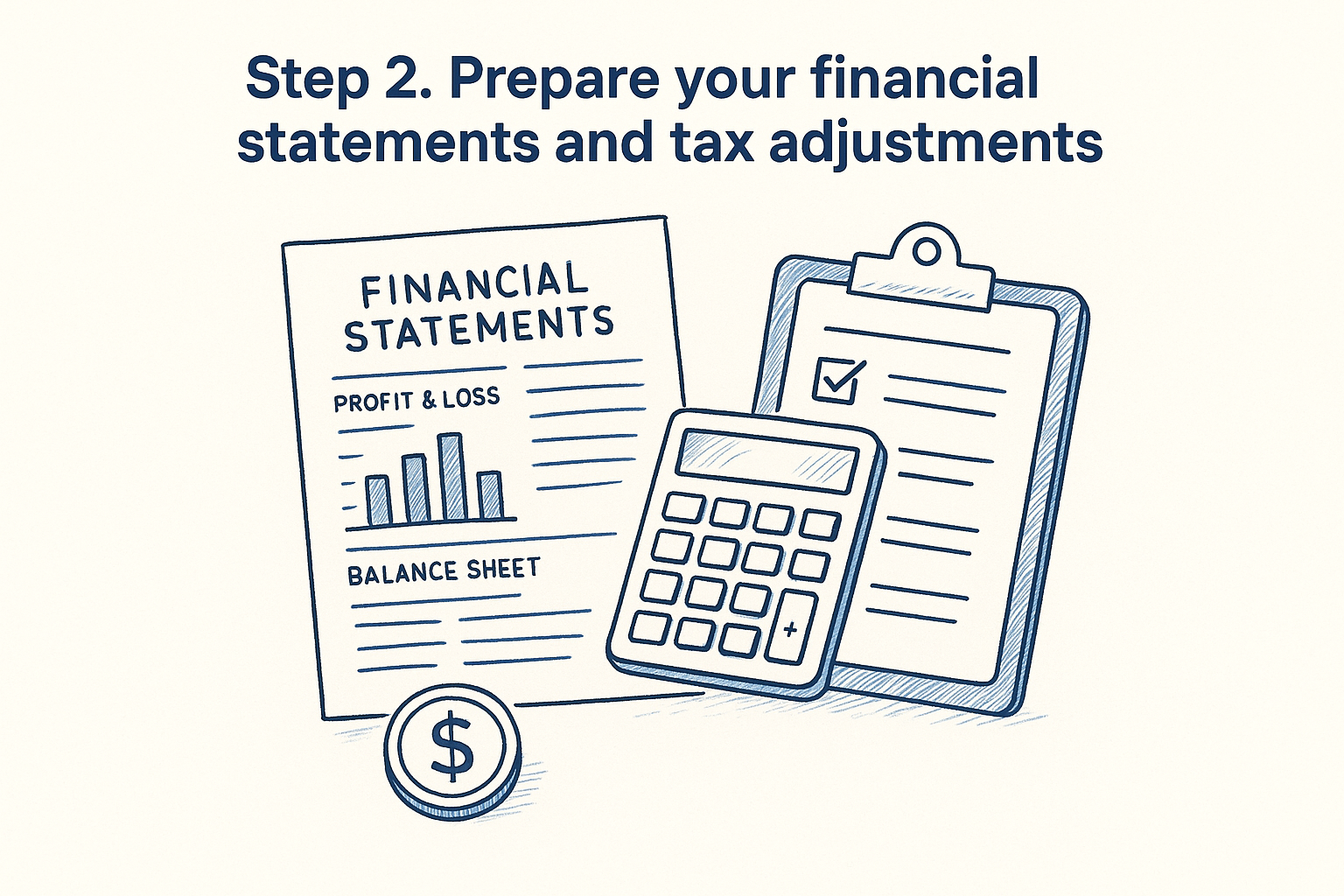
Once your figures reconcile, the next job is turning your bookkeeping records into proper financial statements. Your accounting software can spit out a profit and loss statement and balance sheet, but these need review before they’re tax-ready. Check that revenue is recognised in the right period, that stock on hand matches a physical count, and that any accruals or prepayments actually reflect what happened in the business during the year, not just what’s convenient to book.
Adjust accounting profit to taxable income
Here’s where a lot of first-time lodgers get tripped up: accounting profit and taxable income are not the same number, and the gap between them is where most of the technical work sits. You need to add back expenses that aren’t deductible for tax purposes and adjust for timing differences the tax law treats differently to standard accounting rules. Common adjustments include:
- Depreciation, using tax depreciation schedules rather than accounting depreciation rates
- Entertainment and non-deductible expenses, added back in full
- Prior year tax losses, applied against this year’s profit where continuity of ownership or business tests are met
- Bad debts, only deductible once genuinely written off, not merely provisioned
- Trading stock, adjusted for any change in valuation method between opening and closing stock
Accounting profit tells you how the business performed. Taxable income tells you what the ATO actually wants a cut of, and they’re rarely the same figure.
Check franking accounts and instalment credits
If your company paid dividends during the year, your franking account needs to be up to date before you calculate the tax payable, since franking credits attached to those dividends affect both your company’s position and your shareholders’ personal returns. Reconcile any PAYG instalments paid throughout the year against your instalment activity statements too, because these get credited against your final tax bill, and missing one means you’ll either overpay or face an unexpected shortfall.
This is also the point where it’s worth stepping back and asking whether your structure and adjustments actually make sense for the business you’re running. A caravan park, a franchise, and a trades business each carry different depreciation profiles, stock treatments, and deduction patterns, and getting these wrong doesn’t just cost you money, it can flag your return for closer attention down the track.
Step 3. Choose how to lodge and submit your return
With your figures adjusted and your financial statements finalised, you’ve got two realistic paths for actually getting the return in front of the ATO: lodge it yourself through Online services for business, or hand the whole package to a registered tax agent. Neither option is wrong, but they suit different businesses, and picking the right one depends on how comfortable you are with the tax schedules, not just how confident you feel filling in numbers.
Lodging it yourself through Online services for business
If you’re going the DIY route, you’ll complete the company tax return form directly through the ATO’s portal, using the myID and RAM access you set up earlier. The form pulls in prefilled data where available, like PAYG instalments and some payroll figures, but you’re still responsible for entering the profit and loss detail, reconciliation items, and any schedules that apply to your entity, such as the international dealings schedule or R&D tax incentive schedule if relevant.
Self-lodging works fine for simple, low-transaction companies, but the more schedules your return needs, the more room there is for a costly mistake.
Before you submit, run through this checklist:
- Every schedule required for your entity type is attached, not just the main form
- Franking account balance matches your dividend statements
- Losses carried forward are correctly disclosed with the relevant test applied
- Director details and ACN match ASIC’s current register
- Bank details for any refund are current and correctly entered
Engaging a registered tax agent
Handing your return to a registered tax agent shifts the lodgment through their agent portal instead, and this comes with a genuine practical advantage: agent-lodged returns typically get a later deadline than the standard 28 February cutoff, often into March or May depending on your prior-year lodgment history. An accountant who lodges company returns regularly will also spot adjustment issues, deduction opportunities, and structural problems your own review might miss, particularly if your business runs across multiple entities or has industry-specific quirks like a franchise or caravan park.
Before you commit either way, weigh up the trade-offs directly:
| Factor | Self-lodge | Registered tax agent |
|---|---|---|
| Deadline | 28 February standard | Often extended into March-May |
| Cost | No fee, your time only | Agent fee, but potential tax savings |
| Error risk | Higher for complex returns | Lower, reviewed by a professional |
| Ongoing advice | None | Strategic input beyond compliance |
Most directors running anything beyond a simple, low-turnover company find the agent fee pays for itself in time saved and errors avoided.
Step 4. Pay your tax and meet key deadlines
Lodging the return is only half the job. Once the ATO processes it, you’ll get a notice of assessment confirming exactly what your company owes, and that amount is due whether you self-lodged or went through an agent. Paying late attracts the general interest charge (GIC), which compounds daily, so treat the due date as fixed rather than a suggestion.
The ATO doesn’t care whether you’re waiting on a client payment. Interest accrues from the due date regardless.
Know your actual due date
Your deadline depends on how you lodge and your company’s prior compliance history, not just the calendar. Self-lodgers using Online services for business generally face the standard 28 February deadline for the year following the income year, while companies with a registered tax agent on record by 31 October often get an extended date, sometimes running into March or May. Check your specific date rather than assuming, because the ATO’s key lodgment dates page lists the exact schedule for each lodgment category.
Factor in PAYG instalments already paid
Before you panic at the assessment figure, remember that any PAYG instalments paid during the year get credited against your final bill. If your instalments were set too high relative to actual profit, you may be due a refund rather than facing a payment. If they were too low, budget for the shortfall now rather than waiting for the notice to land, since surprises here are avoidable with a mid-year check against your management accounts.
Set up a payment plan if you need one
If cash flow is tight, don’t ignore the bill and hope it resolves itself. Contact the ATO or your tax agent before the due date to arrange a payment plan, since setting one up proactively avoids escalated debt collection action and keeps the GIC calculation more manageable. A short checklist for this stage:
- Confirm your exact due date against the ATO’s lodgment schedule
- Reconcile PAYG instalments against the final assessed amount
- Set aside funds as soon as the assessment issues, not at the deadline
- Contact the ATO early if you can’t pay in full
Getting this stage right protects your company from unnecessary interest charges and keeps your compliance record clean for next year’s deadline.
Keeping your company’s tax affairs on track
Lodging a company tax return well comes down to preparation, not luck. Reconciled accounts, correctly adjusted taxable income, and a clear decision on who actually submits the return will keep you out of the ATO’s review queue and save you from scrambling near the deadline. Directors who treat this as a once-a-year scramble tend to repeat the same mistakes, while those who build reconciliation into their monthly routine find the actual lodgment almost boring by comparison.
None of this means you need to become a tax expert yourself. If your accounts are straightforward and you’re confident with the schedules, self-lodging through Online services for business is genuinely fine. But if your business runs across multiple entities, carries franking credits, or sits in a specialised industry like caravan parks or franchising, a second set of experienced eyes pays for itself many times over. Get in touch with Gartly Advisory to have your next company tax return handled properly, on time, and with the deadline extension a registered tax agent brings.