

Is an SMSF Right for Me? A 2026 Australian Self-Assessment Guide
The idea of a Self-Managed Super Fund (SMSF) is appealing-complete control over your retirement savings, greater investment choice, and tailored flexibility. But with this freedom comes a world of complex ATO rules, compliance risks, and the nagging question of whether it’s truly worth the time and effort. If you find yourself constantly wondering, ‘is an SMSF right for me?’, you’re asking the most important question on this journey. It’s a significant financial decision, and the fear of making a costly mistake can be overwhelming.
That’s why we’ve designed this 2026 Australian Self-Assessment Guide to act as your trusted partner in finding that answer. Our goal is to provide a clear, straightforward framework that helps you honestly evaluate if the control of an SMSF aligns with your financial situation, expertise, and long-term goals. We’re here to cut through the jargon and provide the support you need to move from uncertainty to clarity.
By following this guide, you’ll gain the confidence to understand the core responsibilities and risks involved. You’ll finish with a clear ‘yes’ or ‘no’ for your specific circumstances and a practical roadmap for your next steps, empowering you to make the best decision for your future.
Key Takeaways
- Understand the critical shift in responsibility from being a passive fund member to an active trustee managing your own retirement savings.
- Use our SMSF Suitability Scorecard to objectively assess your financial position, time availability, and investment knowledge before making a decision.
- Receive a balanced, Australia-specific breakdown of the real pros and cons to help you confidently answer the question: is an SMSF right for me?
- Learn how to manage your legal duties effectively by building a professional support team, turning compliance from a burden into a structured process.
What is an SMSF? Understanding Your Role as Trustee
A Self-Managed Super Fund (SMSF) is a private superannuation fund that you and up to five other members manage yourselves. It’s a structure designed for those who want to take a hands-on approach to their retirement savings. This represents a fundamental shift from being a passive member in a large industry or retail fund, which are regulated by the Australian Prudential Regulation Authority (APRA). When you start an SMSF, you become a trustee. This means you are personally responsible for all investment decisions, administrative tasks, and ensuring the fund adheres to Australia’s complex superannuation laws.
To help you better understand this shift in responsibility, the following video provides a clear overview:
The Appeal of Control and Flexibility
For many Australians asking, “is an SMSF right for me?”, the primary motivation is gaining direct control and unparalleled flexibility. This hands-on approach appeals to those who are confident in their financial literacy and want to build a portfolio that precisely matches their risk appetite and long-term goals. An SMSF unlocks a much wider universe of investment choices, including assets that are often unavailable in mainstream funds. These can include:
- Direct residential or commercial property
- Unlisted shares in private companies or start-ups
- Collectibles like artwork and precious metals (subject to strict rules)
- Direct term deposits and bonds
Beyond investments, this structure also allows for more sophisticated and tailored tax and estate planning strategies, giving you greater command over how your wealth is managed and ultimately passed on to your beneficiaries.
The Reality of Responsibility
This enhanced freedom is balanced by significant and legally binding responsibilities. Your SMSF is governed by a trust deed-its formal rulebook-and every action must comply with superannuation law. Critically, all decisions must satisfy the ‘sole purpose test’, meaning the fund must be maintained exclusively to provide retirement benefits. While an SMSF offers unique flexibility, it operates within the same legislative framework that governs all Superannuation in Australia. The key difference is that the Australian Taxation Office (ATO) is the regulator, and it holds you directly accountable for compliance. This involves lodging an annual return, arranging an independent audit each year, and keeping meticulous records. The penalties for getting it wrong can be severe, so understanding this balance is the critical first step in determining if an SMSF is the right path for you.
The SMSF Suitability Scorecard: Are You the Right Candidate?
Deciding to start a Self-Managed Super Fund is a significant financial step, one that puts you in direct control of your retirement savings. But with great control comes great responsibility. To help you honestly answer the question, “is an SMSF right for me?“, we’ve created this simple scorecard. This isn’t a test with a pass or fail grade; rather, it’s a tool for reflection, designed to provide clarity and help you make a confident, well-informed decision. As your trusted partner, our goal is to provide the guidance you need to succeed.
Your Financial Position: The Super Balance Question
One of the first practical considerations is your superannuation balance. While there’s no legally mandated minimum, the general industry consensus in Australia suggests a starting balance of at least $250,000, with many advisors recommending closer to $500,000 to make it truly cost-effective. The reason is simple: SMSFs have fixed annual costs for administration, accounting, and auditing. On a smaller balance, these fees can represent a significant percentage of your fund, potentially eroding your returns. As your fund grows, these fixed costs become a much smaller proportion, often making an SMSF a more economical choice than traditional super funds.
Your Time & Knowledge: The Hands-On Requirement
An SMSF is not a “set and forget” investment. It requires your active involvement. Before you proceed, ask yourself:
- Do I have the time-likely several hours per month-to dedicate to research, administration, and managing investments?
- Do I have a genuine interest in finance and a willingness to learn about investment strategies, compliance, and legislative changes?
You don’t need to be a financial expert, but you must be engaged. The ultimate responsibility for the fund’s decisions rests with you as the trustee. The government’s own guide asks Is an SMSF right for you? and clearly outlines these duties. Being proactive and committed to ongoing education is essential for navigating the complexities and seizing the opportunities an SMSF provides.
Section 3: Exploring the Unique Advantages of an SMSF
While the control and flexibility of a Self-Managed Super Fund are appealing, the decision isn’t just about managing your own share portfolio. To truly answer the question, is an SMSF right for me, it’s crucial to consider whether you have specific financial objectives that standard super funds simply cannot accommodate. Let’s explore three powerful scenarios where an SMSF provides unique and valuable opportunities that might align with your personal and business goals.
Do you want to buy your business premises with your super?
For many Australian business owners, this is a game-changing strategy. An SMSF can, under strict rules, borrow to purchase a commercial property, which can then be leased back to your own business. This arrangement, known as holding ‘business real property’, provides immense benefits. Your business gains security of tenure by having its own fund as a landlord, and the rent it pays contributes directly to your retirement savings in a tax-effective environment. It’s a powerful way to build a significant asset for your future while simultaneously securing and supporting your business operations today.
Do you want to invest in specific asset classes?
Are you interested in investments beyond the typical shares and bonds offered by large funds? An SMSF gives you the freedom to invest directly in a much broader range of assets. This control allows you to build a portfolio that truly reflects your investment knowledge and strategy. Common examples include:
- Direct residential or commercial investment property
- Unlisted shares or interests in private companies
- Physical gold and other precious metals
- Collectibles like art or antiques (subject to very strict regulations)
This investment freedom is a major drawcard, but it comes with significant legal duties. The Australian government’s Moneysmart website provides essential guidance on the responsibilities you must uphold as a trustee when making investment decisions.
Are you looking for more sophisticated estate planning options?
An SMSF offers a level of control over your legacy that is often unmatched by retail or industry funds. You can implement highly specific and binding instructions for how your superannuation benefits are distributed after you pass away. This includes using non-lapsing Binding Death Benefit Nominations (BDBNs) to provide absolute certainty for your beneficiaries, or establishing structures to pay your super as a pension to a dependent. This strategic planning ensures your wealth is managed and transferred exactly as you intend, providing peace of mind for your family’s future.
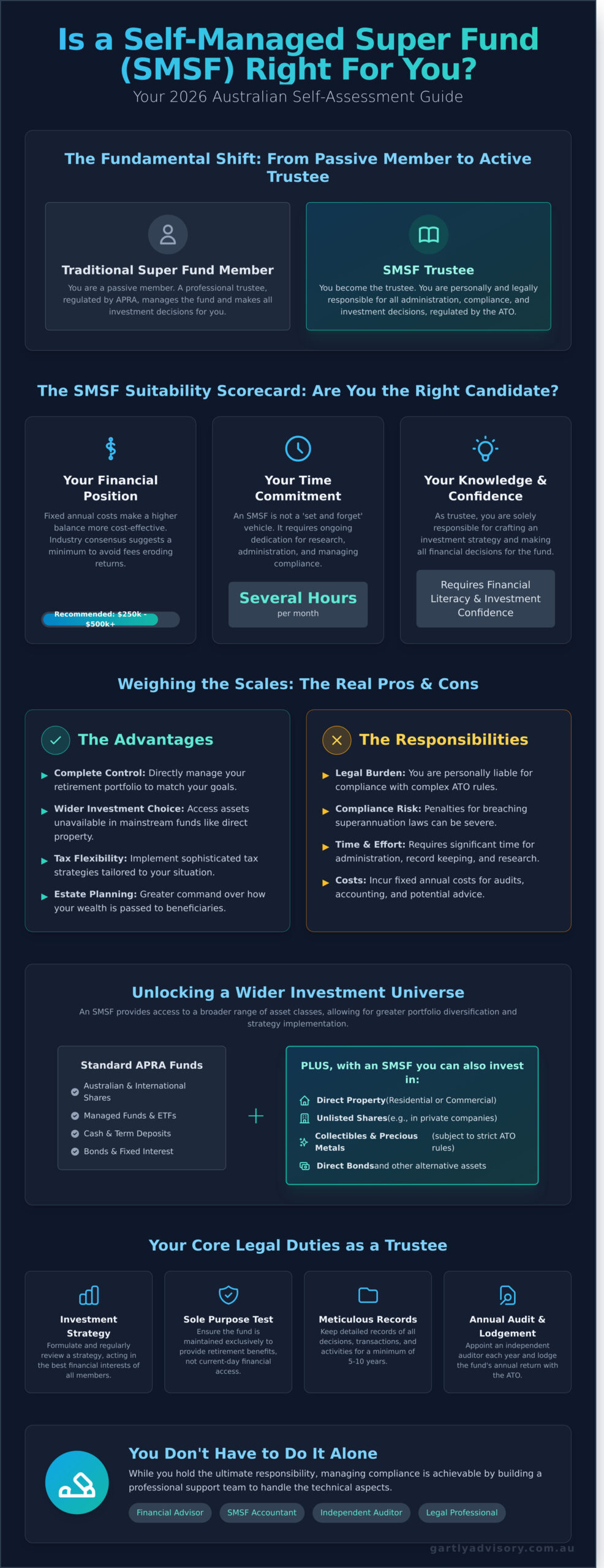
Weighing the Scales: The Real Pros and Cons of an SMSF
Deciding if a Self-Managed Super Fund is the right path requires a clear-eyed look at both its powerful advantages and its significant responsibilities. To truly answer the question, is an SMSF right for me?, you must move beyond generic lists and understand how these factors could impact your financial future. It’s a balance of unparalleled control against direct accountability.
As your trusted partner, we believe in providing a transparent view to help you make an informed decision.
Key Advantages for Savvy Investors & Business Owners
For those with the right circumstances and financial acumen, the strategic benefits can be immense:
- Investment in Business Real Property: For business owners, this is a game-changer. Your SMSF can purchase your commercial premises, and your business then pays market-rate rent directly to your super fund. This strategy builds your retirement wealth while securing your business’s location and turning a major business expense into a personal investment.
- Unmatched Tax Flexibility: You gain direct control over your tax outcomes. For instance, you can strategically time the sale of assets to minimise Capital Gains Tax (CGT). Once you retire and move your fund into the pension phase, investment earnings and capital gains on assets supporting the pension are generally tax-free.
- Cost Efficiency at Scale: While setup costs exist, an SMSF with a substantial balance (typically over $500,000) can be more cost-effective. The fixed annual administration and audit fees can represent a smaller percentage of your total assets compared to the asset-based fees common in many retail and industry funds.
- Tailored Estate Planning: An SMSF offers superior flexibility for your legacy. You can implement specific strategies like non-lapsing Binding Death Benefit Nominations, ensuring your assets are distributed precisely according to your wishes and providing certainty for your loved ones.
Significant Risks and Drawbacks to Consider
With great control comes great responsibility. These are critical factors you cannot afford to overlook:
- The Compliance Burden: As a trustee, the buck stops with you. You are personally liable for the fund’s compliance with complex superannuation and tax laws. The administrative workload is significant, and any breaches, even accidental ones, can attract hefty penalties from the ATO.
- Lack of Diversification: The temptation to put all your eggs in one basket, such as a single investment property, is a major risk. A downturn in that one asset class could severely impact your entire retirement savings, a risk mitigated in large, professionally diversified funds.
- No Statutory Compensation: SMSFs are regulated by the ATO, not APRA. This means they are not covered by the government’s compensation scheme that protects members of public funds in the event of theft or fraud. The security of your nest egg is your sole responsibility.
- Loss of Automatic Insurance: Most large funds provide default Life and Total & Permanent Disability (TPD) insurance at competitive group rates. With an SMSF, you must proactively source, assess, and fund your own insurance policies, which can be more complex and costly.
Your Legal Duties: A Plain-English Guide to Trustee Responsibilities
The thought of legal duties and compliance can often be the biggest hurdle for people asking, “is an SMSF right for me?” It’s easy to feel overwhelmed by the rules. However, we encourage you to think of these responsibilities not as a burden, but as the core activities of running your own highly effective, personalised investment fund. These are the foundations of good governance that protect your retirement savings.
With a clear understanding and the right professional support, these duties are entirely manageable. They are the practical steps you take to ensure your fund is successful and operates within the law, giving you ultimate peace of mind.
Crafting and Following an Investment Strategy
The Australian Taxation Office (ATO) requires every SMSF to have a written investment strategy. This isn’t just a formality; it’s the strategic blueprint for every decision you make. This document must be regularly reviewed and must clearly articulate how you plan to build and protect your retirement assets. Your strategy must be tailored to your fund’s specific circumstances and consider:
- Risk and Return: Balancing the potential for growth with the level of risk you are comfortable with.
- Diversification: Spreading your investments across different asset classes (like shares, property, and cash) to manage risk.
- Liquidity: Ensuring you have enough cash available to pay fund expenses and any member benefits as they fall due.
- Insurance Needs: Considering whether to hold life and/or Total & Permanent Disability (TPD) insurance for members.
Every investment you make must align with this written strategy. It’s your guidepost for making sound, legally compliant financial decisions.
Record-Keeping, Audits, and Reporting
Just like any well-run business, an SMSF requires diligent administration. This is a non-negotiable part of your role as a trustee. The core administrative tasks ensure transparency and prove to the ATO that your fund is being managed correctly. Your key responsibilities include:
- Meticulous Record-Keeping: You must keep accurate and accessible records of all transactions, investment decisions, meeting minutes, and member contributions for at least five to ten years, depending on the document.
- Annual Independent Audit: Each year, your fund’s financial statements and compliance with super laws must be audited by an approved SMSF auditor. This is a crucial check-up to ensure everything is in order.
- Lodge Annual Return: You must lodge an SMSF annual return (SAR) with the ATO, which reports on your fund’s tax and regulatory information.
While this sounds like a lot, it becomes a simple, repeatable process with the right systems in place. Knowing these duties are being handled correctly is a key part of determining if an SMSF is right for you. You don’t have to navigate this complex world alone; let us be your trusted partner to provide the guidance and support you need to meet your obligations with confidence.
Building Your SMSF Support Team: You Don’t Have to Do It Alone
Taking on the role of an SMSF trustee comes with significant responsibilities, but it’s a journey you don’t have to navigate by yourself. The most successful trustees understand that delegating complex tasks to qualified professionals is not an expense, but a crucial investment in their fund’s compliance, security, and long-term success. Building a strong support team provides peace of mind and frees you to focus on the big picture.
As you finalise your decision on is an SMSF right for me, understanding the professional support available can make the prospect feel far more manageable. Let’s explore the key experts who will become your trusted partners.
The Role of an SMSF Accountant & Advisor
Your specialist SMSF accountant is the cornerstone of your support team. They are your guide through the intricate world of superannuation law and ATO regulations. At Gartly Advisory Pty Ltd, we act as your trusted partner, providing comprehensive support that goes beyond the numbers. Our role typically includes:
- Setup and Establishment: Ensuring your fund is structured correctly from day one.
- Ongoing Administration: Handling the complex paperwork and record-keeping required by law.
- Compliance and Strategy: Providing proactive guidance to ensure your fund remains compliant and aligned with your financial goals.
- Annual Reporting: Preparing the fund’s financial statements and the annual SMSF tax return, ready for the mandatory audit.
We provide the stability and expertise needed to manage your fund with confidence.
Finding Other Key Professionals
While your accountant is central, two other professionals are vital to your fund’s integrity. An independent SMSF auditor is a legal requirement in Australia. Their job is to review the financial statements and compliance records prepared by your accountant each year to ensure your fund has followed the rules. You will also likely need a lawyer to establish or update your fund’s trust deed, and a licensed financial planner to provide specific advice on investment products and strategy.
Navigating these responsibilities is a significant undertaking. Having the right team makes all the difference. If you’re ready to take the next step with expert guidance, we’re here to help.
Schedule a complimentary consultation to see if an SMSF is your next step.
Your Next Step: Making the Right SMSF Decision with Confidence
Deciding to establish a Self-Managed Super Fund is one of the most significant financial steps you can take. It’s a journey that offers unparalleled control over your retirement savings but also demands a clear understanding of your extensive legal duties as a trustee. Ultimately, the answer to the question, is an SMSF right for me, is deeply personal and depends entirely on your unique circumstances and financial goals.
You don’t have to find that answer in isolation. Navigating the complexities of SMSF setup and compliance is where expert guidance becomes invaluable. As Chartered Accountants and Licensed SMSF Advisors with over 35 years of experience, we provide the clarity and support you need to make an informed choice. Our commitment to being a trusted partner is reflected in our 70+ 5-Star Google Reviews.
Let us be your trusted partner on your SMSF journey. Contact us for a complimentary consultation.
Frequently Asked Questions About Self-Managed Super Funds
What is the minimum amount of super I need to start an SMSF in Australia?
While there is no legally mandated minimum balance to establish a Self-Managed Super Fund in Australia, it is a critical question of financial viability. The Australian Securities and Investments Commission (ASIC) has previously suggested that a balance of A$500,000 is often required for an SMSF to be cost-effective when compared to mainstream APRA-regulated funds. This figure is not a strict rule but a guideline based on the impact of fixed running costs on your overall investment returns. For example, annual administration and audit fees of A$3,000 represent a significant 3% drag on a A$100,000 fund, but only a 0.6% impact on a A$500,000 fund.
Ultimately, the decision depends on your individual circumstances, investment strategy, and long-term goals. If you have a clear plan to grow your super balance rapidly or intend to pool assets with other family members, starting with a lower balance might be justifiable. However, it is essential to conduct a thorough cost-benefit analysis. We can provide trusted guidance to help you assess your financial position and determine whether the control and flexibility of an SMSF align with your retirement objectives, ensuring you make a decision that supports your journey towards success.
Can I use my SMSF to buy an investment property to live in?
This is a common question, and the answer from the Australian Taxation Office (ATO) is an unequivocal no. You are strictly prohibited from purchasing a residential property within your SMSF for yourself, a family member, or any other related party to live in. This is because all SMSF investments must satisfy the ‘sole purpose test’, which dictates that the fund must be maintained for the sole purpose of providing retirement benefits to its members. Using a fund asset for personal enjoyment or benefit directly contravenes this core regulatory requirement.
Breaching this rule can lead to severe penalties, including substantial fines and potentially having your fund declared non-complying, which could result in a tax penalty of 45% on the fund’s assets. You can, however, use your SMSF to purchase a residential property as a legitimate investment, provided it is rented out to an unrelated third party at a commercial market rate. Navigating the complex rules around property investment in an SMSF, including Limited Recourse Borrowing Arrangements (LRBAs), requires expert advice to ensure you remain fully compliant at all times.
How much does it cost to set up and run an SMSF each year?
Understanding the financial commitment is a vital step in deciding if an SMSF is the right path for you. The costs can be separated into two main categories: initial setup costs and ongoing annual costs. The initial setup fee typically ranges from A$700 to A$2,500. This one-off expense covers the establishment of the fund’s trust deed, registering a corporate trustee if you choose that structure, and obtaining an Australian Business Number (ABN) and Tax File Number (TFN) for the fund.
Ongoing annual costs are more variable and generally fall between A$2,000 and A$5,000, though they can be higher for funds with very complex investments. These recurring expenses include the annual administration fee for preparing financial statements and the SMSF tax return, the mandatory independent audit fee, the ATO’s supervisory levy (currently A$259 per year), and potentially fees for investment advice or insurance premiums. The total cost depends heavily on the complexity of your investments and the level of professional support you require. We believe in transparency and can help you project these costs accurately to ensure there are no surprises.
What happens if I make a mistake and breach the SMSF rules?
As the trustee of your own super fund, you are personally responsible for ensuring it complies with all superannuation laws. The consequences of making a mistake can be significant, and the ATO takes non-compliance very seriously. If a breach occurs, the ATO has a range of enforcement actions it can take, depending on the severity of the contravention. These can include issuing a direction for you to rectify the mistake, requiring you to undertake specific education, or imposing administrative penalties. These financial penalties can be substantial and are payable by you personally, not from the fund’s assets.
In more serious cases, the ATO can disqualify you from acting as a trustee, effectively forcing you to wind up your SMSF. The most severe penalty is to declare the fund ‘non-complying’. This results in the fund’s accumulated assets being taxed at the highest marginal rate of 45%, which can have a devastating impact on your retirement savings. This highlights the critical importance of having a trusted partner to provide proactive guidance. Our role is to support you in navigating these complex rules, helping you avoid mistakes and protect the wealth you have worked hard to build.
Can I have my family members in the same SMSF as me?
Yes, one of the distinct features of an SMSF is the ability to have family members join you in the same fund. An SMSF can now have up to six members, and all members must also be individual trustees of the fund (or directors of the corporate trustee). This structure allows families to pool their superannuation assets, which can be a powerful strategy. By combining balances, you may be able to access larger investment opportunities, such as purchasing a commercial property to lease to a family business, and potentially reduce the per-member administration costs.
However, running a multi-member family fund requires careful consideration beyond the numbers. You must ensure all members agree on a shared investment strategy and have similar risk tolerances and retirement timelines. It is also crucial to have a clear and robust trust deed that outlines what happens in challenging situations, such as a divorce, a family dispute, or the death of a member. Deciding if an SMSF is right for me and my family involves weighing the benefits of a pooled strategy against these potential complexities. Professional advice is essential to establish the right governance from the outset.
Is my money safe in an SMSF?
In an SMSF, the safety and security of your retirement savings rest squarely on your shoulders as the trustee. Unlike large public super funds regulated by APRA, SMSFs are not covered by the government’s statutory compensation scheme, which offers protection in the event of theft or fraud. This means that if your fund suffers a loss due to a poor investment decision or a scam, there is no external safety net to fall back on. This responsibility is a central part of assessing if an SMSF is right for me and requires an honest evaluation of your financial literacy and diligence.
However, you have significant control to protect your assets. Safety in an SMSF comes from establishing and adhering to a well-diversified investment strategy that aligns with your risk tolerance, conducting thorough due diligence on all investments, and maintaining robust security practices to protect against fraud. Using a corporate trustee structure can also add a layer of asset protection by separating the fund’s assets from your personal assets. With the right professional support and a commitment to your trustee duties, an SMSF can be a very secure vehicle for growing your retirement wealth.
How do I wind up an SMSF if it’s no longer right for me?
Winding up an SMSF is a formal legal process that must be completed correctly to ensure you meet all your obligations to the ATO and your fund members. This process is often necessary when the fund is no longer cost-effective, members wish to move to a retail or industry fund, or following a significant life event like a divorce or death. The first step is to ensure all the fund’s compliance requirements, such as lodging annual returns and completing audits, are completely up to date. You must then deal with all remaining assets in the fund.
This typically involves selling the assets and rolling over the resulting cash proceeds to another complying super fund, or in some cases, transferring the assets directly (known as an ‘in-specie’ transfer). Once all assets are gone and any final liabilities are paid, a final audit must be completed and the last SMSF annual return lodged with the ATO. You must then formally notify the ATO within 28 days that you have wound up the fund and, finally, close the fund’s bank account. Engaging a professional advisor can provide invaluable support, ensuring this final stage of your SMSF journey is managed smoothly and compliantly.
Related Posts