Capital Gains Tax Australia: What It Is and How It Works
Sold an investment property, shares, or a chunk of your business this year? You’re probably about to find out what capital gains tax Australia rules actually mean for your tax bill. It catches out plenty of business owners and investors who assume it’s a separate tax altogether, only to discover it’s folded straight into their income tax return and can push them into a higher bracket without warning.
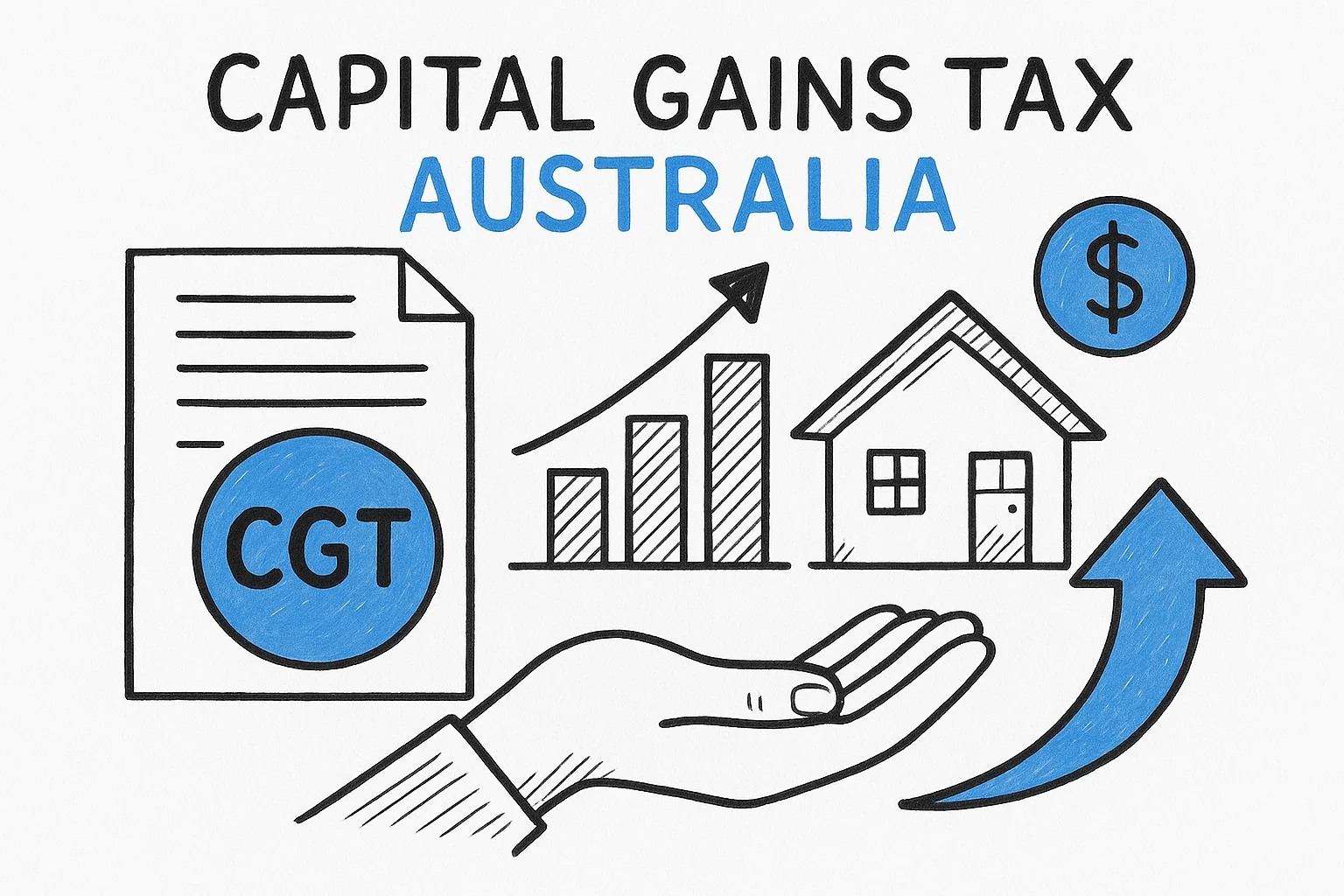
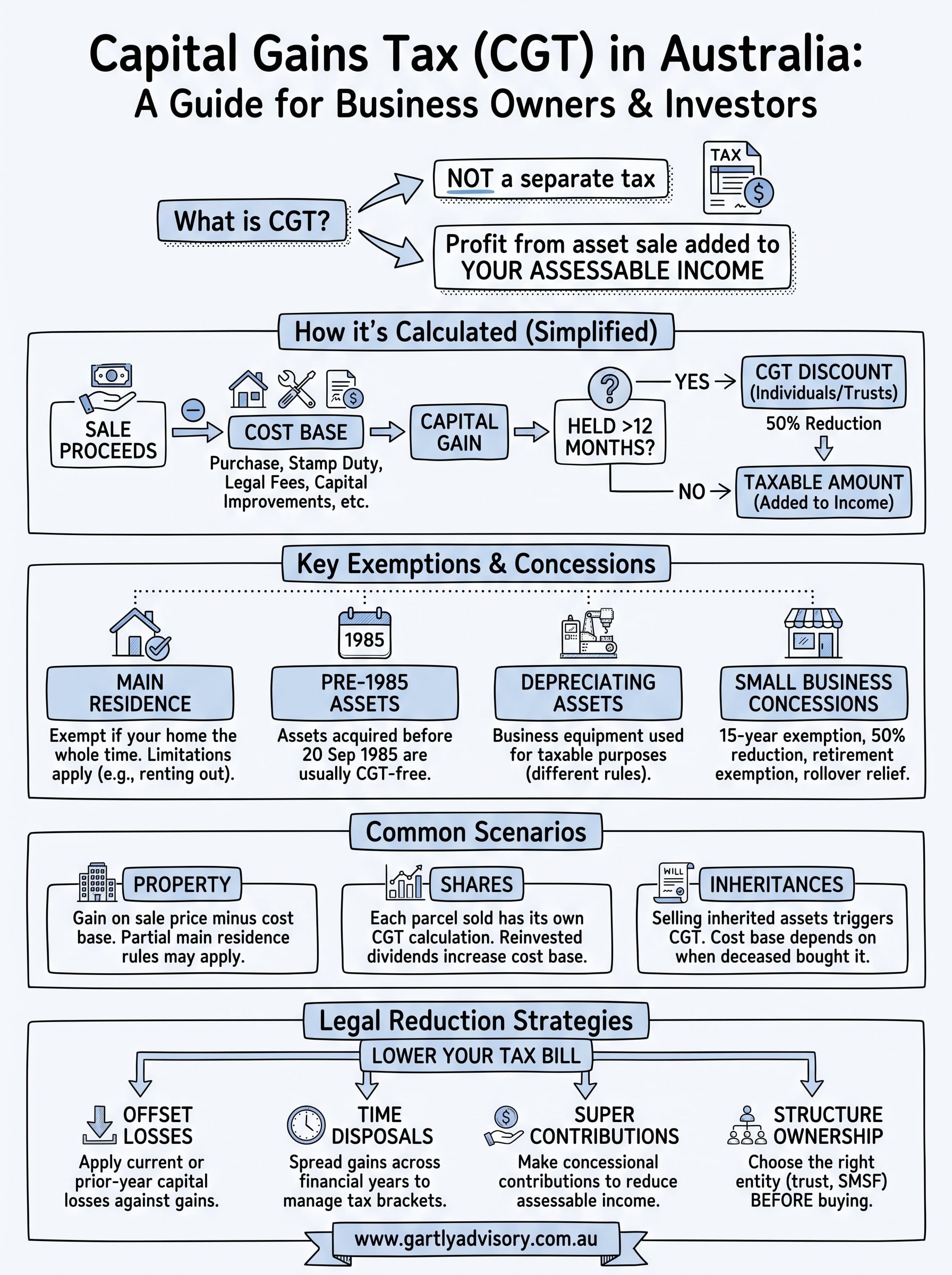
Here’s the direct answer: capital gains tax isn’t a standalone tax at all. It’s the tax you pay on the profit from selling an asset, added to your assessable income for that financial year. The amount you owe depends on how long you held the asset, what discounts apply, and your marginal tax rate at the time of sale.
In this article, we’ll walk through exactly when CGT applies, how the calculation works step by step, which exemptions and discounts can reduce what you owe, and how to report it correctly to the ATO. If you’re weighing up a sale or restructuring your affairs, this gives you the groundwork to plan properly before you sign anything.
Why capital gains tax matters for business owners
For most business owners, capital gains tax isn’t an occasional inconvenience, it’s the single biggest tax event they’ll face in their working life. Selling a business, offloading a commercial property, or cashing in shares can trigger a capital gain worth hundreds of thousands of dollars, and if you haven’t planned for it, that gain lands on your tax return exactly when you least expect it. Unlike PAYG withholding on wages, there’s no automatic deduction happening in the background. You need to set money aside yourself, or you’ll be scrambling to cover a tax bill months after the sale has settled and the funds have already gone toward paying off debt, buying a new property, or funding retirement.
Selling a business or major asset
When you sell a business, CGT applies to more than just goodwill. Plant and equipment, commercial premises, and even client lists can all carry a capital gain, and each component is treated separately under ATO rules. Owners who assume the whole sale price is simply "profit" often miscalculate what they’ll actually keep. This is where proper exit planning pays for itself many times over, because the structure of a sale, whether it’s an asset sale or a share sale, changes the CGT outcome dramatically, and there are practical ways to cut the CGT on selling a business if you plan early.
Get your exit structure wrong, and CGT can quietly swallow a chunk of the sale price you were counting on.
Timing and structure decisions
How and when you sell matters just as much as what you sell. A few practical levers business owners commonly use:
- Timing the sale across financial years to manage which year absorbs the gain
- Choosing the right entity structure (company, trust, or individual) before the sale, not after
- Reviewing eligibility for small business CGT concessions well ahead of settlement
- Coordinating with superannuation contributions to offset assessable income
Each of these decisions needs to happen before contracts are signed. Once the sale is settled, most of your options disappear.
The small business CGT concessions most owners miss
Government concessions exist specifically to help owners retiring from or selling active businesses, but they’re underused because the eligibility rules for the small business CGT concessions are technical.
| Concession | What it does |
|---|---|
| 15-year exemption | Full exemption if you’ve owned the asset 15+ years and are 55+ retiring |
| 50% active asset reduction | Halves the taxable gain on active business assets |
| Retirement exemption | Exempts gains up to $500,000 if proceeds go to super |
| Rollover relief | Defers the gain if proceeds are reinvested in another asset |
Qualifying for even one of these can change a six-figure tax bill into a manageable one, which is why business owners planning a sale should get advice on both CGT planning and exit planning for Australian business owners well before they list the business for sale.
How capital gains tax is calculated and paid
Working out a capital gain starts with one simple sum: your sale proceeds minus your cost base. The cost base isn’t just what you paid for the asset. It includes purchase costs, stamp duty, legal fees, agent commissions, and any capital improvements you’ve made along the way. Get the cost base wrong and you either overpay tax or leave yourself exposed if the ATO reviews your return later.
| Cost base element | Examples |
|---|---|
| Acquisition costs | Purchase price, stamp duty, conveyancing fees |
| Incidental costs | Legal fees, agent commissions, advertising for sale |
| Ownership costs | Rates, insurance (for investment properties, in some cases) |
| Capital improvement costs | Renovations, extensions, major upgrades |
Discounts apply once you’ve calculated the raw gain. If you’ve held the asset for 12 months or longer, individuals, trusts, and complying super funds can apply a 50% CGT discount, cutting the taxable amount in half before it’s added to income. Companies don’t get this discount, which is one reason business structure matters so much when you’re planning a sale.
The CGT discount can literally halve your tax bill, but only if you’ve held the asset long enough and structured the sale correctly.
Reporting your capital gain to the ATO
Reporting happens through your regular income tax return for the financial year the contract of sale was signed, not when settlement occurs. There’s no separate CGT lodgement or payment window.
- Calculate the gain or loss for each asset sold during the year
- Apply any eligible discount or small business concession
- Add the net figure to your assessable income
- Lodge your return by the normal due date, either 31 October or through a registered tax agent’s extended deadline
- Pay tax on the combined income at your marginal rate
Because the gain simply becomes part of your ordinary taxable income, a large sale can tip you into a higher tax bracket for that year alone. That’s why the calculation needs to happen well before settlement, not after the money has already landed in your account.
Which assets attract CGT and which are exempt
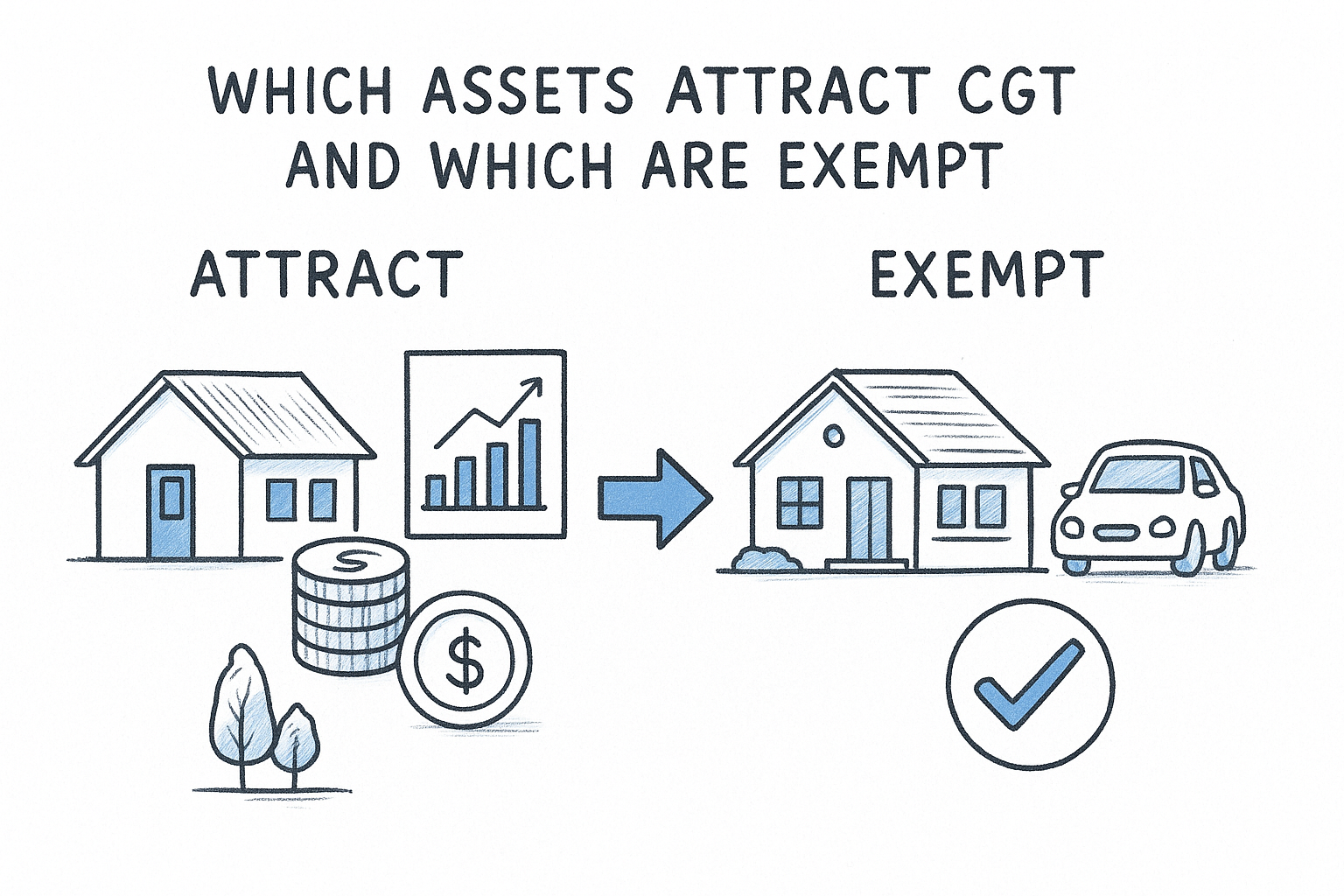
Most assets you acquire after 20 September 1985 fall under capital gains tax Australia rules, but the list is broader than most people expect. It’s not just property and shares. Cryptocurrency, collectables over $500, business goodwill, leases, and even contractual rights can all trigger a gain when you dispose of them. The trigger point, known as a CGT event, isn’t always a straightforward sale either. Gifting an asset, transferring it into a trust, or losing it in a fire and receiving an insurance payout can all count as disposals for tax purposes.
Assets that commonly attract CGT
Here’s where CGT most often shows up for the clients we work with:
- Investment properties and commercial premises
- Shares, managed funds, and other financial investments
- Business assets, including goodwill, plant, and equipment
- Cryptocurrency and digital assets
- Collectables and personal use assets worth more than $500
- Leases, licences, and certain contractual rights
Exempt assets and exclusions
Several categories sit outside the CGT net entirely, and knowing which ones apply to you can save a genuine headache at tax time. Your main residence is exempt from CGT in most cases, the biggest exemption Australians rely on, provided it’s been your home the whole time you’ve owned it. Cars, motorcycles, and most personal use assets bought for less than $10,000 also escape CGT, as do assets you acquired before 20 September 1985, often called pre-CGT assets.
Your home is usually CGT-free, but the moment you rent it out, run a business from it, or sell part of the land separately, that exemption can start to unravel.
Depreciating assets used solely for taxable purposes, like most business equipment, are also excluded because they’re dealt with under different depreciation rules rather than CGT. Superannuation balances inside a complying fund are treated separately too, which is one reason the rules around holding property in an SMSF matter when you’re planning disposals. None of these exemptions are automatic once your circumstances change, so it pays to check eligibility before you assume an asset is safe from tax.
Common CGT scenarios: property, shares and inheritances
Theory is one thing, but CGT plays out differently depending on what you’re actually selling. Property, shares and inherited assets each trigger their own set of rules, and business owners with mixed portfolios often get caught out mixing them up. Understanding how capital gains tax works for each asset type stops nasty surprises when you lodge your return.
Investment property sales
Selling a rental property is the scenario we see trip people up most. The gain is calculated on the full sale price minus your cost base, and if you’ve ever lived in the property, only part of the gain may be exempt under partial main residence rules. Depreciation and other investment property deductions you’ve already claimed on fittings and fixtures also get added back into the calculation, which reduces your effective cost base and increases the taxable gain.
Shares and managed investments
Share sales trigger CGT on each parcel separately, based on when you bought it, so selling shares bought at different times means working out several gains or losses individually. Reinvested dividends through a dividend reinvestment plan actually increase your cost base each time, since you’ve effectively bought more shares with taxed income.
Every share parcel has its own purchase date and cost base, so one sale can mean several separate CGT calculations.
Inherited assets and deceased estates
Inheriting an asset doesn’t trigger CGT on its own, but selling it later does, and the cost base you inherit depends on when the deceased bought the asset and whether it was their main residence.
| Scenario | Cost base you inherit |
|---|---|
| Asset bought before 20 September 1985 | Market value at date of death |
| Asset bought after 1985 | Deceased’s original cost base |
| Main residence, sold within two years | Often CGT-free |
Getting deceased estate CGT wrong is common, which is why estate planning should account for these rules well before assets change hands, not after.
Strategies to legally reduce your CGT bill
Cutting your capital gains tax bill legally comes down to timing, structure, and paperwork, not clever loopholes. The ATO has seen every trick, so the strategies that actually work are the boring ones applied consistently: holding assets past the 12-month mark, offsetting gains with losses, and using the legal strategies for reducing tax in Australia before you sign a contract, not after settlement clears.
Offsetting gains with capital losses
Capital losses from other investments can be applied directly against a gain in the same year, and unused losses carry forward indefinitely until you have gains to absorb them. Before selling a profitable asset, check your portfolio for:
- Shares or managed funds sitting at a loss that you were planning to exit anyway
- Prior-year capital losses still sitting unused on your tax return
- Underperforming assets worth crystallising in the same financial year as the gain
A capital loss sitting unused in a prior return is money you’re leaving on the table right now.
Timing disposals and using super contributions
Spreading a large disposal across two financial years, or delaying settlement until after 1 July, can keep you out of a higher tax bracket altogether. Making a concessional superannuation contribution in the same year as a gain also reduces assessable income, and unused carry-forward contribution caps can let you claim more than the standard annual limit, softening the tax hit while boosting your retirement balance at the same time.
Structuring ownership before you buy, not after
Holding growth assets in the right entity from day one, whether that’s a discretionary trust, an SMSF, or joint ownership between spouses on different incomes, spreads the eventual gain across lower marginal rates. Retrofitting structure after you’ve already signed a contract rarely works, since most of these strategies depend on decisions made well before disposal. If you’re weighing up a sale in the next twelve months, book a conversation with an accountant who does real tax planning and can map out your CGT planning options while every lever is still on the table.
Making sense of your CGT obligations
Capital gains tax Australia rules aren’t complicated once you break them down: work out your gain, apply the right discount or concession, and report it through your normal tax return. What trips people up isn’t the maths, it’s the timing. Decisions about structure, timing, and concessions need to happen before you sign a contract, not after settlement clears and your options have disappeared.
Whether you’re selling a business, offloading an investment property, or planning how an estate will pass to the next generation, the same rule applies: get advice while every lever is still available. A rushed sale without proper CGT planning can cost you far more than the accountant’s fee ever would.
If you’ve got a sale on the horizon or you’re simply unsure where you stand, talk to a tax accountant in Melbourne trusted with personal and business tax returns before you make your next move.