
How to Lodge a BAS: A Step-by-Step Guide
Every quarter, the same question lands on business owners’ desks: how to lodge a BAS without losing an afternoon to confusing ATO portals and GST calculations. If you’ve ever stared at a Business Activity Statement wondering whether your figures are right, or missed a due date and copped a penalty, you’re not alone. It’s one of the most common compliance headaches for small business owners across Melbourne and beyond.
This guide walks you through the actual process, from gathering your records to choosing between lodging online through myGovID, using the ATO’s Online Services for Business, or going through a registered tax agent. We’ll cover the key due dates for each quarter, what happens if you lodge late, and the mistakes that trip up even experienced business owners.
We’ve prepared BAS statements for hundreds of Melbourne businesses over 25 years, and we know where the process usually breaks down. By the end of this article, you’ll understand exactly what’s required, how to avoid common errors, and when it makes more sense to hand the job to a qualified accountant instead of tackling it yourself.
What is a BAS and who needs to lodge one?
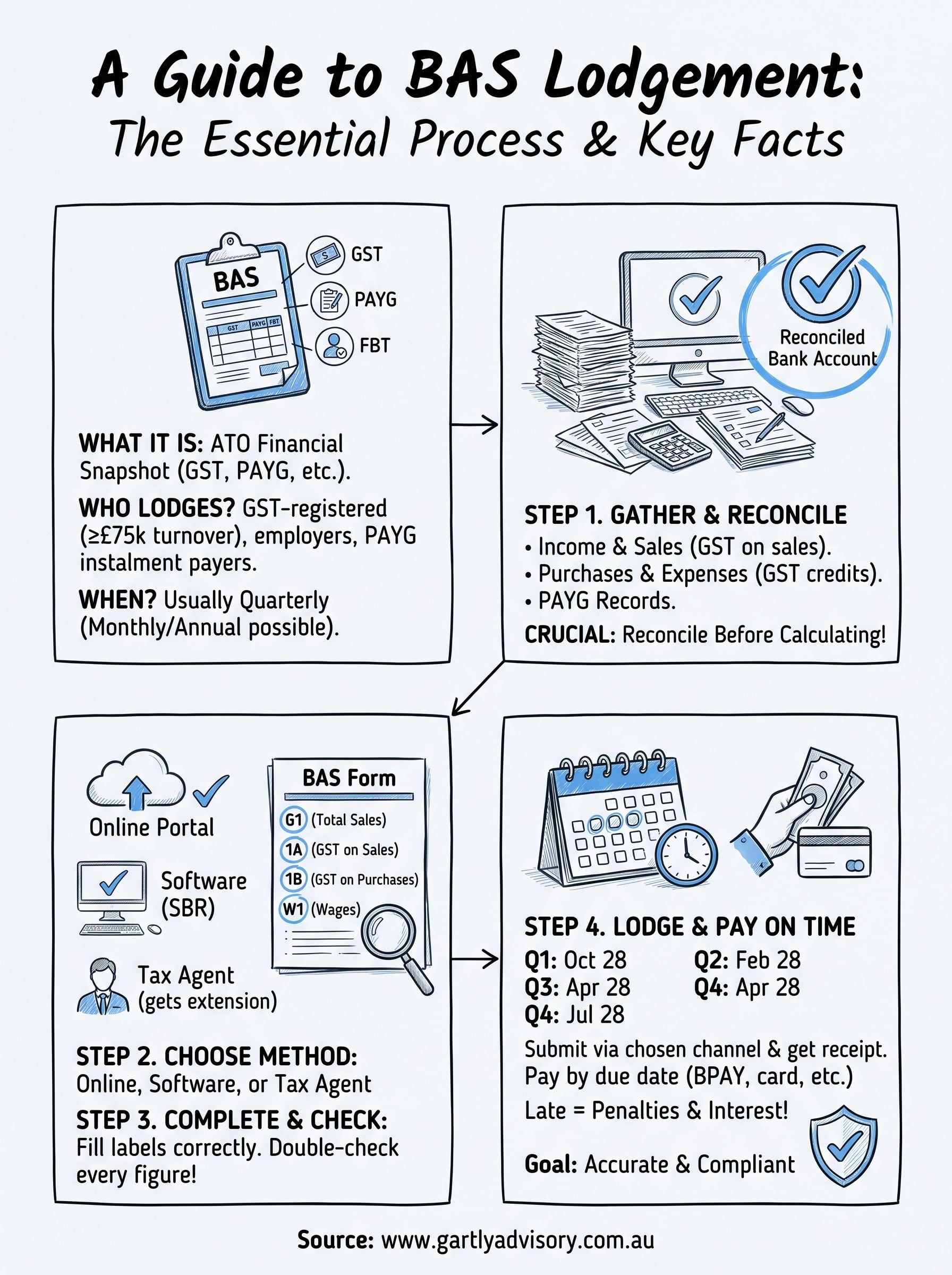
A Business Activity Statement, or BAS, is the form the Australian Taxation Office uses to collect several tax obligations in one hit. It reports your GST collected and paid, PAYG withholding for staff wages, PAYG instalments if you pay tax in advance, and sometimes fringe benefits tax or luxury car tax. Think of it as a periodic financial snapshot the ATO uses to reconcile what you owe against what you’ve already paid throughout the year, and a quick way to check what your BAS obligations actually are. Getting this snapshot right matters because errors here can trigger audits, penalties, or cash flow surprises down the track.
Who is required to lodge
Generally, you need to lodge a BAS if your business is registered for GST, which is compulsory once your turnover reaches $75,000 a year (or $150,000 for non-profits). Businesses under that threshold can register voluntarily, and once you do, BAS lodgement becomes part of your routine. You’ll also lodge a BAS if you withhold tax from employee wages under PAYG withholding, or if the ATO has placed you on the PAYG instalment system based on your income history, which is reported on an instalment activity statement. Sole traders, partnerships, companies and trusts all follow the same rules here, there’s no exemption based on business structure alone.
If you’re registered for GST, lodging a BAS isn’t optional, it’s a legal obligation tied directly to your ABN.
How often you need to lodge
Lodgement frequency depends on your turnover and how the ATO has categorised your business. Most small businesses lodge quarterly, but larger operations or those that opt in report monthly, and some very small GST-registered businesses can apply to lodge annually.
| Turnover / situation | Typical lodgement frequency |
|---|---|
| Under $20 million turnover | Quarterly |
| $20 million or more turnover | Monthly |
| Voluntarily registered, turnover under $75,000 | Annually (by election) |
| Employers withholding large PAYG amounts | Monthly |
Understanding your correct cycle matters because lodging on the wrong schedule, or missing a shift from quarterly to monthly reporting after a growth spurt, is a common way businesses fall behind without realising it.
Why this process trips people up
Small business owners often assume BAS is just about GST, then get caught out when PAYG withholding or instalment obligations appear on the same form without warning. Others confuse how BAS lodgement works with income tax returns, not realising these are entirely separate processes with different deadlines and calculations. We’ve seen clients in Ormond and across Melbourne discover mid-quarter that they’d been calculating GST incorrectly for months, simply because nobody explained upfront exactly which figures belong on the statement. Knowing what a BAS actually covers, and confirming which category applies to your business, is the foundation everything else in this guide builds on.
Step 1. Gather your financial records
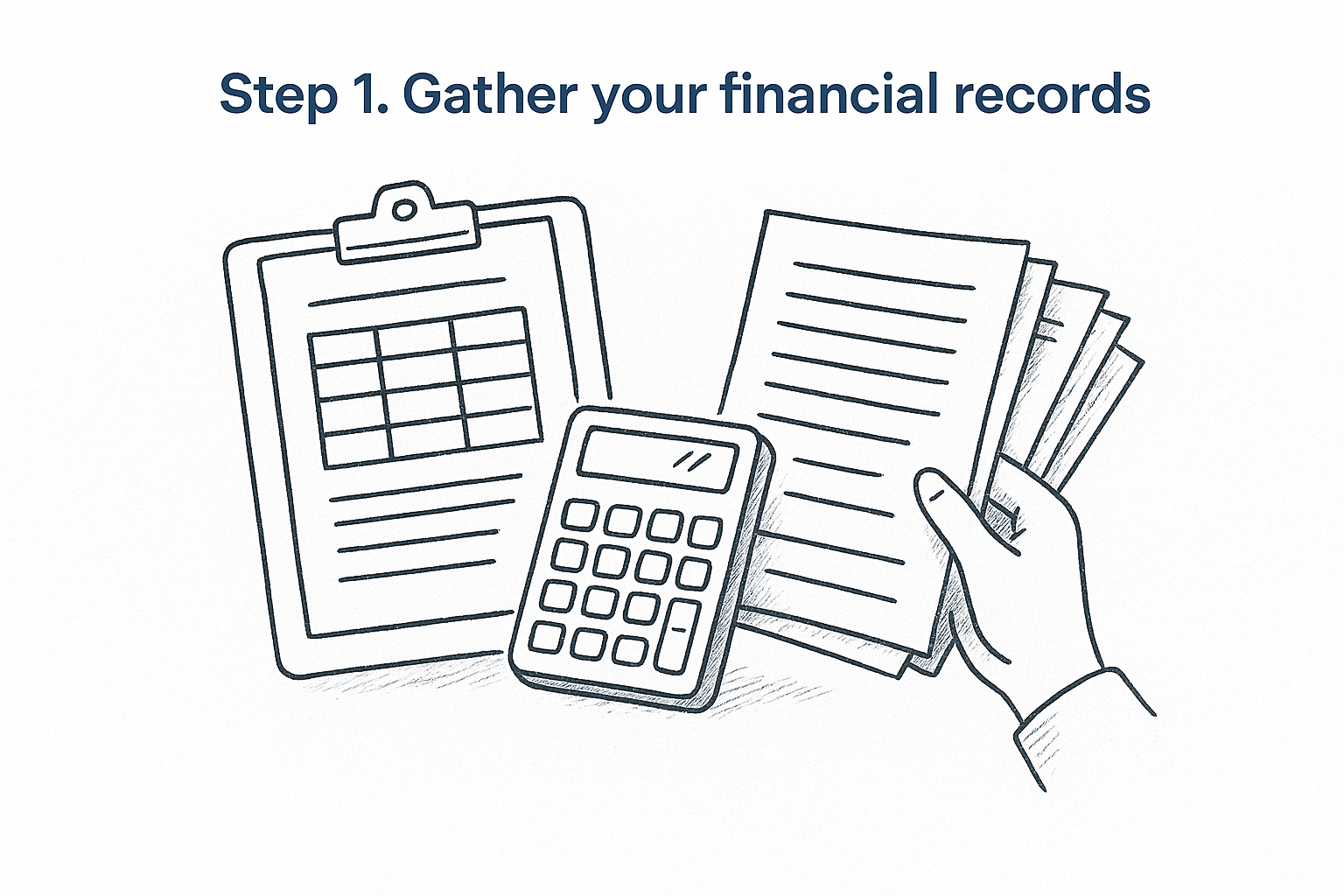
Before you open any ATO portal, pull together every record that touches money moving in or out of your business during the period. This is the step most owners rush, and rushing here is exactly how GST errors creep into an otherwise straightforward lodgement. Set aside an hour, grab your accounting software, and work through the list below methodically rather than piecing figures together from memory or scattered invoices.
Sort your sales and income records
Start with everything that generated GST on sales: tax invoices issued, cash sales, and any adjustment notes for refunds or returns. If you’re using Xero, MYOB, or QuickBooks, run a GST summary report for the exact BAS period, not the calendar month either side of it. Manual record-keepers need bank statements, invoice books, and receipt copies for the same window, cross-checked against what actually landed in the business account.
A BAS is only as accurate as the records behind it, so reconciling before you calculate saves you from amending later.
Collect purchase and expense documentation
Next, gather every purchase where you claimed or intend to claim GST credits, including supplier invoices, fuel receipts, equipment purchases, and subscriptions. Don’t forget PAYG withholding records if you employ staff, since payroll summaries for the quarter feed directly into your BAS figures alongside your GST totals.
Reconcile before you start
Finally, reconcile your bank accounts against your accounting software before touching the BAS form itself. Skipping reconciliation is the single biggest reason businesses lodge incorrect figures, then face amendments or ATO queries weeks later. A quick pre-lodgement checklist helps:
- Bank accounts reconciled to the last day of the period
- Sales and purchase GST reports run for the correct dates
- Payroll and PAYG withholding totals confirmed
- Any private-use adjustments or fuel tax credits calculated separately
Getting this groundwork right sets up everything that follows, including choosing how you’ll actually lodge.
Step 2. Choose your lodgement method
Once your figures are reconciled, you need to decide how you’ll actually get your BAS statement in front of the ATO. There are four main routes, and picking the right one depends on how comfortable you are with the paperwork, how complex your figures are, and whether you’d rather spend that time running your business instead.
Compare your options
Each method has trade-offs worth weighing before you commit, especially if this is your first time lodging or your business has grown since last quarter.
| Method | Best for | Notes |
|---|---|---|
| ATO Online Services for Business | Business owners comfortable with self-lodging | Requires myGovID linked to your ABN |
| myGov (individuals/sole traders) | Sole traders without complex structures | Simpler setup, fewer features than business portal |
| SBR-enabled accounting software | Businesses already using Xero, MYOB or similar | Lodge directly from your software, pre-fills GST figures |
| Registered tax agent | Businesses wanting accuracy and extended deadlines | Agents get automatic lodgement extensions |
Lodging through a registered tax agent often buys you extra time and catches errors before the ATO does.
Set up online access
Going digital yourself means creating a myGovID and linking it to your ABN through Relationship Authorisation Manager, then logging into the ATO’s Online Services for Business. It’s free, and once set up, it stays linked for future quarters, so the admin only happens once.
Consider using a registered agent instead
Handing lodgement to a registered agent worth trusting shifts the risk of miscalculation off your plate entirely, and agents typically have longer lodgement windows than self-lodgers, which eases cash flow pressure around quarter-end. If your GST calculations involve multiple income streams, fuel tax credits, or you’ve had ATO queries before, this is usually the safer path. At Gartly Advisory, our business accounting services include BAS preparation and lodgement, so you get accuracy without the portal hunting.
Whichever method you settle on, stick with it consistently. Switching between software and manual lodgement quarter to quarter is where duplicate figures and missed adjustments start creeping in.
Step 3. Complete and check your BAS
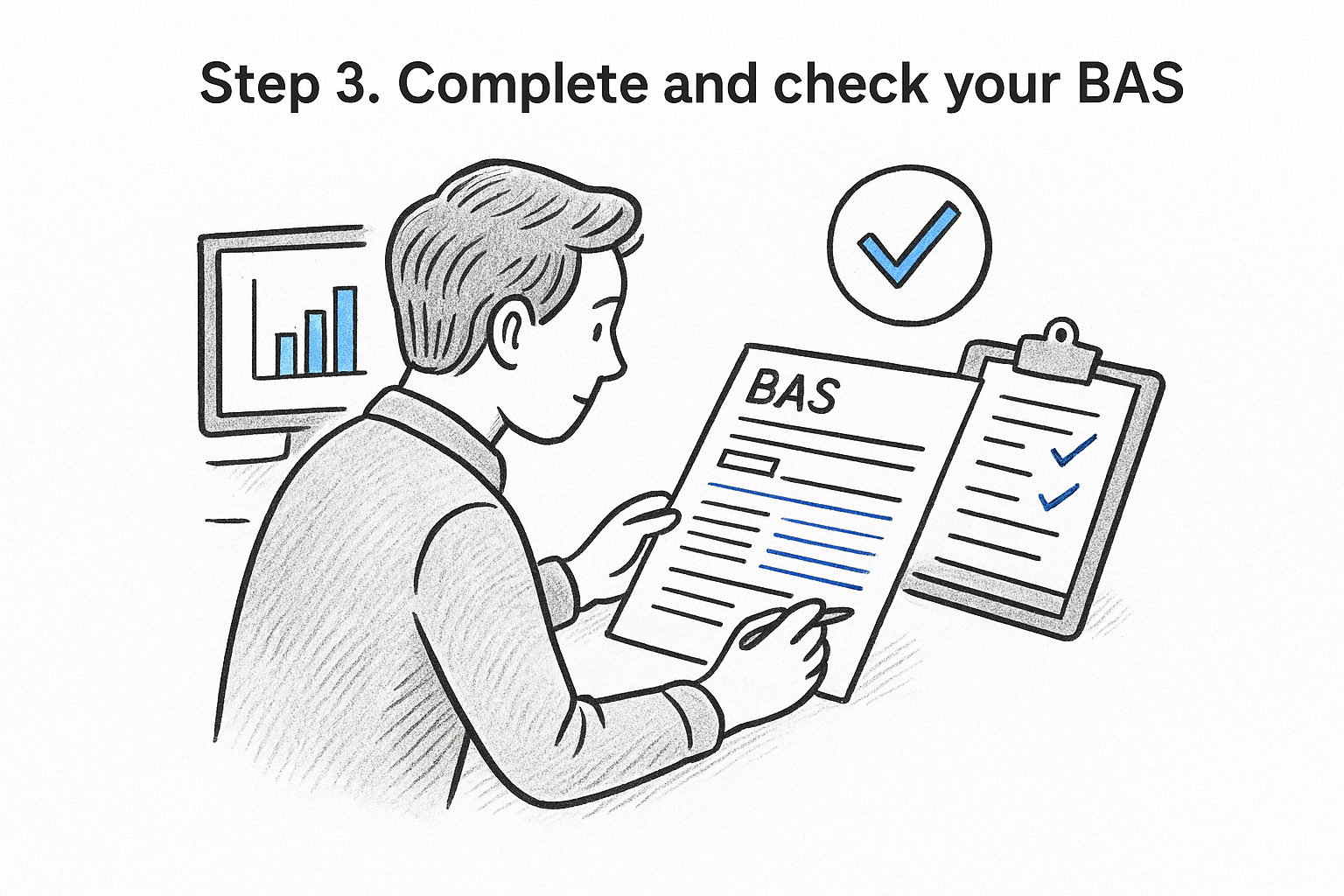
With your records reconciled, it’s time to transfer those figures into the actual BAS form, whether that’s through your accounting software, the ATO portal, or a paper copy your agent has prepared. This is where accuracy matters most, because the ATO cross-checks your figures against industry benchmarks and previous lodgements, and mismatches are one of the audit red flags that trigger questions you’d rather avoid. Take your time here rather than rushing to submit before you’ve verified every field against your source documents.
Understand the key BAS labels
Each BAS uses standardised label codes, and knowing what belongs where prevents the most common transcription errors. Your GST calculation hinges on getting these labels right, since the ATO uses them to work out your net payment or refund.
| Label | What it captures |
|---|---|
| G1 | Total sales, including GST |
| G10 | Capital purchases |
| G11 | Non-capital purchases |
| 1A | GST on sales |
| 1B | GST on purchases |
| W1 | Total wages paid |
| W2 | PAYG withheld from wages |
Getting the GST calculation wrong on your BAS doesn’t just cost money, it invites the exact scrutiny most business owners want to avoid.
Double-check before submitting
Once every label is filled in, run through a final check rather than clicking lodge straight away. Comparing this quarter’s figures against last quarter’s flags anything that looks unusual before the ATO does.
- Confirm G1 matches your accounting software’s sales report exactly
- Verify 1A and 1B reflect GST amounts only, not total invoice values
- Cross-check W1 and W2 against your payroll summaries
- Look for any figures entered as whole dollars where cents were needed
- Compare this period’s totals against the previous quarter for red flags
Spotting an error now, before you’ve submitted anything to the ATO, costs you nothing beyond a few extra minutes. Catching the same mistake after lodgement means filing a revision, and sometimes explaining yourself to the tax office directly.
Step 4. Lodge, pay and meet your due date
Once you’ve checked every label twice, submitting is the easy part. Whether you’re lodging through Online Services for Business, your accounting software, or a paper form sent by your agent, the actual click-to-lodge step takes minutes. The work you’ve already done reconciling and checking is what protects you here, not the submission itself.
Submit through your chosen channel
Hitting submit through the ATO portal generates an instant confirmation receipt, and you should save this alongside your BAS working papers for at least five years. If you’re lodging through Xero or MYOB, the software transmits directly to the ATO and updates your compliance record automatically. Paper lodgement still exists but takes longer to process and offers no confirmation until the ATO manually enters your figures, so avoid it unless you have no other option.
Pay what you owe on time
Paying your BAS payment by the due date matters just as much as lodging on time, since the ATO applies general interest charges separately from lodgement penalties. BPAY, direct debit, and card payments through the ATO’s online portal all process quickly, but card payments attract a small surcharge worth factoring into your cash flow planning, and if the full amount is out of reach you can set up an ATO payment plan.
Lodging on time but paying late still triggers interest charges, so treat both deadlines as equally non-negotiable.
Know your quarterly due dates
| Quarter | Period covered | Standard due date |
|---|---|---|
| Q1 | July to September | 28 October |
| Q2 | October to December | 28 February |
| Q3 | January to March | 28 April |
| Q4 | April to June | 28 July |
Registered tax agents typically get a four-week extension on quarterly deadlines, which explains why so many businesses prefer that route once cash flow gets tight around a due date.
Keeping your BAS obligations on track
Lodging a BAS well isn’t about mastering the ATO portal, it’s about building a routine around reconciled records, correct labels, and deadlines you never let slide. Get the groundwork right each quarter and the actual submission takes minutes rather than an afternoon of stress and second-guessing.
You now know the four steps that matter: gather your records properly, pick a lodgement method that suits how your business operates, check every label before submitting, and treat both lodgement and payment dates as fixed. Miss any one of these and you’re looking at penalties, interest charges, or an ATO query you didn’t need.
If quarterly BAS lodgement still eats into time you’d rather spend running your business, that’s exactly the gap we fill for Melbourne business owners. Talk to Gartly Advisory about handing your BAS preparation and lodgement to an expert BAS accountant who has done it for local businesses for 25 years.