Capital Gains Tax on Investment Property: How It Works
Selling an investment property triggers a tax bill many owners don’t see coming. Capital gains tax on investment property can run into tens of thousands of dollars, and by the time you get your settlement statement, it’s too late to plan around it. If you’re weighing up a sale, you need the numbers before you sign a contract, not after.
This article walks through exactly how the tax applies, from the moment you sell through to the figure the ATO expects on your return. You’ll see how the 50% CGT discount works for properties held over twelve months, what actually counts as your cost base, and why renovations, agent fees, and stamp duty all change the final calculation.
We’ve worked through hundreds of property sales with clients across Melbourne, from single rental units to portfolios built over decades, and the same mistakes keep costing people money. Below, we break down the calculation step by step, cover common exemptions, and flag the traps that catch even experienced investors out.
Why capital gains tax matters when selling a rental property
Selling a rental property doesn’t trigger a separate tax bill in the way stamp duty does when you buy. Instead, the capital gain gets added to your assessable income for that financial year and taxed at your marginal tax rate. That distinction catches out a lot of sellers, because a gain of $200,000 on a property you’ve held for a decade doesn’t get taxed lightly just because you held it a long time. It gets stacked on top of your salary, your business income, or whatever else you earned that year, and that combination can push you into a much higher tax bracket than you expected.
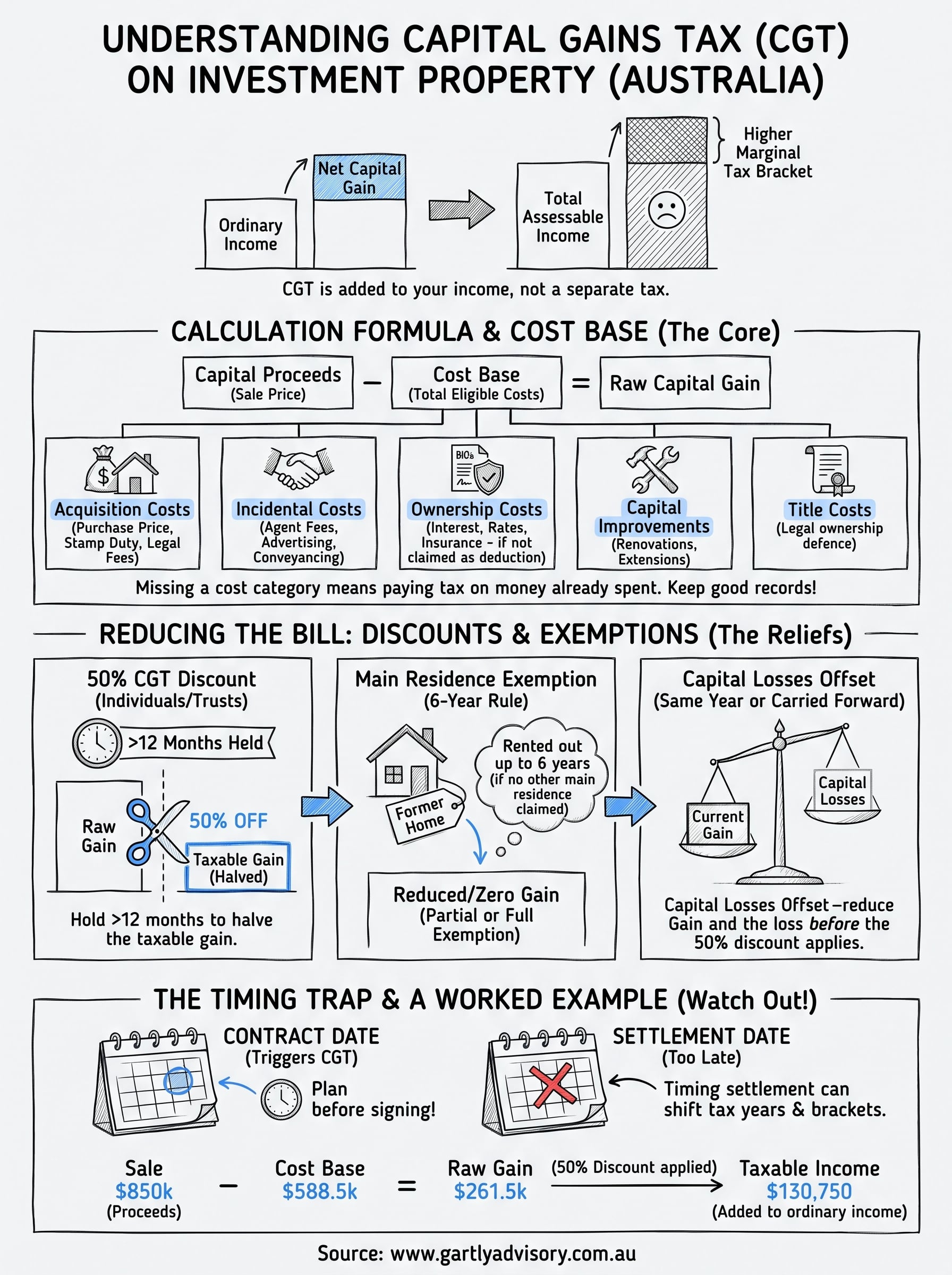
CGT is added to your income, not charged separately
This is the single biggest misunderstanding we see among property investors. There’s no flat "capital gains rate" in Australia the way some countries apply one. The Australian Taxation Office treats your net capital gain as ordinary income, so if you’re already earning $120,000 a year and you add a $150,000 gain on top, a large chunk of that gain gets taxed at 37% or even 45%, not some lower concessional rate.
A capital gain isn’t taxed on its own, it’s added straight to your income and taxed at whatever bracket that pushes you into.
Timing your settlement can shift your entire tax outcome
When your contract settles matters more than most sellers realise. CGT is triggered at the date of the contract of sale, not the settlement date, so a sale signed in June but settling in July still counts in the earlier financial year. If you’re close to a bracket threshold, or expecting a lower income year ahead (retirement, parental leave, a career change), shifting settlement by even a few weeks can genuinely change your tax bill by thousands of dollars. You can read the ATO’s own guidance on this timing rule on their capital gains tax on property page.
Weak records mean you pay more than you legally owe
Investors who’ve owned a property for fifteen or twenty years often lose receipts for renovations, legal fees, and stamp duty paid back at purchase. Every one of those costs reduces your taxable gain, but only if you can substantiate them. We’ve seen clients hand over a shoebox of paperwork that, once sorted, shaved $40,000 off their assessable gain. Without those records, the ATO simply won’t accept the deduction, and you end up paying tax on money you never actually pocketed as profit. Keeping a running file from the day you buy, not the week before you sell, is the cheapest tax planning you’ll ever do.
How to calculate capital gains tax on an investment property
Working out your capital gains tax bill comes down to one core formula: your capital proceeds minus your cost base equals your capital gain. From there, you apply any discounts you’re entitled to, then add the resulting figure to your taxable income for the year. It sounds simple on paper, but the accuracy of that number depends entirely on how thoroughly you’ve tracked your costs since the day you bought the property.
Start with your capital proceeds
Capital proceeds means the sale price of the property, not the amount you receive after your agent and legal fees come out. Those selling costs get accounted for separately, as part of your cost base, so don’t double-count them by subtracting them twice. If you sold for $850,000, that full figure is your starting point, before any deductions.
Build out your cost base properly
Your cost base isn’t just the purchase price. The ATO recognises five categories of costs that reduce your taxable gain:
- Acquisition costs: purchase price, stamp duty, and legal fees paid when you bought
- Incidental costs: agent commissions, conveyancing, and advertising at the time of sale
- Ownership costs: interest on loans, council rates, and insurance, only if never claimed as a tax deduction
- Capital improvements: renovations, extensions, and structural upgrades
- Title costs: expenses incurred defending or establishing legal ownership
Your cost base is rarely just the purchase price, and missing a category means paying tax on money you already spent.
Subtract to find your raw gain
Once you’ve totalled every eligible cost, subtract that figure from your capital proceeds. The result is your gross capital gain before any discount applies. This is the number most investors get wrong, usually by underestimating their cost base rather than overestimating their sale price, which is exactly why the record-keeping habit we mentioned earlier pays off at this exact step.
Discounts and exemptions that can reduce your CGT bill
Once you’ve calculated your raw capital gain, the next step is checking whether any discounts or exemptions apply before that figure hits your tax return. Several reliefs exist specifically for property investors, and stacking the wrong one, or missing one entirely, can mean paying tax on a gain that’s legally smaller than what you’ve reported.
The 50% discount is the big one
If you’ve held the property for more than twelve months as an individual, trust, or complying super fund, you’re entitled to the 50% CGT discount. This halves your assessable gain before it’s added to your income, so a $300,000 gain becomes $150,000 for tax purposes. Companies don’t get this discount, which is one reason property held in a corporate structure often makes less sense for long-term investors.
Hold a property past the twelve-month mark and you cut your taxable gain in half, that timing alone can be worth tens of thousands of dollars.
The main residence exemption still applies to former homes
If the investment property was once your home before you rented it out, you may qualify for a full or partial main residence exemption under the ATO’s six-year absence rule. This lets you treat the property as your main residence for up to six years after you move out and start renting it, provided you don’t claim another property as your main residence during that period. Get the dates wrong and you lose the exemption entirely, so this calculation needs care.
Capital losses offset gains in the same year
If you’ve sold another asset at a loss in the same financial year, or you’re carrying forward losses from previous years, you can offset those against your property gain before applying the discount. Losses reduce your gain first, and the 50% discount applies to whatever remains, so the order of operations genuinely changes your final bill.
A worked example of calculating CGT on a property sale
Numbers make this easier to follow than formulas alone, so here’s a realistic scenario based on a client we worked with recently. Say you bought an investment unit in Ormond for $500,000 in 2015, held it for eight years, and sold it in 2023 for $850,000. You paid stamp duty and legal fees at purchase, spent money on a kitchen renovation, and covered agent commission when you sold.
Laying out the numbers
Getting the cost base right means listing every eligible expense before you touch the calculation. Here’s how that breaks down:
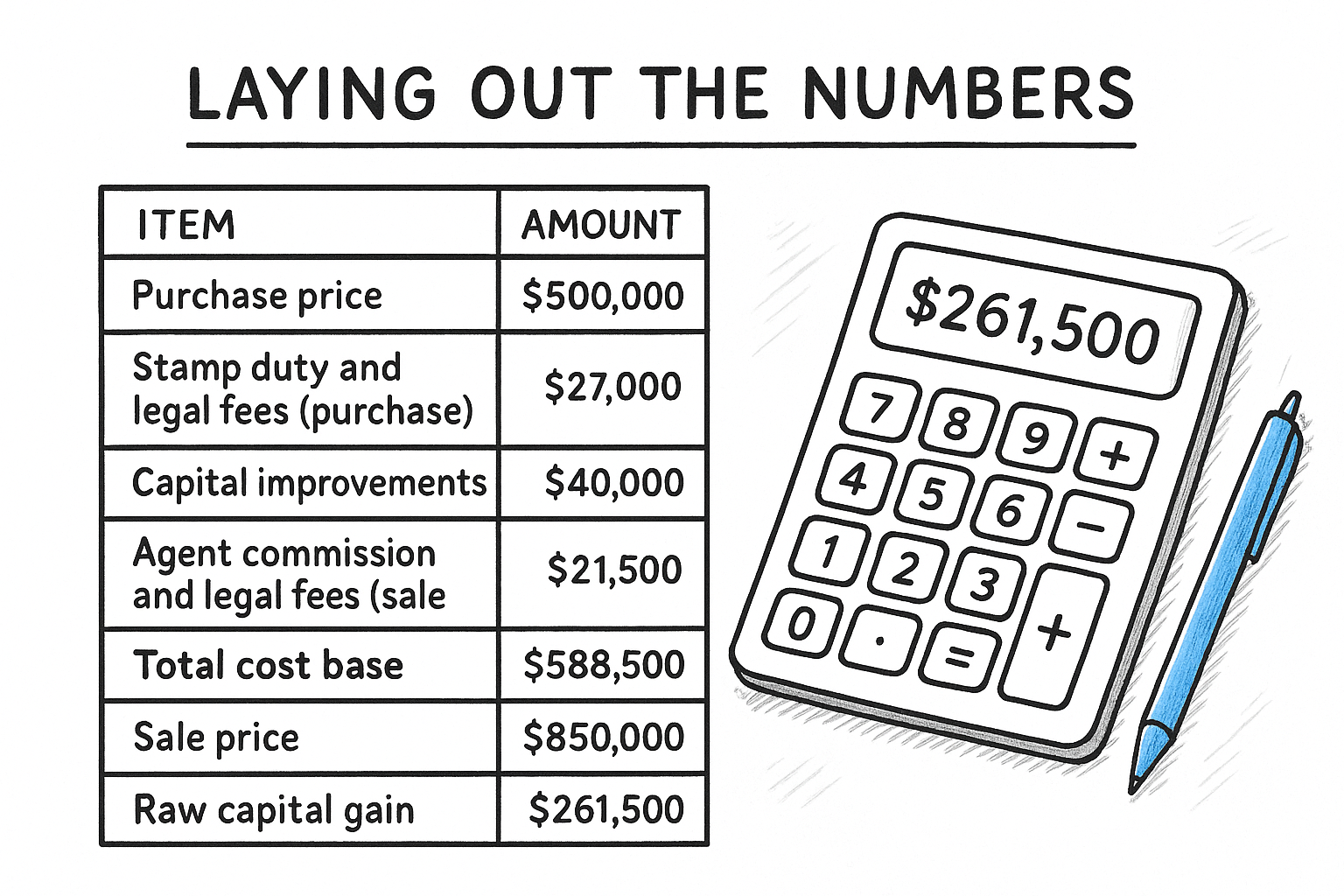
| Item | Amount |
|---|---|
| Purchase price | $500,000 |
| Stamp duty and legal fees (purchase) | $27,000 |
| Capital improvements (renovation) | $40,000 |
| Agent commission and legal fees (sale) | $21,500 |
| Total cost base | $588,500 |
| Sale price (capital proceeds) | $850,000 |
| Raw capital gain | $261,500 |
Applying the discount and finding the final figure
Once you’ve got your raw gain, the 50% CGT discount applies because the property was held for more than twelve months. That drops the taxable amount from $261,500 to $130,750. This is the figure that gets added to your assessable income for the year, not the full gain, and not the sale price.
A $261,500 profit on paper can become a $130,750 tax problem once the discount and cost base are applied correctly.
Run that $130,750 through the client’s marginal tax rate, and the actual liability depends heavily on what else they earned that year. Someone already on a high income might pay close to $60,000 in tax on that gain, while someone in a lower income year might pay half that. Skipping any single line in the cost base table, like forgetting the renovation, would have added roughly $18,000 to the taxable gain unnecessarily, which shows exactly why the record-keeping habit matters more than most sellers assume.
Getting your next property sale right
Capital gains tax on investment property comes down to three things: knowing your cost base, applying the 50% discount correctly, and timing your contract with the rest of your income year in mind. Get those right and you pay exactly what you owe, no more. Get them wrong, through missing receipts or a poorly timed settlement, and you hand the ATO money you didn’t need to.
Most investors only work this out after settlement, when the options for reducing the bill have already closed. Running the numbers before you list the property gives you room to time the sale, offset losses, and confirm every dollar in your cost base actually stacks up.
If you’re planning a sale in the next twelve months, get the calculation checked properly before you sign anything. Talk to Gartly Advisory and we’ll work through the figures with you.